Published to clients: July 16, 2025 ID: TBW2077
Published to Readers: July 17, 2025
Whisper Club Release: December 15, 2025
Public and Video Edition: December 17, 2025
Analyst(s): Dr. Doreen Galli
Photojournalist(s): Dr. Doreen Galli
Abstract:
“Media companies now favor hybrid cloud workflows for flexibility, speed, and cost-efficiency. Open standards ensure interoperability, while strong security protects valuable IP. Experts stress aligning cloud use with business goals, maintaining control and visibility, and using cloud strategically—not universally—to optimize collaboration, performance, and infrastructure investment.”
Target Audience Titles:
- Chief Technology Officer, Chief Digital Officer,
- Chief Data Officer, Chief Marketing Officer, Chief Content Officer
- VP Engineering, VP Media Technology, Dir Cloud Strategy, Dir Media Ops, Head of post production, Direct of IT Infrastructure
- Cloud Solution Architects, Media System engineers, DevOps Engineer, Video Platform Engineer, Broadcast Engineer, Post Production Engineer, Media Workflow Specialist, Software Engineer, Storage and Archiving Engineer, SRE
Key Takeaways
- Hybrid workflows balance cloud flexibility with on-prem performance and cost control.
- Open standards ensure seamless integration across media tools and platforms.
- Strong security protects media IP with access control and audit trails.
- Cloud strategy should align with business goals, not just follow trends.
What are the best practices for integrating cloud technologies in media workflows?
We took the most frequently asked and most urgent technology questions straight to the Technology experts gathering at NAB Show 2025 held in Las Vegas at the Las Vegas Convention Center. This Whisper Report addresses the question regarding what are the best practices for integrating cloud technologies in media workflows?
Media and the Cloud
Its been fascinating to watch the Media’s use of the cloud the last handful of years. As Axle.ai’s Sam Bogoch observed, “during covid people would just put things in the cloud willy-nilly because there was no reason to put it anywhere else. They didn’t go to their offices. There was no on premise. There was no concentration of work.” Furthermore, as Dell Technologies’ Tom Burns pointed out, “The promise of cloud was that you didn’t have to own or maintain infrastructure and that’s been awesome.”
Or as Ross’s David Green observed, “they don’t have to have a large upfront capital investment.” Thus when there was no concentration of workers or work, the lack of capital investment and no need for infrastructure maintenance was quite attractive. But its important to keep in mind as Ross’s David Green further explained, “cloud is just a technology – not a solution.” Thus, in the post-COVID world, Media has been rebalancing how as an industry it works with cloud.
Standard Open Systems
Regardless of where you put your workload for what part of the media workflow, the technologies involved must work together. Latakoo’s Jade Kurian gave us a great example, “if I have one company that does transcription let’s say really really well but it’s no connected to my media workflow. Then if I start using that as an enterprise media company, then the problem is I’ve created something that slows down my team even though I’m trying to make it faster for them.” To prevent the slowdown from incompatible tools, Cinnafilm’s Dom Jackson suggested, “to make sure that all of these technologies are using somewhat standardized APIs and ontologies and so on to allow somewhat atomic solutions to be combined easily into larger workflows.” In other words as Magnify’s Ken Ruck summarized, “the best ways to be open and not be a closed system.” The goal, as summarized by Jade Kurian, “it is all about speed -speed from camera to that pane of glass that exists that somebody’s watching on the other end”
Secure Media
Regardless of where your solution executes or where the media resides, protecting that media is absolutely critical. As Eon Media’s Greg Morrow simply stated, “media companies are built on their intellectual property so protection of their IP is incredibly important.” As warned during our coverage of Conference Whispers: NAB Show 2025, just because a technology can share media, doesn’t mean it does so securely with an audit trail. Lucidlink’s Gergana Berman further cautioned, “a lot of providers out there might claim that they have a very secure solution, but you have to check for yourself.” If this is an area your team is concerned with, clients should book an inquiry before purchasing the technology. In 2025, it is also critical to check the terms and conditions of any AI technologies leveraged. As Gergana Berman further explained, “ make sure their terms and conditions are not saying they can use your media copyrighted media.” Or as the saying goes, don’t use free products for when something is free – you are the product. In this case the valuable IP is the product of the media company for which you are working.
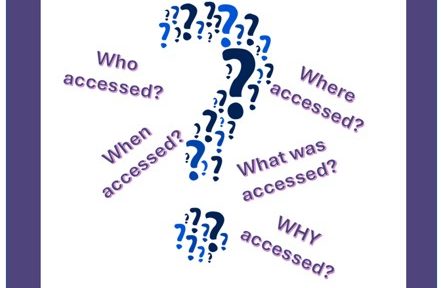
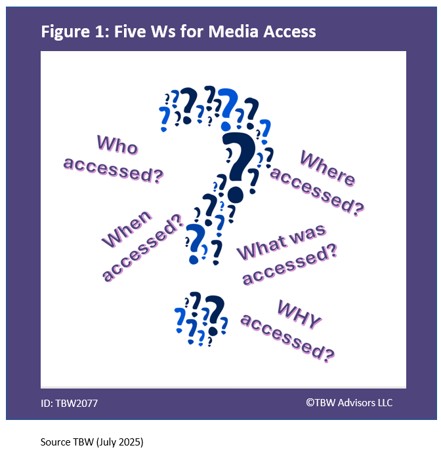
Some solutions have built in capabilities to assist in protecting your intellectual property. Greg Morrow pointed out that Eon Media’s solution has, “three levels of watermarking that we produce So we have produce a visible watermark on the asset and an invisible watermark.” Leostream’s Karen Gondoly perhaps best summarized the totality of the need, “I need to have control of my data. I need to have control of who has access to it. I want to secure that data so I want to make sure that I’m authorizing users correctly. I want to make sure that I’m using zero trust principles when I’m providing access to people. I need visibility. I want to make sure I always know who has access to my data what they’re doing with it where they’re accessing it from.” In other words, I don’t just need to be able to control it, I need a full audit trail of the five w’s for my data. Who accessed, What was accessed, When accessed, Where accessed and Why accessed as depicted in Figure 1.
Hybrid Solutions
Today, most media companies have settled into hybrid architectures involving a combination of on premise and cloud technologies. Strada’s Michael Cioni best summarized, “no one can actually put everything in one cloud. There’s too many collaborators. There’s too many different clouds. There’s too many pros and cons to clouds and nobody has enough money to store everything there So I think the best practices for integrating cloud into your workflow is to actually look for alternative solutions that may not use the cloud in the traditional ways and figure out how to collaborate across clouds versus putting everything in one place.” So what should go where? One can observe, those with on-premise based solutions have different answers vs those with predominantly cloud based solutions. Ross’s David Green recommends, “to not start with I want to do cloud the key is to start with why do I want to use cloud and then figure out who can help you solve those.”
SNS’s Alex Hlvarty cautions, “we can’t control internet outages or data breaches or things like that are mitigated by making sure that you keep your own assets on site in your possession but then utilizing cloud for its very clear benefits as far as making things available to people all over the world through one single portal.” Axle.ai’s Sam Bogoch also likes to keep things he is actively working on close. “on premise the things that you’re immediately working on because it does not make sense to keep asking for them politely from the cloud when you’re getting work done much faster on premise and meanwhile things like archive and backup clearly belong in the cloud.” From a capitalization perspective, Dell Technologies Tom Burn’s recommends an extension of a common metaphor. “let’s think of the old rocks pebbles sand metaphor where rocks are the fully capitalized on prem infrastructure that you need to keep 99.9% utilized and the pebbles are the project-based uses of compute and storage that aren’t part of your base commit and don’t hit your ybudget and the sand is the pure burstable joy that is the public hyperscalers. We’re looking at hybrid workflows that combine all three screening up.”
Once again, clients should schedule an inquiry to review your hybrid media architecture against your organizational priorities.
Related playlists
- Whisper Report: How can AI and machine learning transform media and entertainment?
- Whisper Report: What are the best practices for integrating cloud technologies in media workflows?:
- Conference Whispers: NAB Show 2025
Corporate Headquarters
2884 Grand Helios Way
Henderson, NV 89052
©2019-2025 TBW Advisors LLC. All rights reserved. TBW, Technical Business Whispers, Fact-based research and Advisory, Conference Whispers, Industry Whispers, Email Whispers, The Answer is always in the Whispers, Whisper Reports, Whisper Studies, Whisper Ranking, The Answer is always in the Whispers, and One Change a Month, are trademarks or registered trademarks of TBW Advisors LLC. This publication may not be reproduced or distributed in any form without TBW’s prior written permission. It consists of the opinions of TBW’s research organization which should not be construed as statements of fact. While the information contained in this publication has been obtained from sources believed to be reliable, TBW disclaims all warranties as to the accuracy, completeness or adequacy of such information. TBW does not provide legal or investment advice and its research should not be construed or used as such. Your access and use of this publication are governed by the TBW Usage Policy. TBW research is produced independently by its research organization without influence or input from a third party. For further information, see Fact-based research publications on our website for more details.
Research available only to clients at this time.