Published to Whisper Club: June 1, 2026 ID: TBW2178
Analyst(s): Dr. Doreen Galli
Photojournalist(s): Dr. Doreen Galli
ABSTRACT:
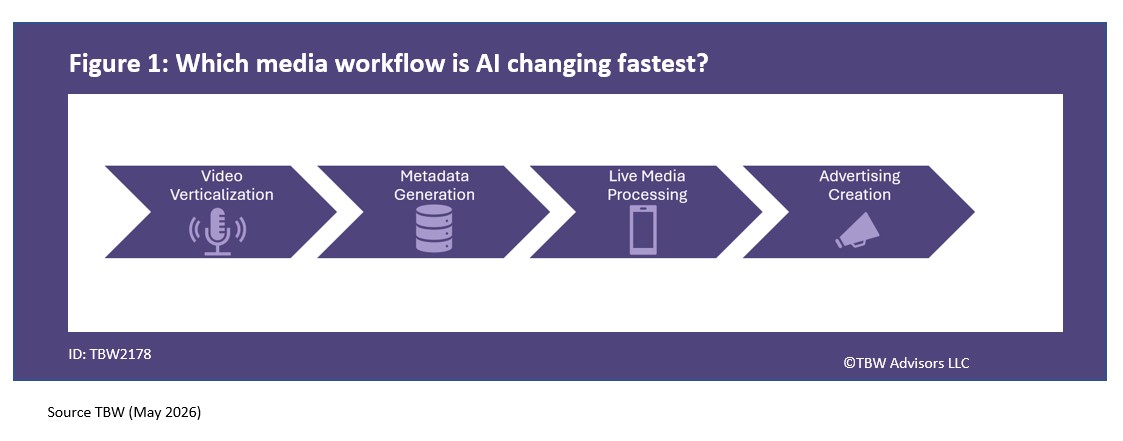
“This Whisper Report investigates which media workflow is AI changing fastest? It distills expert perspectives from NAB Show 2026, spotlighting the workflows where AI is compressing cycles and reshaping execution across teams—signaling where attention should shift next. Cited experts : Tony Abrahams AI Media, Carl Rutman Brightcove, Glen Wastyn Freepik..”
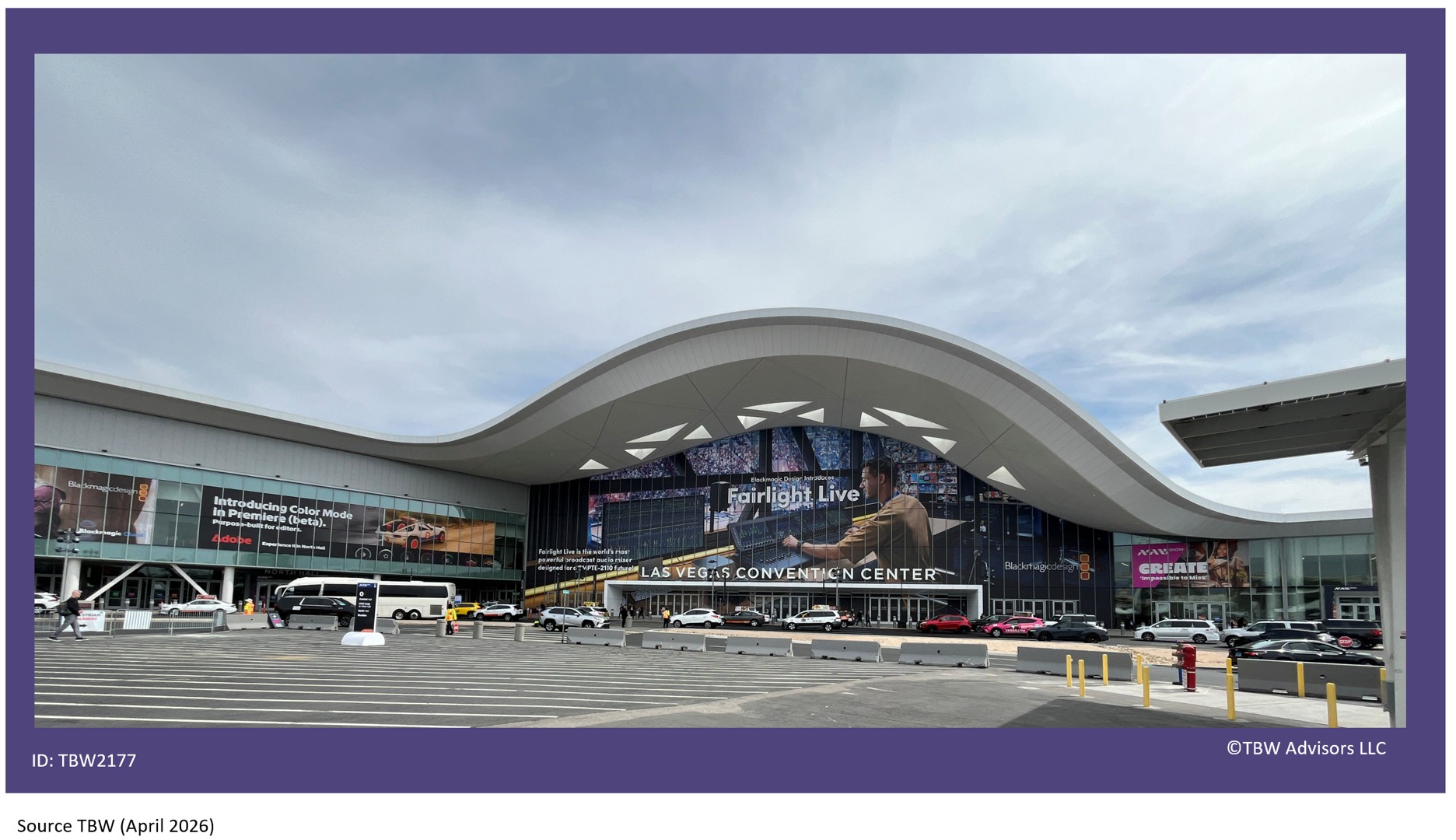
“NAB Show 2026 in Las Vegas convened over 58,000 media and broadcast professionals across production, distribution, and operations. On the show floor, conversations centered on evolving broadcast stacks, asset management realities, creation workflows, and physical infrastructure. Examples on display reflected shifts toward flexibility, scalability, and integration without consensus on where standardization ultimately settles across the industry today.”
The Conference
A community of over 58,000 media and broadcast professionals gathered at the Las Vegas Convention Center.
70% of the attendees were buyers with 48% were first-time registered attendees.
Cautions
Friendly reminder: this research provides examples of what was shared with us at the event, not an evaluation, validation, or recommendation of the given technology.
Just because a technology can do something in general doesn’t mean it will work in your environment. It is critical to validate a technology including its false positive and error rates.
The Lexi Language Layer by AI Media acts as a secure regulated gateway for major broadcasters ensuring captioning and language services meet strict broadcast standards. With an incredible 80% market share, this platform enables AI native tool integration at the final point of broadcast distribution. This in turn enables the capture of valuable viewer and content insights. All of this capability has been moved from a traditional Capex model to an Opex model enabling broadcasters to quickly update their equipment.
Brightcove is all about scale achieved through strategic innovation and investment. In fact, Brightcove was acquired by Bending Spoons resulting in over 20 new major features and capabilities since the closing a year ago. Brightcove brings their end-to-end solution to Broadcasters, Media Networks, Sports Networks, and Publishers.
Moving coverage from the platform to networks, one of the longest desires in broadcasting is the ability to leverage Internet-based flexible workflows. Zixi started with this goal in mind and delivers a dynamic protocol translation including IP. They are excited about the ease with which they enable their customers to create regional variants for thousands of events at once. This enablement spans language, cultural, and local requirements without physical hardware in every market.
WOWZA provides media infrastructure that can run on your laptop, avoiding monthly cloud fees. Their claim to fame is the ability to connect users to live video feeds. Since it can run on a laptop, they are able to operate behind firewalls to provide a video intelligence framework or the plumbing to apply AI. This AI can be applied to live video in real-time. Furthermore, this solution runs on a Java stack enabling portability across Linux, Windows, macOS, and containerized laptops.
Many in media have mountains and mountains of data but have no idea what they have or more importantly cannot find what they want on demand. Axle AI enables semantics search over all your videos. Thanks to an acquisition since we last covered them, they now feature extensive capabilities for photographs as well. If your organization insists data must remain localized for security and data control reasons, Axle AI has you covered. Finally, the solution runs in a browser.
One of the more difficult tasks in media workflows is how to ensure everyone has access to what they need without extensive delays. The IT team worries about the network costs of constantly moving massive amounts of data. In the meantime, legal is terribly worried about having the organization’s IP spread everywhere. Lucidlink prides itself on enabling global instant access to media teams from centralized storage without massive, constant file movement.
Planetcast provides an end-to-end broadcast ecosystem powered by 100% Planetcast intellectual property and code. This ownership enables full control over the infrastructure enabling flexible, hybrid, workflow operations. A key focus today is empowering customers with searchability and meta indexing for asset management.
Endless sessions run throughout the event. For example, here is a quick peek at, “How fortune brands are betting on Creatives”. In this session, it was emphasized that organizations should develop ecosystems and relationships as opposed to strictly transactional. The best relationships have the most impact over time, not just a one-off advertisement hit piece.
So how can one create these wonderful assets? Coming soon to a Library, Media Room, or Shared office space near you is Studiomatics’ One-button Studio Go recording kiosk. Enjoy the demo to understand how easy this sophisticated system is to operate. From auto user detection to integrated digital lightboard, whiteboard, and easy content sharing, everything is automated right to the delivery of the created video.
A software solution that aggregates asset libraries, collaboration tools, enterprise features, Freepik enables IT and security over all AI models. Furthermore, their complete creative studio enables real-time collaboration and offers support and training.
Backpacks are an asset in any industry, but in media many carry sensitive, heavy equipment, particularly cameras and related gear. The Wandrd backpack shared their solution that provides 3 different sizes and 7 colors portfolio. Each pack works with a series of modular interior camera cubes. This flexibility alongside their designs with zippers anywhere you might need one, it’s a fun product to evaluate for your needs if you’re in media or simply want a highly useful, flexible, backpack system.
A common required asset in the media, commercial, LED displays, unlike those of consumers’, are specifically designed for long, often continuous operations. GCL was excited to share that they have a warehouse full of inventory in Dallas, Texas. Their inventory is ready to go them with 3-year local support. GCL has been manufacturing LED displays for 27 years.
After over 50 videos including two livestreams and over a dozen fact checks, our coverage of NAB Show 2026 closes. Registration was quite efficient and was available at every hall of the Las Vegas Convention Center sans South Hall that hosted another event – Wrestle Mania Fan Fest. West Hall featured the AI Innovation Pavilion, Start-Up Pavilion, and Sports Theater. Central Hall hosted the Creator Center, TV and Radio Headquarters as well as a massive networking lounge. North Hall hosted the Main Stage and vendors related to production workflows. The standard transportation options were available at the Las Vegas Convention Center be it the Vegas Loop or taking the West to North Hall connector bridge. Likewise, the standard eateries across West Hall and Central and North Halls including their shared food court.
We always try to bring you fresh vendors in our coverage, but you will recognize many brands in the walkabout from our coverage of prior NAB Shows in 2025 and 2024, as well as InfoComm.
We once again live streamed from on site. On Sunday from North Hall and Monday from West Hall. Specifically, we request those attending to find me to answer Questions 1-6, to introduce all to TBW Advisors LLC, and request assistance. Specifically, I requested assistance on your favorite videos for my syndicated segment on the April 25th nationally broadcast edition of Computer Talk Radio.
We conducted research for six additional forthcoming Whisper Reports for our clients. The playlists are unlisted but available with the video version to be distributed via YouTube Whisper Club upper tier membership area on our YouTube Channel.
Readers and viewers wishing to experience the entire event are encouraged to view the Conference Whispers: NAB Show 2026 Las Vegas Playlist in its entirety. The playlist will be sited in the end screen, description, and as a pinned comment of the video edition.
The video edition will conclude with gratitude towards those that contributed and a montage of responses to Bonus Question, “What’s the best part about attending the NAB Show live in Las Vegas?”.
The 2026 Vegas NAB Show will once again return to Las Vegas Convention Center on April 4-7, 2027.
*When vendors’ names are shared as examples in this document, it is to provide a concrete example of what was on display at the conference, not an evaluation or recommendation. Evaluation and recommendation of these vendors are beyond the scope of this specific research document. Other examples of products in the same category may have also been on display.
Published to clients: September 29, 2025 ID: TBW2087
Published to Readers: September 30, 2025
Published to Email Whispers: TBD
Public and Video Release: TBD
Analyst(s): Dr. Doreen Galli
Photojournalist(s): Dr. Doreen Galli
Abstract:
“The creator economy is no longer a niche—it’s a strategic force reshaping media, marketing, and consumer expectations. This report explores how businesses can partner with creators to unlock scalable engagement, rival traditional media in quality and speed, and adapt to a market where authenticity and agility win. Insights from NAB Show 2025 reveal why enabling creators isn’t optional—it’s essential. “
Target Audience Titles
Chief Data Officer, Chief Marketing Officer, Chief Content Officer, Chief Data Officer
Chief Technology Officer, Chief Digital Officer,
Head of AI/ML for Media or Marketing, Data Scientists, Creator Partnerships Manager, Director of Content Strategy,
Product Managers, Content Managers
Key Takeaways
Creators connect directly with consumers, offering scalable, intimate interactions.
Businesses must support creators with tools, partnerships, and infrastructure.
Creators rival traditional media in quality, speed, and production scale.
The creator economy is reshaping media and consumer expectations.
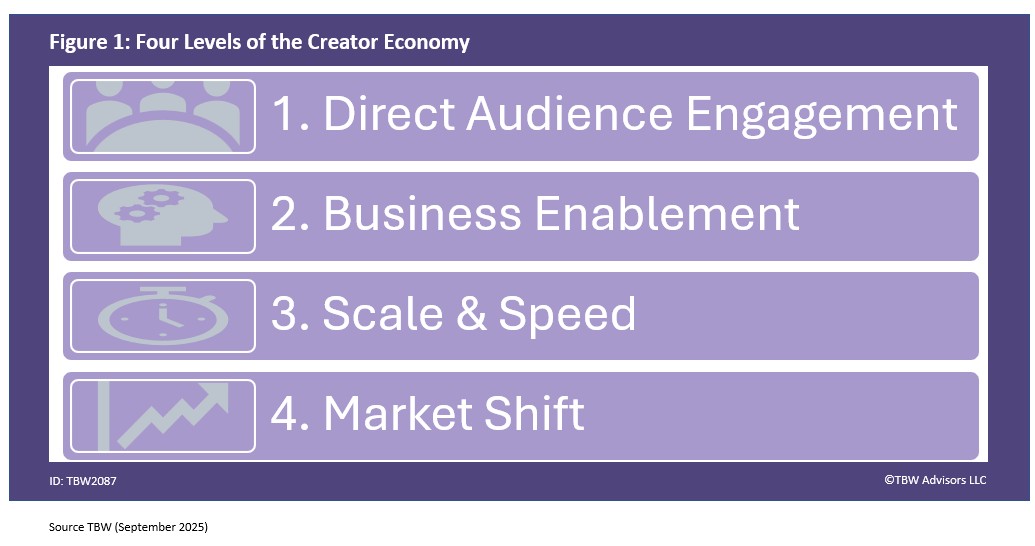
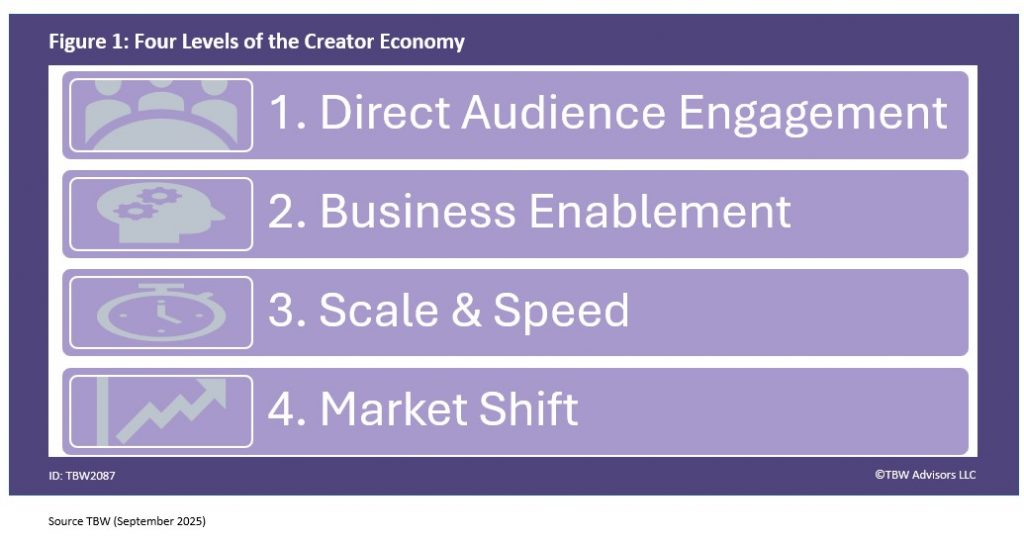
We took the most frequently asked and most urgent technology questions straight to the Technologists gathering at NAB Show 2025 held in Las Vegas, Nevada. This Whisper Report addresses the question regarding how can we leverage the creator economy to drive business growth? As Latakoo’s Jade Kurian shared, “every single person out there is a content creator right and they all want to be able to take their content in put it one place and do the editing do the transfers do the transcoding.” With all these creators, a shift is coming. As Strada’s Michael Cioni observed, “the creator economy is actually the economy we should be we’re following them now we should emulate.” Figure 1 depicts the four levers of the Creator Economy that we will now dive into.
Creators connect directly with consumers, offering scalable, intimate interactions. As DeepDub’s Oz Krakowski noted, “I think that in a world of creator economy where independent creators have a direct reach to the consumers ignoring that part of the business is a big mistake.” TightRope Dana Healy argued, “we still need to tie these new technologies to stories and creators are really good at telling stories.” Not only are they great at telling stories, but as LucidLink’s Gergana Berman reported, “we really think that the voices of individual creators and independent creators are really the trusted voices out there.” This trusted, storytelling capabilities with a direct reach results in, as Oz Krakowski observed, “unique product that very unique IP where they can reach different types of audiences and the ability to interact to have that level of interaction that is sometimes very intimate with their audiences is extremely scalable.” In conclusion per Tightrope’s Dana Healy, “the creator economy is still very valuable in the organic reach.”
Businesses must support creators with tools, partnerships, and infrastructure. There is a critical question all media vendors should be asking themselves, according to Axle.ai’s Sam Bogoch. “How can we enable them to make better content and how can we help them repurpose and retarget that content better.” Latakoo’s Jade Kurian noted, “creator economy to drive business growth for us it’s really about giving creators on one-stop shopping.” Catering to the creator economy is valuable for as Strada’s Michael Cioni proposed, “they are effectively bigger than professional media and entertainment and so what we need to understand is that consumer tastes have changed and what we have been protecting through our history and traditions for a long time is no longer as relevant.” Finally, and perhaps most critical, Cinnafilm’s Dom Jackson contended, “other piece is that we have to adjust to the way that those people do business we have to make sure that our cost models match their revenue models so that we can make a compelling case that we are tools that fit with their businesses.”
Creators rival traditional media in quality, speed, and production scale. Ross’s David Green emphasized, “The truth of the matter is some of these creators are just doing incredible things and their production quality is sometimes better than those of us who think that we’re the you know the you know the enterprise class content professionals. And when you when you look at some of the biggest content creators in the world they’re truly innovating in terms of how they’re creating this amazing content doing it flexibly doing it fast doing it on the run doing it efficiently.” David was not alone in sharing his enthusiasm for the creator economies scale. Per Dell’s Tom Burns, “size of the creator economy dwarfs what we have thought of for the last 100 years as episodic and feature production pipelines.”
The creator economy is reshaping media and consumer expectations. DeepDub’s Oz Krakowski declares companies must collaborate with content creators, “companies and businesses have to do this in order to cannot basically cannot ignore it.” And why would you ignore it for as Axle.ai’s Sam Bogoch asserted, “the creator economy is the biggest growth area in media right now and not just the official creator economy but also things like user generated content for marketing purposes.” And there is a very good reason creator content is growing. Per Strada’s Michael Cioni, “we have to get over that and meet them where they are because the next generation of consumers 10 and 20 years from now will not be going to see movies in theaters they’re not going to watch traditional broadcast television.”
“Media companies now favor hybrid cloud workflows for flexibility, speed, and cost-efficiency. Open standards ensure interoperability, while strong security protects valuable IP. Experts stress aligning cloud use with business goals, maintaining control and visibility, and using cloud strategically—not universally—to optimize collaboration, performance, and infrastructure investment.”
Target Audience Titles:
Chief Technology Officer, Chief Digital Officer,
Chief Data Officer, Chief Marketing Officer, Chief Content Officer
VP Engineering, VP Media Technology, Dir Cloud Strategy, Dir Media Ops, Head of post production, Direct of IT Infrastructure
Cloud Solution Architects, Media System engineers, DevOps Engineer, Video Platform Engineer, Broadcast Engineer, Post Production Engineer, Media Workflow Specialist, Software Engineer, Storage and Archiving Engineer, SRE
Key Takeaways
Hybrid workflows balance cloud flexibility with on-prem performance and cost control.
Open standards ensure seamless integration across media tools and platforms.
Strong security protects media IP with access control and audit trails.
Cloud strategy should align with business goals, not just follow trends.
We took the most frequently asked and most urgent technology questions straight to the Technology experts gathering at NAB Show 2025 held in Las Vegas at the Las Vegas Convention Center. This Whisper Report addresses the question regarding what are the best practices for integrating cloud technologies in media workflows?
Its been fascinating to watch the Media’s use of the cloud the last handful of years. As Axle.ai’s Sam Bogoch observed, “during covid people would just put things in the cloud willy-nilly because there was no reason to put it anywhere else. They didn’t go to their offices. There was no on premise. There was no concentration of work.” Furthermore, as Dell Technologies’ Tom Burns pointed out, “The promise of cloud was that you didn’t have to own or maintain infrastructure and that’s been awesome.”
Or as Ross’s David Green observed, “they don’t have to have a large upfront capital investment.” Thus when there was no concentration of workers or work, the lack of capital investment and no need for infrastructure maintenance was quite attractive. But its important to keep in mind as Ross’s David Green further explained, “cloud is just a technology – not a solution.” Thus, in the post-COVID world, Media has been rebalancing how as an industry it works with cloud.
Regardless of where you put your workload for what part of the media workflow, the technologies involved must work together. Latakoo’s Jade Kurian gave us a great example, “if I have one company that does transcription let’s say really really well but it’s no connected to my media workflow. Then if I start using that as an enterprise media company, then the problem is I’ve created something that slows down my team even though I’m trying to make it faster for them.” To prevent the slowdown from incompatible tools, Cinnafilm’s Dom Jackson suggested, “to make sure that all of these technologies are using somewhat standardized APIs and ontologies and so on to allow somewhat atomic solutions to be combined easily into larger workflows.” In other words as Magnify’s Ken Ruck summarized, “the best ways to be open and not be a closed system.” The goal, as summarized by Jade Kurian, “it is all about speed -speed from camera to that pane of glass that exists that somebody’s watching on the other end”
Regardless of where your solution executes or where the media resides, protecting that media is absolutely critical. As Eon Media’s Greg Morrow simply stated, “media companies are built on their intellectual property so protection of their IP is incredibly important.” As warned during our coverage of Conference Whispers: NAB Show 2025, just because a technology can share media, doesn’t mean it does so securely with an audit trail. Lucidlink’s Gergana Berman further cautioned, “a lot of providers out there might claim that they have a very secure solution, but you have to check for yourself.” If this is an area your team is concerned with, clients should book an inquiry before purchasing the technology. In 2025, it is also critical to check the terms and conditions of any AI technologies leveraged. As Gergana Berman further explained, “ make sure their terms and conditions are not saying they can use your media copyrighted media.” Or as the saying goes, don’t use free products for when something is free – you are the product. In this case the valuable IP is the product of the media company for which you are working.
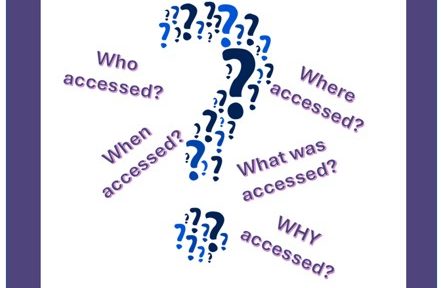
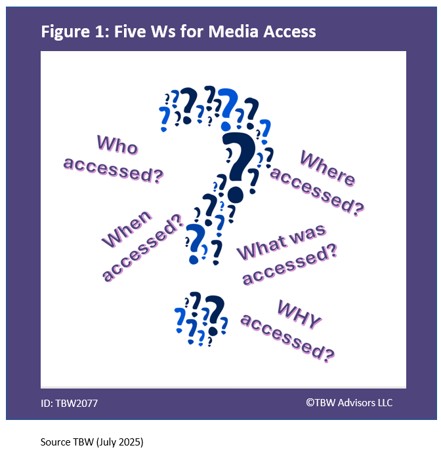
Some solutions have built in capabilities to assist in protecting your intellectual property. Greg Morrow pointed out that Eon Media’s solution has, “three levels of watermarking that we produce So we have produce a visible watermark on the asset and an invisible watermark.” Leostream’s Karen Gondoly perhaps best summarized the totality of the need, “I need to have control of my data. I need to have control of who has access to it. I want to secure that data so I want to make sure that I’m authorizing users correctly. I want to make sure that I’m using zero trust principles when I’m providing access to people. I need visibility. I want to make sure I always know who has access to my data what they’re doing with it where they’re accessing it from.” In other words, I don’t just need to be able to control it, I need a full audit trail of the five w’s for my data. Who accessed, What was accessed, When accessed, Where accessed and Why accessed as depicted in Figure 1.
Today, most media companies have settled into hybrid architectures involving a combination of on premise and cloud technologies. Strada’s Michael Cioni best summarized, “no one can actually put everything in one cloud. There’s too many collaborators. There’s too many different clouds. There’s too many pros and cons to clouds and nobody has enough money to store everything there So I think the best practices for integrating cloud into your workflow is to actually look for alternative solutions that may not use the cloud in the traditional ways and figure out how to collaborate across clouds versus putting everything in one place.” So what should go where? One can observe, those with on-premise based solutions have different answers vs those with predominantly cloud based solutions. Ross’s David Green recommends, “to not start with I want to do cloud the key is to start with whydo I want to use cloud and then figure out who can help you solve those.”
SNS’s Alex Hlvarty cautions, “we can’t control internet outages or data breaches or things like that are mitigated by making sure that you keep your own assets on site in your possession but then utilizing cloud for its very clear benefits as far as making things available to people all over the world through one single portal.” Axle.ai’s Sam Bogoch also likes to keep things he is actively working on close. “on premise the things that you’re immediately working on because it does not make sense to keep asking for them politely from the cloud when you’re getting work done much faster on premise and meanwhile things like archive and backup clearly belong in the cloud.” From a capitalization perspective, Dell Technologies Tom Burn’s recommends an extension of a common metaphor. “let’s think of the old rocks pebbles sand metaphor where rocks are the fully capitalized on prem infrastructure that you need to keep 99.9% utilized and the pebbles are the project-based uses of compute and storage that aren’t part of your base commit and don’t hit your ybudget and the sand is the pure burstable joy that is the public hyperscalers. We’re looking at hybrid workflows that combine all three screening up.”
Once again, clients should schedule an inquiry to review your hybrid media architecture against your organizational priorities.
AI is transforming media and entertainment, reshaping workflows and automating the tedious. This shift isn’t new—it’s an evolution already well underway. While concerns about disruption persist, AI is proving to be a powerful tool that enhances efficiency, making content more accessible and refining quality. From metadata enrichment to streamlined production, AI empowers professionals by eliminating the mundane and allowing more focus on creativity. Rather than replacing jobs, it shifts how work gets done, seamlessly integrating with existing processes to unlock new possibilities in storytelling, production, and distribution. The industry is adapting, and AI is at the heart of that transformation.
Target Audience Titles:
Chief Technology Officer, Chief Supply Chain Officer, Chief Digital Officer
Chief Data Officer, Chief Marketing Officer, Chief Content Officer
Head of AI and Machine Learning, Data Scientists
Product Managers, Content Managers, Sound Engineers, Distribution Engineers
Production Technologists, Streaming Platform Developers
Chief Technology Officer, Chief Supply Chain Officer, Chief Digital Officer
Key Takeaways
AI is transforming workflows, automating the tedious, and reshaping media and entertainment.
Efficiency gains let creators focus on storytelling while AI enhances accessibility and searchability.
AI isn’t replacing jobs—it’s evolving how work gets done, integrating seamlessly into production processes.
We took the most frequently asked and most urgent technology questions straight to the Technology experts gathering at NAB Show 2025. This Whisper Report addresses the question regarding how can AI and machine learning transform media and entertainment?
As DeepDub’s Oz Krakowski stated, “We see is a lot of the work that was done before is now done in different.” These changes have already hit the headlines for as Dell Technologies’ Tom Burns pointed out, “Everybody’s all concerned with Gen AI but of course the writers and actors strikes were all about that.” Thus this AI transformation is not new but rather is currently underway. Latakoo’s Jade Kurian offered this perspective. “The question now is how do we do this thoughtfully? How do we do it in a way that we don’t compromise ethics – where we don’t compromise people’s jobs? How do we make it flow back and forth where we take advantage of AI and machine learning to make our lives easier, make our lives better, and make entertainment and media better.” Cinnafilm’s Dom Jackson suggests we take another step back to gain a larger perspective, “There’s a lot of fear around AI and those technologies and in that sense, I see those as part of a continuum of ongoing automation processes that have been going on since the industrial revolution. Everyone’s always scared when something new comes along and then very quickly it becomes normal and it empowers us to work in new and different and usually more efficient ways.” See Figure 1 for the Cornucopia of AI use cases suggested. Let’s explore some of those new, and different, more efficient ways.
One thing is for certain, there is no shortage of opportunity for AI to positively impact the media and entertainment sector. The favorite use case among all users, as Strada’s Michael Cioni put it, “AI is best for our industry as a utility form to do the mundane tasks .. we need AI that automates mundane tasks like color correcting sound noise reduction, video audio noise reduction, face tagging, locations, objects, emotions – those are all the things that no one wants to sit and log footage. AI can log it for us.” Or per Ross’s David Green, “AI is going to make us more efficient and more effective and let us focus on what we love doing which is creating amazing content.” No matter which perspective you prefer – the elimination of the mundane or the freeing up to do the fun parts – AI is here to stay in media workflows. As Dell’s Tom Burns observed, “Machine learning has already transformed media and entertainment in so many invisible ways from security to fixing single pixel defects to all kinds of low-level network functions and automated provisioning.”
When it comes to all that stored media, there are plenty of suggestions of how AI can assist as well. Per SNS’s Alex Hlavaty, “It actually can be an incredibly helpful buddy to sort through the stuff we don’t want to do parse through petabytes worth of information. Help us find assets more quickly and just interact with our data in a much more meaningful way while reducing man hours doing things that are laborious.” . Eon Media’s Greg Morrow observed, “our customers have large libraries of video files that only have a file name or have just a a small title. We really enriched those assets with information to make those assets more usable by identifying people places things emotional sentiment um ethnicity as part of those assets.” Dell Technologies’ Tom Burns denoted, “One of the GEN AI things that is proving to be useful is for companies that have large archives or studios that have that have the rights holders to a lot of content, using AI to extend the metadata and inform them of what they actually have in their archive allows them to make that more searchable and therefore more monetizable on.” Increasing metadata for the purpose of search and the related business cases that come from having truly searchable content is a common theme. As Axle.ai’s Sam Bogoch simply stated, if, “they can’t find it they can’t reuse it.”
In some of the use cases such as sound editing, it has completely transformed the task at hand. As DeepDub’s Oz Krakowski observed, “just like you cannot imagine a graphics designer not using Photoshop it’s unheard of right however 20 years ago this was extremely questionable nowadays thinking of doing voice design and editing dialogues without using AI.” Ross’s David Green offers additional suggestions, “things like camera tracking so instead of having to every single second manually figure out where things are and do manual keying you know markers and those sort of things we can use AI to automatically be able to do those things .. instead of having to flip through a manual.” Dell’s Tom Burns observed, “when you render your VFX AI upsampling has gotten so good now that you can render at 2K and up to 4K and it looks better than if you rendered at 4K in the first place.” Wow! Upsampling rendering better than if it was 4k in the first place – now that is an improvement – by definition. Localization is another area that has been drastically impacted by AI. Today, with AI tools such as Yella Umbrella are, “making content accessible to users that wouldn’t have access to it normally either because there’s no one to localize that content or just because the content that they want to access is not available in the accessibility form that they prefer.” If the form you prefer isn’t about language but more about duration, Magnify’s Ken Ruck shares today one can, “edit automatically (and) create clips automatically.” Clients may recall our coverage of Conference Whispers: NAB Show 2023 when automated shorts were first highlighted.
One of the most treasured advancements is that of workflow automation. As Eon Media’s Greg Morrow stated, “workflow automation to improve the efficiency of a media organization in order for the people in the organization to create higher value content and less of the drudgery work.” In other words, AI can transform Media and Entertainment by enabling all to do more with less. But if you are worried about your job, Cinnafilm’s Dom Jackson assured, “strangely ultimately people always end up having jobs they’re different jobs but people always end up with plenty of work.”