Published to clients: December 30, 2025 ID: TBW2114
Published to Readers: December 31, 2025
Whisper Email Release:
Public/Video Release:
Analyst(s): Dr. Doreen Galli
Photojournalist(s): Dr. Doreen Galli
Abstract
“This Whisper Report investigates the biggest supply chain risk CIOs ignore. It captures urgent insights from Retail, Supply Chain, and Logistics Expo revealing how external shocks, demand disconnects, and fragmented systems quietly erode resilience. Industry leaders share candid perspectives on tariffs, inventory pitfalls, and costly tech missteps—issues that can derail growth overnight. If you think your supply chain strategy is future-proof, this report may challenge everything you assume about stability.”
Target Audience Titles:
- Chief Information Officer, Chief Technology Officer, Chief Supply Chain Officer, Chief Operations Officer, Chief Procurement Officer, Chief Logistics Officer
- Vice President of Supply Chain, Vice President of Operations, Director of Logistics, Director of Procurement, Director of IT, Director of Inventory Management
- Supply Chain Analyst, Logistics Coordinator, Procurement Specialist, Inventory Planner, IT Systems Analyst, Operations Scheduler
Key Takeaways
- External shocks like tariffs and conflicts can cripple supply chains without proactive disruption modelling.
- Demand disconnects from stockouts or overstock erode customer trust and lifetime value.
- Fragmented systems and poor tech choices lead to costly inefficiencies and integration failures.
What’s the biggest supply chain risk CIOs ignore?
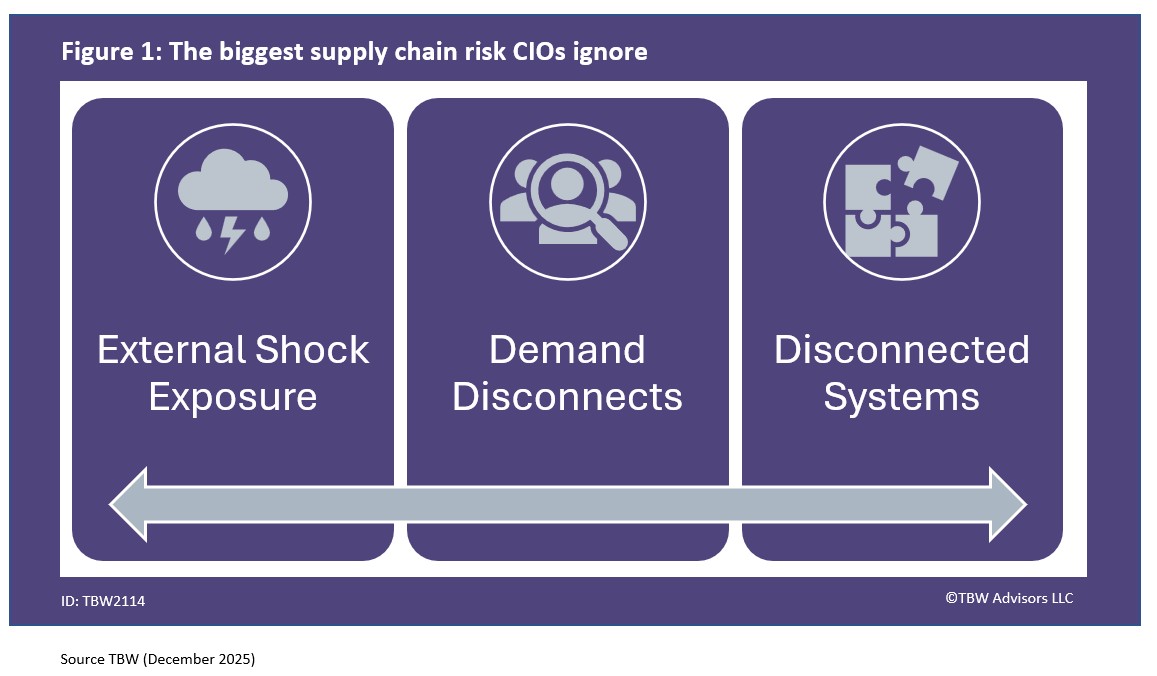
We took the most frequently asked and most urgent technology questions straight to the professionals gathering at the Las Vegas Convention Center for the Retail, Supply Chain, and Logistics Expo. This Whisper Report addresses the question regarding the biggest supply chain risk CIOs ignore as depicted in Figure 1.
1. External Shock Exposure
Diving into this question, Lufthansa’s Ingo Pietruska went straight to the point. “Tariffs and supply chain interruptions.” When suddenly the world changes in terms of who can supply globally or what it costs or how long it will take – it’s a risk. In 2025 it may be all about Tariffs but in 2020 it was all about Covid and in 2022 it was all about the Ukraine/Russia conflict. In many years, hurricanes disrupt many trade routes. While each of these is technically unexpected, they shouldn’t be. As first discussed in Whisper Report: Can generative AI prevent supply chain disruptions?, organizations should develop a disruption threat model to maximize resiliency when external shocks are experienced. Clients should be sure to schedule an inquiry on the topic so we can guide you in establishing the framework.
2. Demand Disconnects
Our second risk comes from Warehouse Craft’s Steve Harris. He believes the biggest risk, “is stockouts are the biggest problem a company can have. I should say in addition to overstock. So, managing that JIT for your inventory is really important.” Of course JIT or just in time is great for minimizing costs except in the external shock exposure scenarios. Many wanted to expedite shipments to avoid tariffs. Others, without back-up inventory suffered greatly during covid when workers were too sick to work.
Expanding on the stock issue, Midstates Group’s Taylor Wensmann takes a step back. “is capacity. What are you going to do when a high volume of orders come through? Do you have the team and the support to be able to fulfil and meet all your customers’ expectations and deadlines to keep those customers as lifetime values? If you’re promising and committing to an order getting shipped and then you don’t ship it, you just increase the likelihood of losing that lifetime customer by 40%.” In both cases, the supply chain is disconnected from and unable to meet demands of the customers and therefore the business.
3. Disconnected systems
Supply chain and logistics involves many moving pieces. To succeed one needs a cohesive, coherent picture of what is going on. With the many varieties of external shocks creating regular demand disconnects, the solution must be functional and agile. Unfortunately, many get advice from the wrong places. MetaOption’s Naushad Ahmed shared a story about a vendor that previously convinced someone into using a completely different tech stack from their existing solution. Nonetheless, the client, “decided to move forward whenever they have implemented. One of the biggest pain points and they actually ended up spending a huge amount of money hundreds of thousands of dollars into that solution.” Selecting the wrong components or an integration partner with no experience or expertise can be quite expensive. Be sure to work with your independent industry analyst at TBW Advisors LLC to review all strategies, proposals and architectures – even if the work is outsourced.
Related playlists and Publication
- Whisper Report: What’s the biggest supply chain risk CIOs ignore?
- Whisper Report: How will AI change warehouse architecture?
- Whisper Report: What tech will kill manual logistics in 5 years?
- Whisper Report: What’s the best part about attending RSCLE live in Vegas?
- Conference Whispers: Retail, Supply Chain, & Logistics Expo
Corporate Headquarters
2884 Grand Helios Way
Henderson, NV 89052
Downloading, re-uploading, or redistributing this file is not permitted under any license.
©2019-2026 TBW Advisors LLC. All rights reserved. TBW, Technical Business Whispers, Fact-based research and Advisory, Conference Whispers, Industry Whispers, Email Whispers, The Answer is always in the Whispers, Whisper Reports, Whisper Studies, Whisper Ranking, Whisper Club, and One Change a Month, Vegas Convention Library; Leading Professionals, Real Questions, Real Time, are trademarks or registered trademarks of TBW Advisors LLC. This publication may not be reproduced or distributed in any form without TBW’s prior written permission. It consists of the opinions of TBW’s research organization which should not be construed as statements of fact. While the information contained in this publication has been obtained from sources believed to be reliable, TBW disclaims all warranties as to the accuracy, completeness or adequacy of such information. TBW does not provide legal or investment advice and its research should not be construed or used as such. Your access and use of this publication are governed by the TBW Usage Policy. TBW research is produced independently by its research organization without influence or input from a third party. For further information, see Fact-based research publications on our website for more details.