Published to clients: February 2, 2026 ID: TBW2135
Published to Whisper Club: February 2, 2026
Whisper Email Release:
Analyst(s): Dr. Doreen Galli
Photojournalist(s): Dr. Doreen Galli
Abstract:
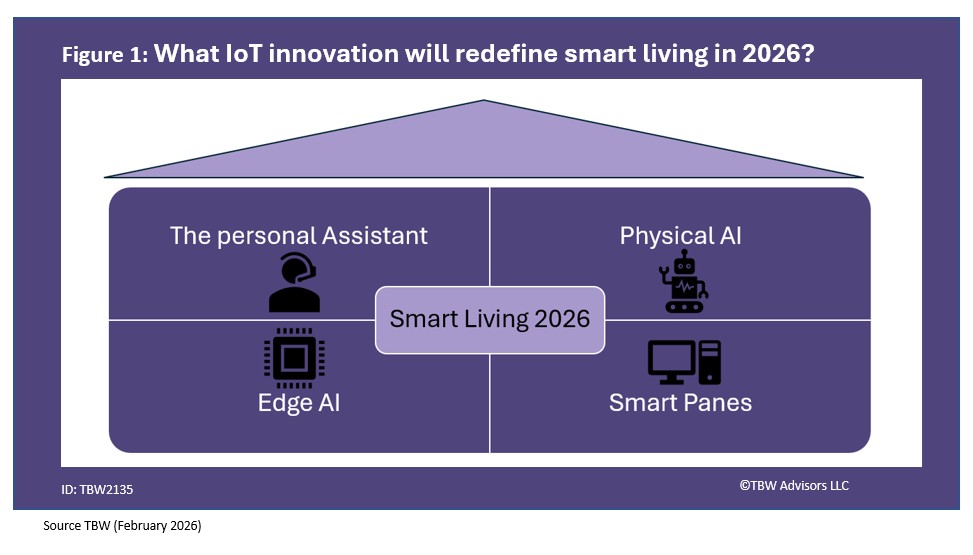
“This Whisper Report investigates what IoT innovation will redefine smart living in 2026. Researched on‑site at CES 2026, it explores how emerging technologies are reshaping home experiences in ways that blend intelligence, responsiveness, and new forms of interaction. Designed to spark curiosity, the report brings forward perspectives from Perfect Corp.’s Dr. Wayne Liu, X‑Origin’s Szeyu Wong, RiseLink’s Dr. Pengfei Zhang, and LG Electronics’ Chris DeMaria.”
“This Whisper Report investigates the next data breach our industry isn’t ready to handle. It captures urgent insights from Put Data First revealing how emerging threats are reshaping risk landscapes. These include AI pipeline compromises, indirect prompt injections, company chat exfiltration, and deep fake-driven social engineering. Expert perspectives explain why traditional defenses fail. The report urges proactive strategies to secure data integrity across every stage of AI-driven operations before vulnerabilities escalate.”
Target Audience Titles:
Chief Executive Officer, Chief Information Officer, Chief Technology Officer, Chief Data Officer, Chief Security Officer, Head of Data Strategy, Head of Information Security
Director of Cybersecurity, Director of AI Operations, Director of Risk Management, Director Data Governance Manager, Enterprise Architect
Data Scientist, Machine Learning Engineer, Cybersecurity Analyst, AI Operations Specialist, Risk Analyst, Cloud Security Engineer, Threat Intelligence Analyst
Key Takeaways:
AI pipelines are vulnerable at every stage, requiring continuous protection of training data and outputs.
Indirect prompt injections can manipulate AI agents through unvalidated web content, creating hidden security risks.
Company AI chat data is a high-value target for exfiltration, exposing sensitive organizational insights.
Deep fakes amplify social engineering attacks, eroding trust and enabling data breaches through deception.
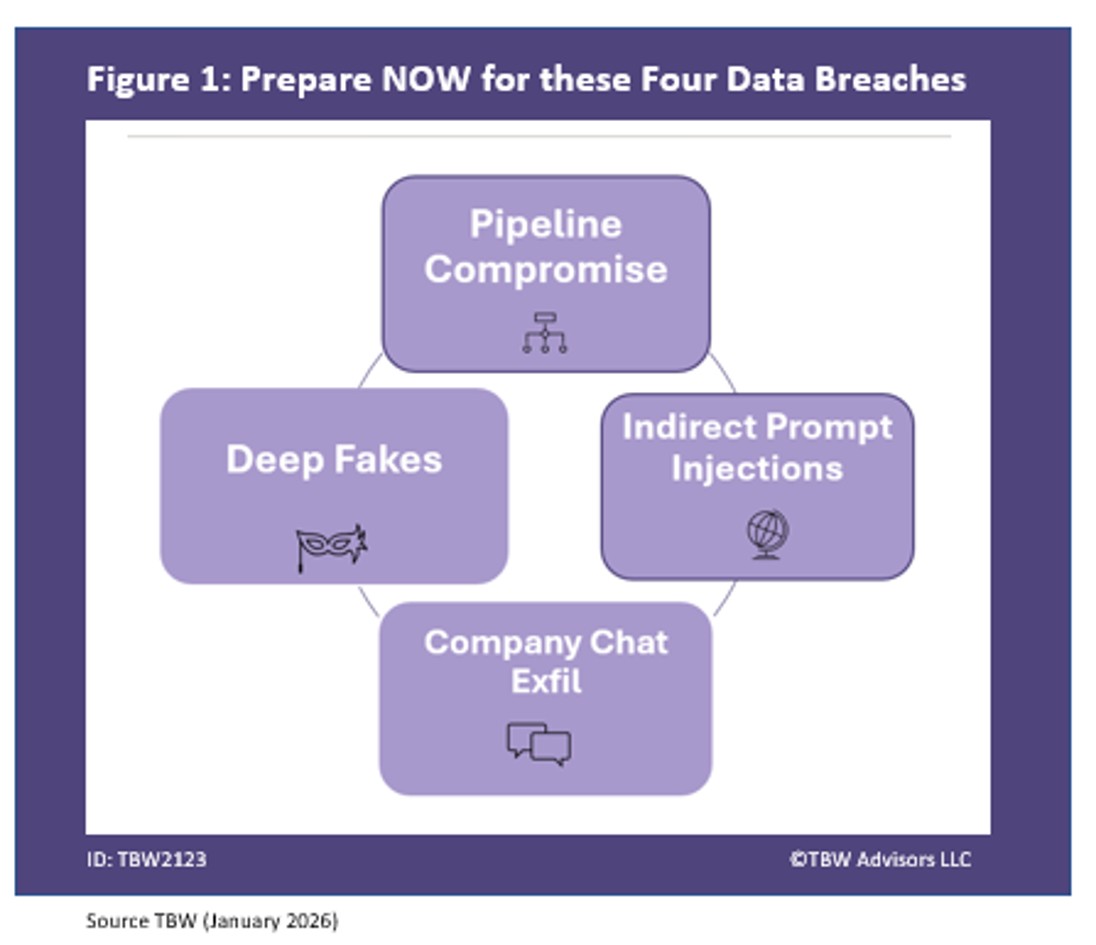
We took the most frequently asked and most urgent technology questions straight to the data and AI experts gathering at the Put Data First’s Inaugural event held at Planet Hollywood in Las Vegas. This Whisper Report addresses the question regarding the biggest AI risk no one in your organization is talking about as depicted in Figure 1.
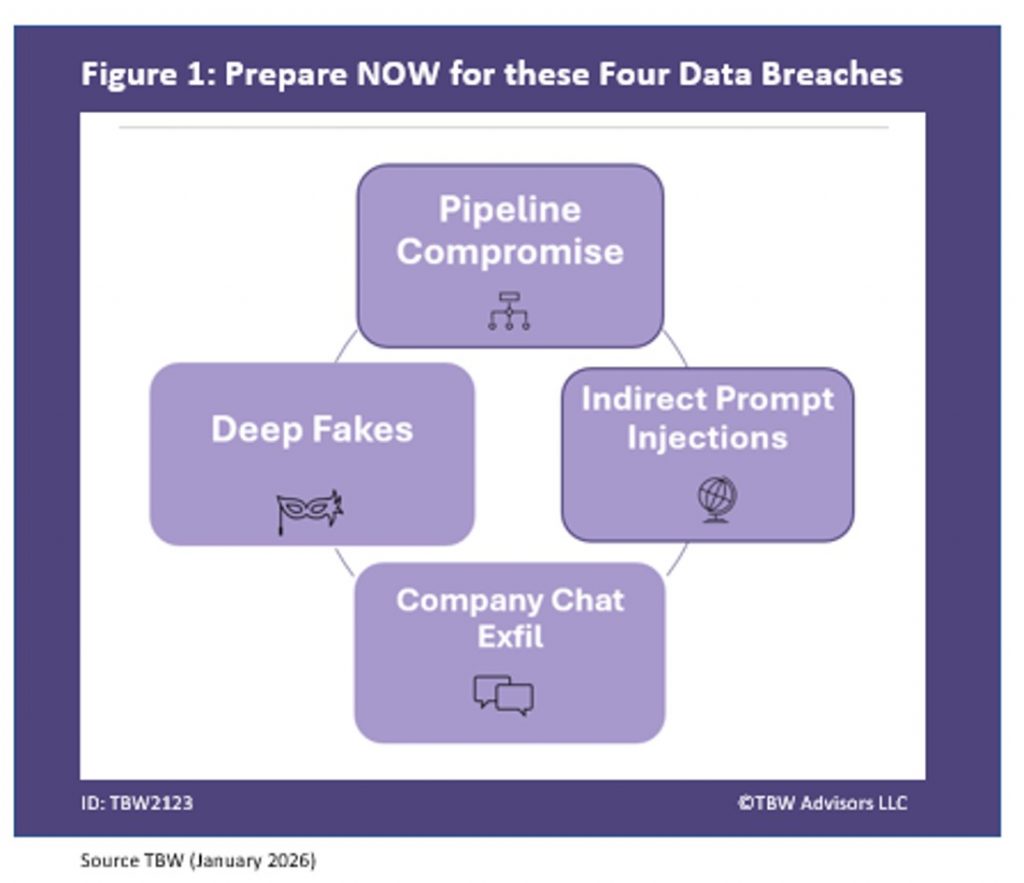
Figure 1. Prepare NOW for these Four Data Breaches
Our first area to defend, was suggested by SafeBreach’s Hudney Piquant. “The AI pipeline I like to call it. It’s the pipeline of the data that you are the training data that you have and then your prompting that you’re doing and then the output like those three things I believe that that’s going to be the biggest breach that the adversaries will be looking at because if you’re able to really manipulate those things it’s going to affect the pipeline from a scalability perspective.” Hudney raises an important point that data needs to be always protected, every step of the way on its journey. For more research on how to protect data during execution see Industry Whispers: Public is Private -Confidential Computing in the Cloud.
The next attack vector, brought by Mend.io’s Amit Chita, is subtle and exploits GenAI. “Indirect prompt injections. All the web contains websites. We take AI agents, we connect them to get information from these websites, but we don’t validate that it that this website doesn’t contain prompt injections within them. and they can manipulate our agents as they surf through the web. I think this is going to be one of the major issues that we’re going to deal with in the next coming weeks.” One may want to be careful where you let your agents roam!
Our third attack vector is an insider and SaaS risk with significant exposure potential, highlighted by AnswerRocket’s Shanti Greene. “Exfiltrating company AI chats. So, the organizers like Open AI have done a good job of giving you a sandbox for your company to work within and they’re not training on your data. But being able to exfiltrate a company’s specific use and see what they’re prompting with could be interesting. There’s probably some interesting gold in that data.”
Our final area of concern may not be a direct data breach but rather is a tool frequently leveraged to breach data and trust and is brought to us by The Agentic Manager’s Neil W. Smith. “The implications of deep fakes. We’re already used to AI being used for fishing expeditions, for extracting information from our databases. But what we don’t realize as humans is that we trust other humans to play by the rules more often than not. However, with deep fakes, both voice fakes, visual fakes, and context fakes, I think more and more humans are going to be fooled by the efficacy of deep fakes.” And the more humans that are fooled, the more systems can be compromised. Despite how widely discussed this topic is, deep fakes remain underestimated for their use in fraud and as a social engineering threat.
Published to clients: December 30, 2025 ID: TBW2114
Published to Readers: December 31, 2025
Whisper Email Release:
Public/Video Release:
Analyst(s): Dr. Doreen Galli
Photojournalist(s): Dr. Doreen Galli
Abstract
“This Whisper Report investigates the biggest supply chain risk CIOs ignore. It captures urgent insights from Retail, Supply Chain, and Logistics Expo revealing how external shocks, demand disconnects, and fragmented systems quietly erode resilience. Industry leaders share candid perspectives on tariffs, inventory pitfalls, and costly tech missteps—issues that can derail growth overnight. If you think your supply chain strategy is future-proof, this report may challenge everything you assume about stability.”
Vice President of Supply Chain, Vice President of Operations, Director of Logistics, Director of Procurement, Director of IT, Director of Inventory Management
Supply Chain Analyst, Logistics Coordinator, Procurement Specialist, Inventory Planner, IT Systems Analyst, Operations Scheduler
Key Takeaways
External shocks like tariffs and conflicts can cripple supply chains without proactive disruption modelling.
Demand disconnects from stockouts or overstock erode customer trust and lifetime value.
Fragmented systems and poor tech choices lead to costly inefficiencies and integration failures.
What’s the biggest supply chain risk CIOs ignore?
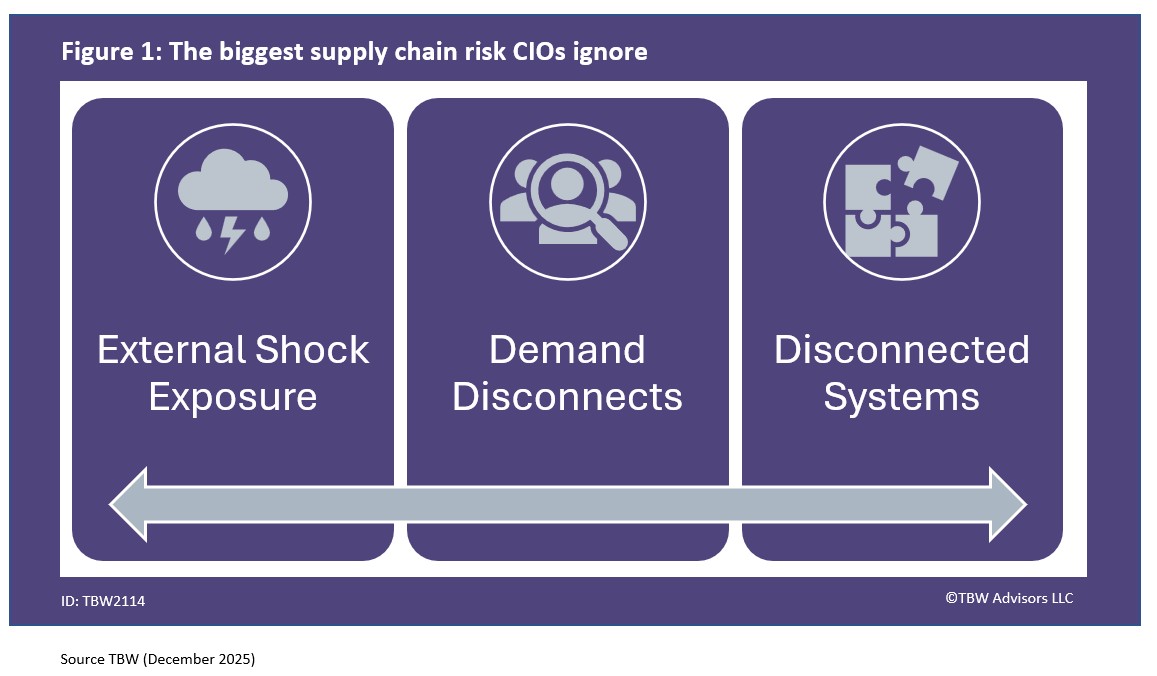
We took the most frequently asked and most urgent technology questions straight to the professionals gathering at the Las Vegas Convention Center for the Retail, Supply Chain, and Logistics Expo. This Whisper Report addresses the question regarding the biggest supply chain risk CIOs ignore as depicted in Figure 1.
1. External Shock Exposure
Diving into this question, Lufthansa’s Ingo Pietruska went straight to the point. “Tariffs and supply chain interruptions.” When suddenly the world changes in terms of who can supply globally or what it costs or how long it will take – it’s a risk. In 2025 it may be all about Tariffs but in 2020 it was all about Covid and in 2022 it was all about the Ukraine/Russia conflict. In many years, hurricanes disrupt many trade routes. While each of these is technically unexpected, they shouldn’t be. As first discussed in Whisper Report: Can generative AI prevent supply chain disruptions?, organizations should develop a disruption threat model to maximize resiliency when external shocks are experienced. Clients should be sure to schedule an inquiry on the topic so we can guide you in establishing the framework.
2. Demand Disconnects
Our second risk comes from Warehouse Craft’s Steve Harris. He believes the biggest risk, “is stockouts are the biggest problem a company can have. I should say in addition to overstock. So, managing that JIT for your inventory is really important.” Of course JIT or just in time is great for minimizing costs except in the external shock exposure scenarios. Many wanted to expedite shipments to avoid tariffs. Others, without back-up inventory suffered greatly during covid when workers were too sick to work.
Expanding on the stock issue, Midstates Group’s Taylor Wensmann takes a step back. “is capacity. What are you going to do when a high volume of orders come through? Do you have the team and the support to be able to fulfil and meet all your customers’ expectations and deadlines to keep those customers as lifetime values? If you’re promising and committing to an order getting shipped and then you don’t ship it, you just increase the likelihood of losing that lifetime customer by 40%.” In both cases, the supply chain is disconnected from and unable to meet demands of the customers and therefore the business.
3. Disconnected systems
Supply chain and logistics involves many moving pieces. To succeed one needs a cohesive, coherent picture of what is going on. With the many varieties of external shocks creating regular demand disconnects, the solution must be functional and agile. Unfortunately, many get advice from the wrong places. MetaOption’s Naushad Ahmed shared a story about a vendor that previously convinced someone into using a completely different tech stack from their existing solution. Nonetheless, the client, “decided to move forward whenever they have implemented. One of the biggest pain points and they actually ended up spending a huge amount of money hundreds of thousands of dollars into that solution.” Selecting the wrong components or an integration partner with no experience or expertise can be quite expensive. Be sure to work with your independent industry analyst at TBW Advisors LLC to review all strategies, proposals and architectures – even if the work is outsourced.
Published to clients: December 23 2025 ID: TBW2128
Published to Readers: December 24, 2025
Whisper Email Release: February 9, 2026
Public Editions: February 12, 2026
Analyst(s): Dr. Doreen Galli
Photojournalist(s): Dr. Doreen Galli
Abstract
“Aftermarket innovation in 2026 faces three critical blind spots: workforce training lagging behind rapid tech adoption, supply chain visibility gaps impacting profitability, and misinterpretation of EV battery health undermining consumer trust. These challenges, identified through expert insights at AAPEX and SEMA 2025, demand proactive strategies to ensure sustainable growth and competitiveness in an evolving automotive landscape.”
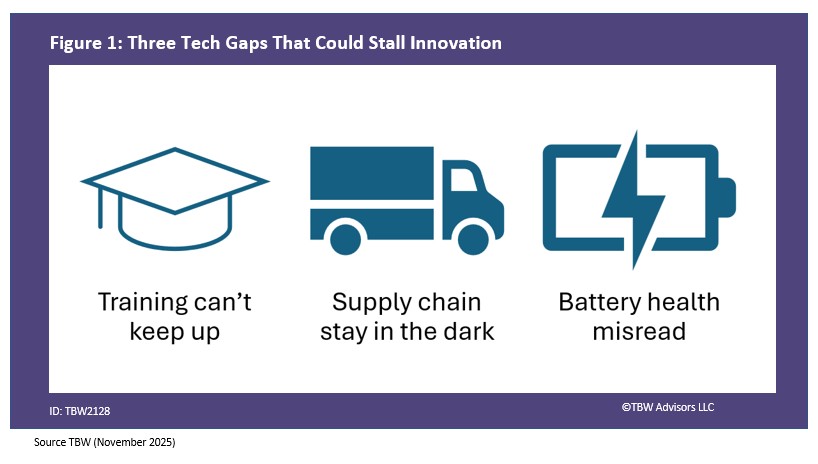
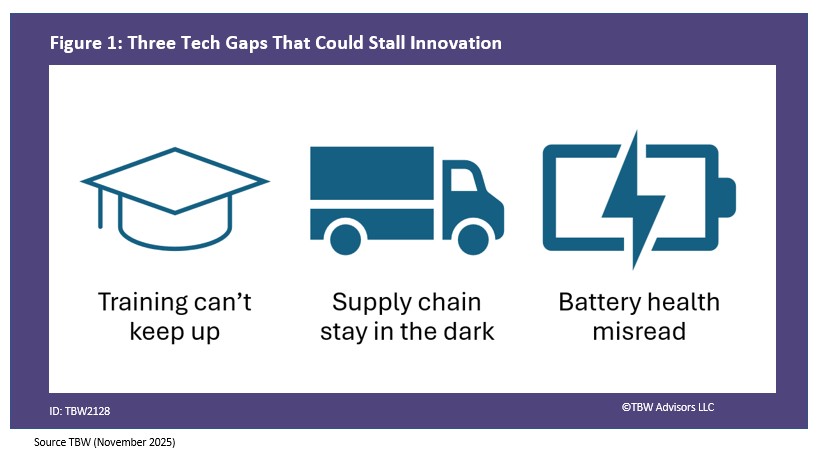
We took the most frequently asked and most urgent technology questions straight to the experts from the automotive sector gathering at the Venetian Convention Center AND Caesars Forum AND the Las Vegas Convention Center for AAPEX & SEMA 2025. This Whisper Report addresses the question regarding what tech blind spot will stall aftermarket innovation in 2026 as depicted in Figure 1.
New innovation is great but only if you know how to use and apply it. The first challenge isn’t as much as the tech as the ability for the employees in the organizations to use the tech as shared by Texa’s Fabio Mazzon. “Up to speed with new technology and be try to be trained as much as possible and follow everything that is new in the automotive world.” Sometimes, the technology changes come faster than the teams are ready for. Keeping up to date with the current speed of innovation is a common challenge of many today. Be sure to schedule your inquiry with your TBW Advisors LLC’s analyst to ensure your roadmap is futureproofed and ready for all the new innovations coming your way. For additional research on training technologies available see Conference Whispers: HR Tech 2025.
One of the biggest challenges for those in the aftermarket industry is simply staying profitable with the greatest challenge being the supply chain. The tariffs alone have thrown global supply chain into a new environment. As Lynnco’s Andrew Yokiel emphasized, “Supply chain. Having greater data and visibility into everything from small parcel down to up to full truckload, LTL, and getting your product to your customers faster and having an idea where it is in the marketplace and having cleaner data to make business decisions to be profitable.” Profitability, much like having customers, is truly a key ingredient to staying in business.
In order for the used and aftermarket to flourish, the value of those components or in adding those components should be commonly agreed upon and understood. Unfortunately, this is a challenge particularly in the EV market as Midtronics’ Lance Losinski emphasized. “Consumer understanding and credibility of the value say the health of a battery pack. That drives the market prices down because the understanding versus mileage on a gas car versus what’s the state of health battery and how long is it going to last and how do you repair these things, creates the biggest gap for a consumer to be able to trust and utilize the vehicle despite having lower service costs long term and things like that. I think that’ll be the biggest blocker in the near term.”
Published to clients: December 16, 2025 ID: TBW2118
Published to Readers: December 17, 2025
Whisper Email Release: TBD
Public and Video Release: TBD
Analyst(s): Dr. Doreen Galli
Photojournalist(s): Dr. Doreen Galli
Abstract
“This Whisper Report investigates the biggest fintech risk CIOs are underestimating. It captures urgent insights from Money 20/20 USA 2025, revealing why incremental improvements won’t protect enterprises from disruption. From rapid shifts in payment models to vendor lock-in, integration hurdles, and data complexity that derails AI ambitions—these risks demand immediate attention. Future-proofing architecture and optimizing data fabric are no longer optional. Read on to uncover strategies that redefine resilience before the next wave hits.”
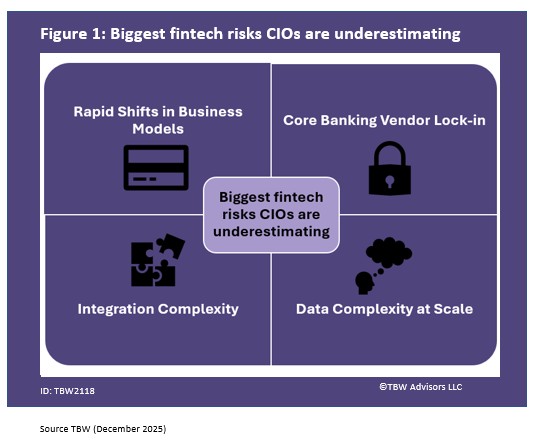
We took the most frequently asked and most urgent technology questions straight to the fintech professionals gathering at the Sands Convention Center in Las Vegas for Money 20/20 USA 2025. This Whisper Report addresses the question regarding the biggest fintech risk CIOs are underestimating as depicted in Figure 1.
Figure 1. Biggest fintech risks CIOs are underestimating
A very big issue, according to Globant’s Marc St. Pierre is, “is not looking ahead to future business models where instead of investing today and improving their existing infrastructure.” One does not need to improve an infrastructure that one will not be utilizing in a few years. Marc went on to provide a real-world example. “The best example I can give you is Pix down in Brazil. I was just at a meeting where I learned a statistic that today in Brazil, I think it’s only three years after they introduced Pix, 44% of volume transacted is credit card and 40% is Pix. That’s remarkable to think about and it’s not crazy to imagine the US or other markets in the world could get to that.” Wow 40% market dominance achieved in 3 years in the world of payments.
With such rapid shifts in business models, it is no wonder Alacriti’s Jamie Harris sounded the alarm bringing us risk number 2. “The underestimation of their vendor dependency on the Core (Core banking) and the limitations of those Cores to meet their payment modernization needs.” Jamie suggests we should seek, “modernized payment architecture and infrastructure stack that’s API first, tech first, and really allows institutions to be very nimble and adaptable as they look at new business models build potentially new use cases for either their consumer or business segment.” It’s valuable to note that enterprises dependent on such vendors will land up with a bifurcated solution as they attempt to adopt and evolve to catch the market opportunities.
Risk number three comes from AutoRek’s Nicholas Botha. “The interoperability between systems within a tech stack and the relationship that those have in the cloud.” It is valuable to note that one should never select a technology just because it may be the best. A given organization and architecture have existing components. New technology that works great for organization A may or may not be able to deliver the same in your organization. Clients should always schedule an inquiry before expanding their technology footprint as well as annual reviews of your architecture, your strategy and road map. Future proofing your infrastructure today enables you to handle what suddenly arrives tomorrow.
Our fourth risk comes from Zoominfo’s Brandon Tucker. “The complexity that’s added as data scales.” Brandon continued, “People are really excited about AI and the opportunity to leverage AI to derive new insights. I think businesses are expecting that AI is going to be able to solve a lot of their foundational data problems. That’s really not the case. You’ve got to be able to think about and understand what data is relevant, what insights are relevant, how are you going to save money rather than just re-summarizing and reanalyzing the same data over and over. I don’t think enough time is being spent thinking about optimizing the underlying data models to unlock AI to actually go and solve problems.” One can never emphasize enough, it is not about AI, it is about solving the business problem. To do that, one must have clean and organized data fabric to support all your business needs. Putting garbage data in will only provide results that lead your business to the dumpster. One must move past transformational patches and future-proof your organization at the data layer. Clients facing these challenges should schedule your inquiry immediately.
Published to Readers: December 10, 2025 ID: TBW2110
Whisper Club Release: December 10, 2025
Public and Video Release: February 24, 2026
Analyst(s): Dr. Doreen Galli
Photojournalist(s): Dr. Doreen Galli
Abstract
“This Whisper Report investigates the biggest 5G myth tech leaders still believe. Insights from MWC Las Vegas reveal why common assumptions—like 5G being only about bandwidth, too costly, or reserved for telecom giants—are wrong. These misconceptions can stall innovation and strategy. Explore how 5G is enterprise-ready, cost-effective, and far more transformative than most expect. If your roadmap relies on outdated beliefs, this report will challenge and reshape your perspective.”
Chief Information Officer (CIO), Chief Technology Officer (CTO), Chief Digital Officer (CDO), VP of Network Engineering, VP of IT Infrastructure, Head of Enterprise Architecture, Director of Mobility & Wireless Strategy
Enterprise Network Architect, Wireless Systems Engineer, IT Infrastructure Engineer, Mobility Solutions Specialist, Telecom Integration Engineer, Cloud & Edge Computing Engineer
Key Takeaways
5G delivers far more than bandwidth—it enables future-proofing and advanced capabilities critical for enterprise innovation.
Private 5G is cost-effective, often cheaper than traditional wireless, and offers unique advantages over Wi-Fi.
5G is enterprise-ready today, with deployment and management as simple as traditional IT networks
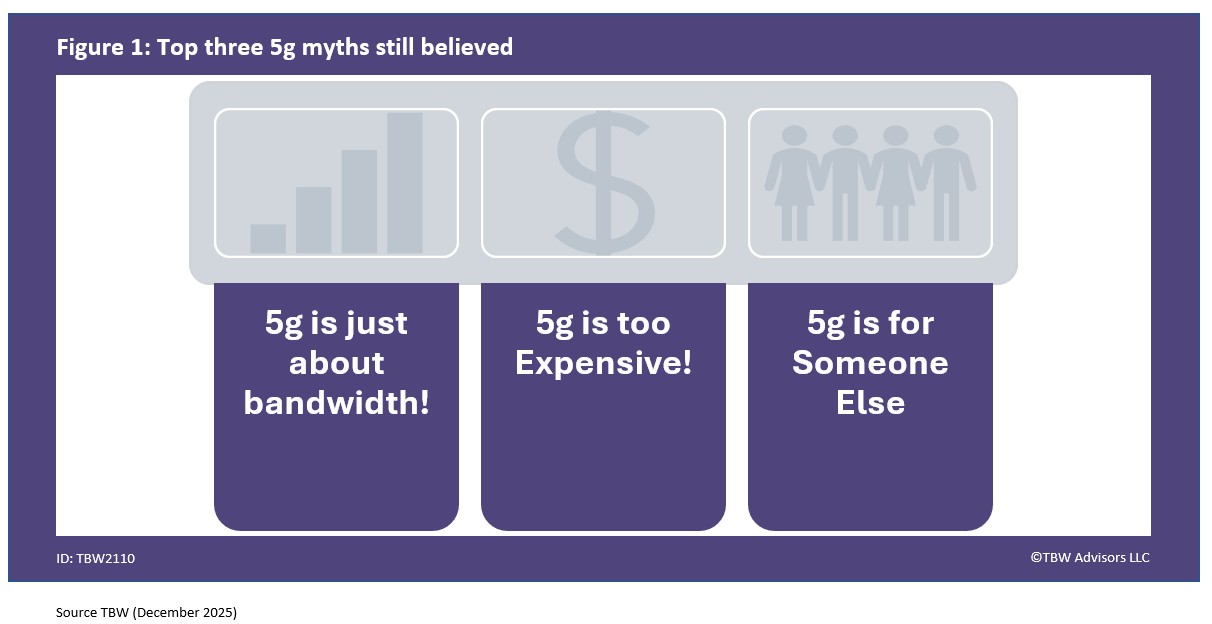
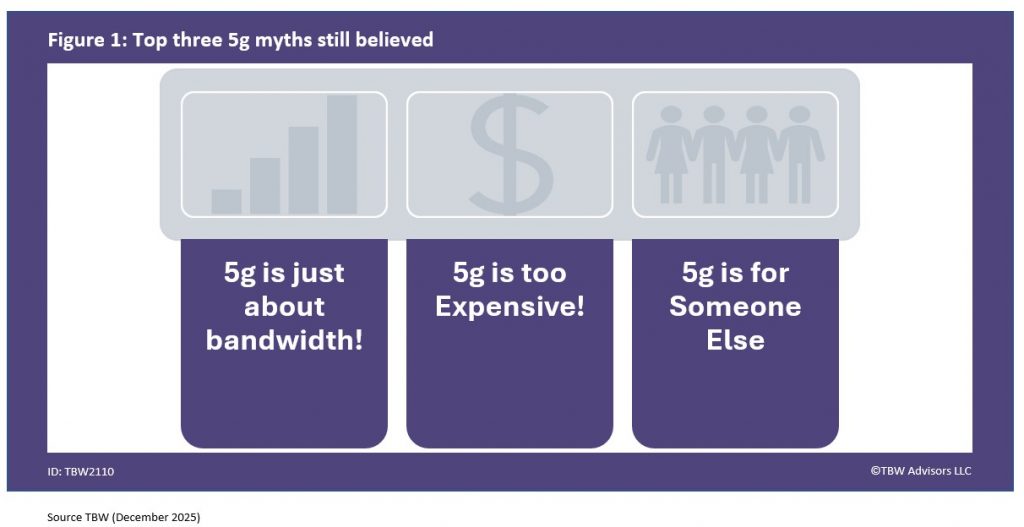
We took the most frequently asked and most urgent technology questions straight to the mobility and wireless experts gathering at the MWC Las Vegas held at the Fontainebleau. This Whisper Report addresses the question regarding the biggest 5G myth tech leaders still believe as depicted in Figure 1.
Our first myth comes from GetWireless’ Kalpit Kadia, “5G is more like a throughput requirement than future proofing.” If you believe the only thing 5g brings to the table is bandwidth you are missing it. Kalpit continued. “So it’s not all about through requirement. It’s you know also to do with future proofing your product because as network infrastructure is changing by different carriers, it’s a good idea to move to a 5g stack technology which is going to be here around here for a long time.” Remember when you enable 5g in our organization you empowered it with more than just bandwidth, you enabled all the capabilities that come with 5g beyond the bandwidth.
The next myth is a critical one particular for those building out wireless infrastructure in public spaces. Baicells’ Minchul Ho argued that the biggest myth is, “the cost or differentiation from Wi-Fi.” Minchul elaborated further. “There’s a huge upside to 5G that you cannot get with any other wireless technologies at about the same price if not half the cost of what traditional wireless system would take.” If you are working on your business justification for 5g expansion in your organization, be sure to schedule an inquiry with your analyst at TBW Advisors LLC. We can review not only your strategy and roadmap, but help ensure the major use cases in your organization have been captured to ensure maximum business impact.
Perhaps the biggest myth of all is brought to us by Canoga Perkins’ Siddharth Khattar. “That private 5G is still seen by many as a telecom only technology. Something that is hard to roll out, something that is hard to administer across your enterprise networks and comes with enterprise environments and therefore comes with a lot of expense and it’s always a technology for somebody else.” The reality is 5g is enterprise ready and is not just for telecoms for tech giants. Even more important is the easy of deployment and management as Siddharth explains further. “What we are doing the truth is that today’s private 5G networks can be administered and managed much more like IT and enterprise that people that CIOS and organizations are used to doing. Be able to administer and manage that as easily as you would a as easily as you would your traditional IT networks today with so much more functionality than what they deliver today.”
In conclusion, 5g is about so much more than the bandwidth, is cost effective, and is ready today for you to deploy in your organization.
oin us for “AI in Medicine: Promise or Peril?”—a candid discussion with leading experts on how artificial intelligence is reshaping healthcare. From groundbreaking diagnostic tools to ethical dilemmas and patient safety concerns, we’ll explore whether AI is the ultimate game-changer or a ticking time bomb. Gain insights into what’s real, what’s hype, and what’s next for medical innovation. Don’t miss this chance to separate fact from fiction and prepare for the future of healthcare.
Research Code: TBW2129
Cannot make it live? Register and submit your question. The answer will be in the video on TBW Advisors’ YouTube Channel.
NO AI note takers allowed. Event copyrighted by TBW Advisors LLC All Rights Reserved.
BIOS
Doreen Galli, PhD MBA
Doreen Galli, PhD MBA is the Chief of Research at TBW Advisors LLC and regular contributor to Computer Talk Radio. She’s led significant and measurable changes as an executive at IBM, DPWN, Dell, ATT, and most recently Microsoft. Dr Galli was Chief Technology and Chief Privacy Officer in Azure’s MCIGET. Gartner recognized Dr. Galli as an expert in data ingestion, quality, governance, integration, management, and all forms and analytics including sensor data.
Barry P. Chaiken, MD, MPH
Barry P. Chaiken, MD, MPH is a physician, public health specialist, and internationally recognized expert in healthcare AI, clinical informatics, and digital transformation. Trained at SUNY Downstate Medical Center and the Harvard School of Public Health, Dr. Chaiken previously worked with the U.S. Centers for Disease Control and Prevention, experience that informs his expertise in public health analytics, system-level strategy, and the design of resilient, data-driven healthcare systems.
A former Chairperson of the Healthcare Information and Management Systems Society (HIMSS), he has served as a strategic advisor to healthcare IT companies, life sciences organizations, and health systems worldwide. Dr. Chaiken is the author of Future Healthcare 2050 and Navigating the Code, and is a leading keynote speaker on AI, trust, clinician workflow, and patient experience.
A two-time cancer survivor and 41-year rider in the Pan-Mass Challenge, Dr. Chaiken brings a unique perspective that connects clinical knowledge, policy insight, and human experience.
Susie Branagan BSN,RN
Susie Branagan is a highly experienced nurse and healthcare leader whose career spans 25 years of ICU, pediatric psychiatry, adult medical-surgical care, telemetry, perioperative services, and hospital leadership. She has served in roles from frontline clinician to Nurse Manager, gaining a deep understanding of patient care, caregiver well-being, and the operational realities that shape healthcare systems.
As the founder of Susie Branagan Consulting, Susie specializes in trauma-informed care, Just Culture principles, leadership development, communication strategies, and building safe, supportive care environments. She helps teams strengthen accountability, improve psychological safety, and respond to challenging situations with clarity, compassion, and evidence-based practice.
What sets Susie apart is that everything she teaches comes directly from real-life experience, not from textbooks or theory. Her coaching, trainings, and leadership support are grounded in decades of navigating complex cases, supporting distressed families, advocating for staff, and leading teams through high-pressure clinical moments.
Susie’s mission is to transform healthcare culture by empowering leaders and caregivers with practical, human-centered tools that create safer, stronger, more resilient organizations.
Chris Hutchins
Chris Hutchins is the Founder & CEO of Hutchins Data Strategy, a consultancy that helps healthcare organizations unlock the value of data, AI, and analytics with clarity, ethics, and measurable impact. A nationally recognized voice in healthcare transformation, Chris previously served as SVP and Chief Data & Analytics Officer at LifePoint Health, and prior to that, as Chief Data & Analytics Officer at Northwell Health, New York’s largest integrated delivery network.
Over the past two decades, Chris has led enterprise-wide initiatives in self-service analytics, ambient AI, digital governance, and workforce enablement, always with a sharp focus on care equity, operational sustainability, and trust. His leadership is grounded in building practical, inclusive strategies that bring technologists, clinicians, and operators into shared alignment.
Chris is also the creator and host of The Signal Room, a podcast platform amplifying leadership, ethics, and innovation in health. He is a frequent contributor to CDO Magazine, HIMSS, and other national forums, where he advocates for AI adoption that augments human care, not replaces it.
Chris holds a deep belief that every data strategy is ultimately a human strategy, and that transformation only succeeds when it is designed with care at the center.
*When vendors’ names are shared as examples in this document, it is to provide a concrete example of what was on display at the conference, not an evaluation or recommendation. Evaluation and recommendation of these vendors are beyond the scope of this specific research document. Other example products in the same category may have also been on display.
Published to clients: November 28, 2025 ID: TBW2098
Published to Readers: December 1, 2025
Public Release Date: April 13, 2026
Analyst(s): Dr. Doreen Galli
Photojournalist(s): Dr. Doreen Galli
Abstract
This Whisper Report reveals nine overlooked AI risks in HR—from loss of human connection and identity challenges to compliance, data quality, and black-box concerns. Insights from HRTech2025 experts stress the need for ethical design, integrated systems, and AI literacy to safeguard trust and organizational resilience.
Target Audience Titles:
Chief Human Resources Officer (CHRO), Chief People Officer (CPO), Chief Technology Officer (CTO), Chief Information Officer (CIO), Chief Data & Analytics Officer (CDAO)
VP of HR Technology, VP of Talent Management, Director of HRIS (Human Resource Information Systems), Director of Data Privacy & Compliance
HR Technology Manager, HRIS Analyst, Data Scientist (HR Analytics), AI Ethics Specialist
Key Takeaways
Keep humans in HR: Overreliance on AI erodes trust and relationships—HR must preserve human touchpoints for employee engagement.
Protect identity and ethics: AI adoption impacts employee identity; embed responsible AI design and ethical standards from the start.
Secure and integrate systems: Data security lapses and fragmented AI tools increase risk—prioritize compliance and cohesive integration.
Invest in AI literacy: Lack of training leads to misuse; HR teams need prompt engineering and clear goals for effective AI use.
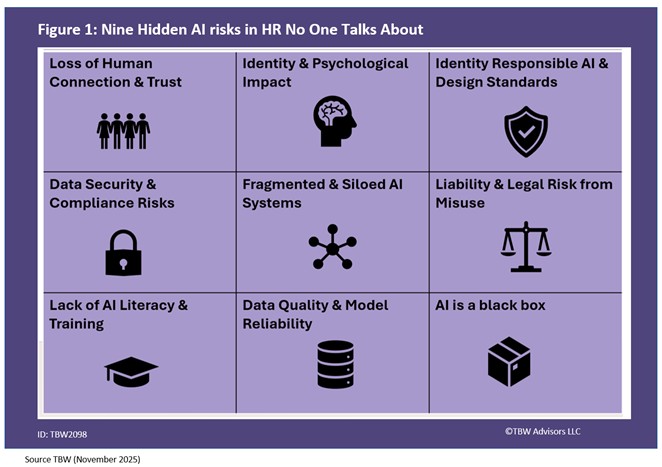
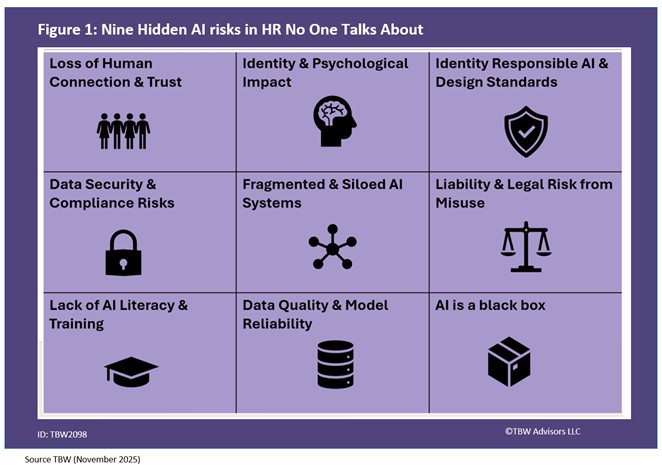
We took the most frequently asked and most urgent technology questions straight to the human resource technology professionals gathering at HRTECH2025 held in Las Vegas. This Whisper Report addresses the question regarding the biggest AI risk in HR no one talks about? Figure 1 displays the nine risks we will now discuss.
Figure 1. Nine Hidden AI risks in HR No One Talks About
Human resources is all about managing the employees of an organization. It is one of the most critical relationships an organization has. Fountain’s Bastian Botella raises one very concerning risk. “It’s the loss of trust between employees and the company. AI is all over right anywhere from the hiring phase down to retention communication tools everywhere. Okay. At some point and I think it’s going to be sooner rather than later all employees will figure out that the human has been removed from all processes. Removed from interviews, removed from communication, removed from any touch points that they have with their employer.” BambooHR’s Paul Swenson is on the same page. “I see in HR is the over reliance on AI. HR is all about people, right? Like interacting with people and AI can sometimes pull you away from that. So HR needs to stay close to the people. Build relationships with the people that they work with in their companies. But sometimes I think an over reliance on AI can lead to people not doing as much of that which is really the bread and butter of what HR is good at and what they excel at. Right? So as we use AI we need to make sure that we’re you know remaining consistent with our relationships with the people at our companies and providing great employee experiences for our people.” In other words, let’s keeps the humans in humans resource management!
HRTech2025’s opening keynote speaker, FranklinCovey Leadership’s Patrick Leddin observed, “a lot of people in the organization find a lot of value in the work they’re doing. It isn’t just about replacing a task and giving somebody a new task or saying this is going to be something that generative AI is going to do and you you’ll be able to do more analysis. It’s recognizing that people’s sense of self is often times connected to their work and if you take that away from them, how are you going to help them find their new identity?” Given that one of the first questions a stranger asks outside of your name is your profession, it is easy to understand how one’s profession is tied to one’s identity. What is a software engineer who no longer writes code but monitors the AI writing code?
Our next risk came from Eightfold AI’s Michael Dunne. “Great concern that should be attention given to is responsible AI by design.” Many of the critical aspects of a solution need to be thought of from the very beginning. TBW Advisors LLC repeatedly reminds one that security, privacy, and accessibility cannot be an afterthought. Ethical AI is right in the center and a critical part of the predesign work. Michael continued, “You having this bloom of hype around AI and the possibilities. There’s a lot of excitement but one is always take into account then how was this system built from the start and so what I like to say is people should look at their providers and see has this been done by design which means have they done understandings about managing the data what’s called feature sets and how it goes in for recommendations also understand whether the right certifications have been done around data privacy data residency and controls around the use of AI. One is for developing applications being consumers of applications and the use of that data. And you’ll see that now with a number of standards that have come out a lot of people pay attention about the EU AI act. There’s also ISO 420001.” Thus the organization’s ethical stance on how to use the data and AI should be defined in conjunction with your security and privacy policies.
With AI comes a lot of data and information. Darwinbox’s Eli Kameron warns that, “people are sending their data all over the place without even thinking about security. This was a problem already with APIs and it is going to explode with agentic AI particularly folks using MCP protocol servers. So a lot of folks are not thinking about the risks and the compliance risks that they are exposing themselves to when they send data everywhere.” Just because it will take your data, doesn’t mean you should be sharing it with the application. Even lower tiered paid models do not provide the privacy expected by many enterprises.
Risk number five comes to us from Benifex’s Joe Sears. “All these different AI agents out there with different functionality. But each of these companies has their own thing that they’re doing and we need to keep that message joined up and all of the different AI needs to talk to one another. If we can integrate our AI capabilities with the wider AI capabilities that are going on, then that’s going to be that best experience for the employee.” In other words, much like what we saw with commercial UAV’s in the enterprise, AI systems are popping up by function within organizations. Enterprises should take a cohesive desired solutions approach to achieve the best ROI with their AI investments. If AI and your data is becoming siloed in your organization, be sure to schedule your inquiry with your TBW Advisors LLC’s analyst. We can provide you guidance based on first hand experience that is sure to make the difference even is the work is outsourced.
One concerning risk was highlighted by Paychex’s Nathan Shapiro. “Over reliance on AI and even furthermore folks outside HR trying to practice because lacking the expertise can lead to dangerous things. The democratization of AI and the proliferation is fantastic and is going to really change the way we work. But lacking that expertise can run you into some significant challenges and liability. Just think about asking AI for guidance on a termination scenario with an employee and lacking the expertise to know that their age is really critical for discrimination law. What jurisdiction is going to rule on that and the liability it could create?” As long as worker’s have rights and the AI isn’t training on the complexities and nuances of those rights, it may be best to keep seasoned professionals as the humans in the loop!
A tool is only useful if it is used and used properly. As Attensi’s Joanna Akar denoted, a huge risk in, “AI is actually not having the knowledge on how to use it. If you don’t know how to prompt engineer or use AI or Gen AI or whatever type of AI you’re using within your day-to-day. If we fall
you risk not being able to follow the trend, not being able to be more efficient within the learning environment. So, it’s super important that HR people are trained in how to prompt AI or prompt engineering to make sure that they’re utilizing it in the best way possible to get the most return on investment that they can get out of their people.” Lollipop’s Jonathan Ferrell shared very similar concerns. “Lack of understanding on what AI is and what it isn’t. I think a lot of people recognize how quickly it’s able to solve immediate tasks and maybe make it feel like it’s a more complex task, but what really matters is what you’re trying to accomplish. And if you don’t know upfront what you’re trying to accomplish, you could really go in the wrong direction.” Thus to minimize this risk, start with the problem and learn how to communicate with the specific AI you are using for best results!
One Model’s Phil Schrader reports our next risk. “Data quality. The AI is going to be able to answer questions in new ways for organizations. But if you don’t have a quality data model to feed into it or quality reliable tools for it to use, it is going to generate noise, it is going to generate nonsense that actually moves you backward.” Or as previously highlighted in Whisper Report: What are the biggest challenges of Using Gen AI in Logistics?, you put garbage data in you get garbage out. Without quality data, it is not possible to get reliable answers.
The final risk should come as no surprise from anyone but is always important to remember. Aptia USA’s Jeff Williams reminds all, “AI is a black box the way it’s permeating everything we do on an everyday basis. And think about how little each of us really understand about what AI is, how it’s generating the answers it’s generating, and the advice it’s dispensing, and the actions that are being taken as a result. I think the fact that we are lumping AI together for things as simple as a chatbot and things as complex as fully generative large language models. I think kind of lumping all that together, calling it AI and expecting to solve all of our problems without really knowing what’s feeding it underneath, I think is a big un-discussed risk that we really need to address.” Clients will recall a similar warning arrived in Whisper Report: What’s the biggest Cybersecurity Myth in 2025? One of the biggest requirements to shine the light on the black boxes are logs. Let’s make 2026 the year all AI systems are required to provide immutable logs.
Published to clients: November 20, 2025 ID: TBW2107
Published to Readers: November 21, 2025
Whisper Email Release:
Public Release Date:
Analyst(s): Dr. Doreen Galli
Photojournalist(s): Dr. Doreen Galli
Abstract:
“This Whisper Report explores the most desired casino innovations identified at G2E 2025. Industry experts highlighted two key areas: operational improvements for casinos—such as seamless system integration and cross-platform play—and enhanced player experiences through biometric authentication, personalized VIP services, and engagement strategies. These insights reveal opportunities for transformation and differentiation in gaming technology.”
Target Audience Titles:
Chief Information Officer (CIO), Chief Operations Officer (COO), Vice President of Gaming Technology
Chief Data Officer, Chief Technology Officer, VP of Gaming Technology, Director of Gaming Technology, Chief AI Officer
Casino Systems Engineer, Gaming Platform Developer, Security & Compliance Analyst
Key Takeaways
Casino operators want seamless integration across systems, from cage operations to ERP, eliminating manual QA and enabling true plug-and-play functionality.
Cross-platform gaming—switching between land-based and online play without disruption—is a top innovation priority for industry leaders.
Biometric authentication is seen as critical for secure, personalized player experiences and streamlined identity verification.
Personalized VIP experiences for mid-tier players, including concierge-style services, could transform engagement and loyalty in casinos.
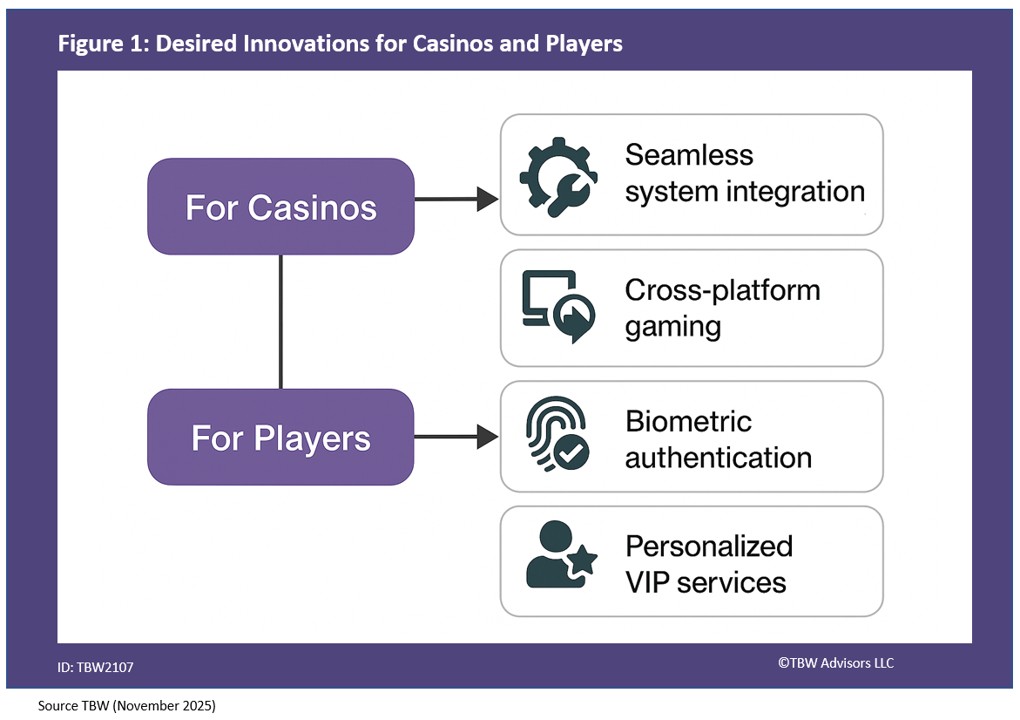
We took the most frequently asked and most urgent technology questions straight to the operation engineers and technology professionals gathering at the Global Gaming Expo held in Las Vegas better known as G2E 2025. This Whisper Report addresses the question regarding one casino innovation you wish existed today? The innovations are divided into two categories. First those focused on the casino itself and second those focused on the player experiences as depicted in Figure 1.
The first group of desired technology applies to the casinos themselves. CCT’s Wanor Franca’s focus is on the money trail. “It’s the ability to track your cage operations all the way through a revenue audit into your ERP. No solution is connecting all the data sources.” This integration issue is a common issue as Druvstar’s Melissa Aarskaug highlighted, “One innovation I wish the industry had was simple integration. Everything was plug and play and as soon as it was in implemented, it just worked. We didn’t have to do any QA testing. It just plugs and plays.” Diving in further, Incisor’s Aaron Jones highlighted, “seamless play between playing a land-based game and being able to play that game online.” Sounds like the entire industry could use a significant transformation and standardization. TBW Advisors LLC provides significant first-hand experience on digital transformation so be sure to schedule your inquiries if those integrations are bogging you down.
Attendees at G2E also had ideas of much wanted technology innovations that directly affect players. For one, Seon’s Matt DeLauro believes, “A casino innovation that I wish existed today would be more biometric authentication for players.” Additional research concerning biometric identification and authentication can be located in our coverage of ISC West and Identiverse.
Once the casino knows who the player is through advanced biometric authentication, Relay’s Chris Chuang believes more players could feel special. “I feel like uh there was a way that casinos could use technology to really bring the VIP experience to every gamer, right? People want to come to Vegas and feel like a VIP. Of course, they have that for the high rollers, but how do you personalize a VIP experience for the pre high rollers who are not quite there but maybe on their way.” But what exactly would that look like? Chris continues, “I think that that would involve different ways to welcome guests to make the check-in experiences more lux and personal. Maybe a personal concierge.” A personal concierge. Looks like Continent 8 Technologies’ Justin Cosnett was on the same page. “Making sure that players don’t have a bad experience. Yes, they’re going to lose money over the longtime lifetime, but the worst thing you could possibly see is players who will come, they’ll try a game for the first time or try a website for the first time, and if their experience is all loss very quickly over a short period of time. The thing that needs to really happen is people’s back offices making sure that players can actually enjoy themselves over a longer period of time rather than being short sharp .” Of course if you are going to dream of the idea casino innovation Plotline’s Erik Regan said what we are all truly thinking. “What’s one casino innovation you wish existed today? Unlimited free play!” That’s right unlimited free play – if you are going to dream – why not dream big!
Published to clients: November 10, 2025ID: TBW2125
Published to readers: November 11, 2025 am
Published to Email Whispers: November 11, 2025 pm
Public with video edition: November 12, 2025
Analyst(s): Dr. Doreen Galli
Photojournalist(s): Dr. Doreen Galli
ABSTRACT
AAPEX and SEMA brought together over 161,000 from the Automotive sector to Las Vegas for live presentations, interactive demos, training, education, and networking. TBW Advisors LLC captured over 140 minutes across 61 segments including two live streams and 2 miles of walkabouts across the various exhibit halls and lots. Leveraging over 1.2 million net square feet of exhibit space and additional 1 million square feet outside of the LVCC in neighboring areas including the Westgate, the event concludes with a public event, SEMA Fest.
AAPEX and SEMA (Specialty Equipment Market Association Show) Consistently attract over 161,000 to Las Vegas including over 70,000 buyers and 3300 media and 2400 exhibiting countries form 140 countries.
The event leverages 1.2 million net square feet of exhibit space and additional 1 million square feet outside of the LVCC in neighbouring areas including the Westgate.
Cautions
Friendly reminder: this research provides examples of what was shared with us at the event, not an evaluation, validation, or recommendation of the given technology.
After almost 30,000 steps, including some 500 minutes of standing, 2 Vegas loop rides, 61 video segments including 2 live streams and 140 minutes of content, our coverage of AAPEX (Automotive Aftermarket Products Expo) and SEMA (Specialty Equipment Market Association Show) closes. AAPEX and SEMA consistently attract over 161,000 to Las Vegas including over 70,000 buyers and 3300 media and 2400 exhibiting countries form 140 countries. The event leverages 1.2 million net square feet of exhibit space and additional 1 million square feet outside of the LVCC in neighbouring areas including the Westgate.
Featuring over 1500 vehicles in booths and throughout the convention center and over 3,000 new products, it is THE place to be in those in the automotive sector. The combined events feature live presentations, interactive demos, training, education, and networking within the global automotive industry. That means the event featured a lot of virtual garage space.
AAPEX leveraged the full Venetian Expo lower hall, the entire upper hall including leveraging rooms for meetings and sessions. The usual Venetian eateries were available including the café, the food marketplace and the bistro! In addition, AAPEX always features the Truck Stop downstairs and a Beer Garden near the bridge to Caesars Forum. Admittedly, it is the only time I noticed the movable temporary eateries named something reflecting the nature of the conference. AAPEX also formally leverages all of Caesars Forum for exhibits.
For getting around, those wishing to zip from AAPEX over to SEMA, Caesars Forum has a Monorail station one can leverage. Buses also ran between all AAPEX and SEMA locations. Within SEMA, the West Hall and North Hall are connected via a connecting corridor that hosted the legendary SEMA Art Walk. One can also take the Vegas Loop from South Hall, Central, or West Halls to get to each other or hotels connected.
SEMA spanned the entirety of the Las Vegas Convention Center sans the new Central Hall lobby still under construction; TBW Advisors LLC was able to get a sneak speak of its upcoming grandeur. It is valuable to note that many vendors had multiple booths at both events. While in 2019 the event wasn’t sure what a technologist and data expert would do at AAPEX and SEMA, this year, just as last year featured more and more technology for us to dig into especially in North Hall. North Hall was dedicated to first-time exhibitors, business services and mobile electronics and technology. We were able to capture the Healthy eatery in North Hall while we were there. South Hall lower featured the tire expo as well as wheels and accessories. South Hall upper featured collision repair and refinishing both equipment and tools to execute. Central Hall featured racing, performance, powersports, utility vehicles, hot rod alley and the entire restoration marketplace. West Hall features all the speciality recreating, trucks, SUVs, & off-roads speciality equipment including accessories. As is customary, we also caught the food available in West Hall. SEMA is also very well known for the SEMA SHOW outdoor exhibition of cars – enjoy our walkabout.
We once again live streamed from on site. On Tuesday from AAPEX requesting those attending to find me to answer Questions 1-3, and Wednesday from SEMA SHOW to requesting assistance on your favorite videos for my segment on the November 8 broadcast edition of Computer Talk Radio.
While at AAPEX SEMA 2025, we conducted research for three additional forthcoming Whisper Reports for our clients. The playlists are unlisted but available and will eventually fill in with the video version of the report so you may wish to bookmark these playlists.
Readers and viewers wishing to experience the entire event are encouraged to view the Conference Whispers: AAPEX SEMA Playlist in its entirety. The playlist will be cited in the end screen, description, and as a pinned comment of the video edition.
The video edition will conclude with a montage of responses to Question 4 — “What’s the best part about attending AAPEX and SEMA live in Vegas?” — capturing the energy and moments that made the event unforgettable.
Touring the exhibits we captured, we will start with the technology to help auto shop owners be found online in the first place, AutoShop Solutions. Need to get your technicians certified? AVTECC is not just talking about certifications, they to help ensure your team has the right qualifications to meet your customer’s needs. Hunter Engineering was on hand with their portfolio of solution. Their focus is making life easier for technicians, more profitable for owners leading to happier end customers to get the word out. Boasting over 50,000 customers world-wide in 35 countries, klipboard provides solutions form point of sale through inventory management, e-commerce, and catalogue including all data for tire and service companies. If you are seeking diagnostics for anything from automotive, heavy-duty truck, all highway equipment, marine and powersport you are in luck! TEXA revealed their 5 in 1 diagnostics solution including demonstrations in their Bay at Joe’s Garage. If the challenge in your shop is diagnosing and calibrating ADAS (advanced driver assistance systems) equipped vehicles, Opus IVS wants their intelligent vehicle support solution on your radar. Opus IVS is literally an entire ecosystem for the automotive aftermarket for diagnosing and calibrating ADAS equipped vehicles.
Instead of going to an Autoshop, perhaps you dream of an auto shop coming to you? Perhaps even insisting they bring OEM equipment? Then Elitek is making your dreams come true! If it isn’t necessarily about repair but a complete rebuild? Even rebuilding heavy trucks? Then LKQ has a solution to fit your needs. They can even help create parts no longer available. Have a big truck and want to avoid accidents or more specifically remove your blind spots? Voxx was very excited to share their revolutionary aftermarket product with you. Perhaps it is not so much about blind spots but recording what is going on around your vehicle? Worried about the solution failing over putting a huge drain on your batter? Having a hard time finding one with decent resolution? Or better yet one with both built in privacy so you can share your videos on line and technology to clean up plates images for accountability? One of the stars from our CES coverage, Vueroid, was back at SEMA with their high-res, never fail dashcam.
Perhaps one is seeking a fast car? Turntide was in Central Hall with their Axial Flux Motor in an All-Electric Sierra Echo-S able to reach a top speed of 140 miles an hour. Electric vehicles on your mind but are more concerned with replacing your EV battery on your car in your garage? Greentec has 35 locations across the US and include recycling capabilities. More of a traditional ‘no replacement for displacement’ combustion motors fan but find the ECU getting in the way of your performance dreams? AutoTune brought their solution able to assist you with over 21,000 different cars.
Finally as denoted, many technology companies were there to support the general business functions of the business including Lyncco with their global logistics solutions. Lyncco proudly shared they can help you optimize your entire supply chain – globally.
*When vendors’ names are shared as examples in this document, it is to provide a concrete example of what was on display at the conference, not an evaluation or recommendation. Evaluation and recommendation of these vendors are beyond the scope of this specific research document. Other example products in the same category may have also been on display.