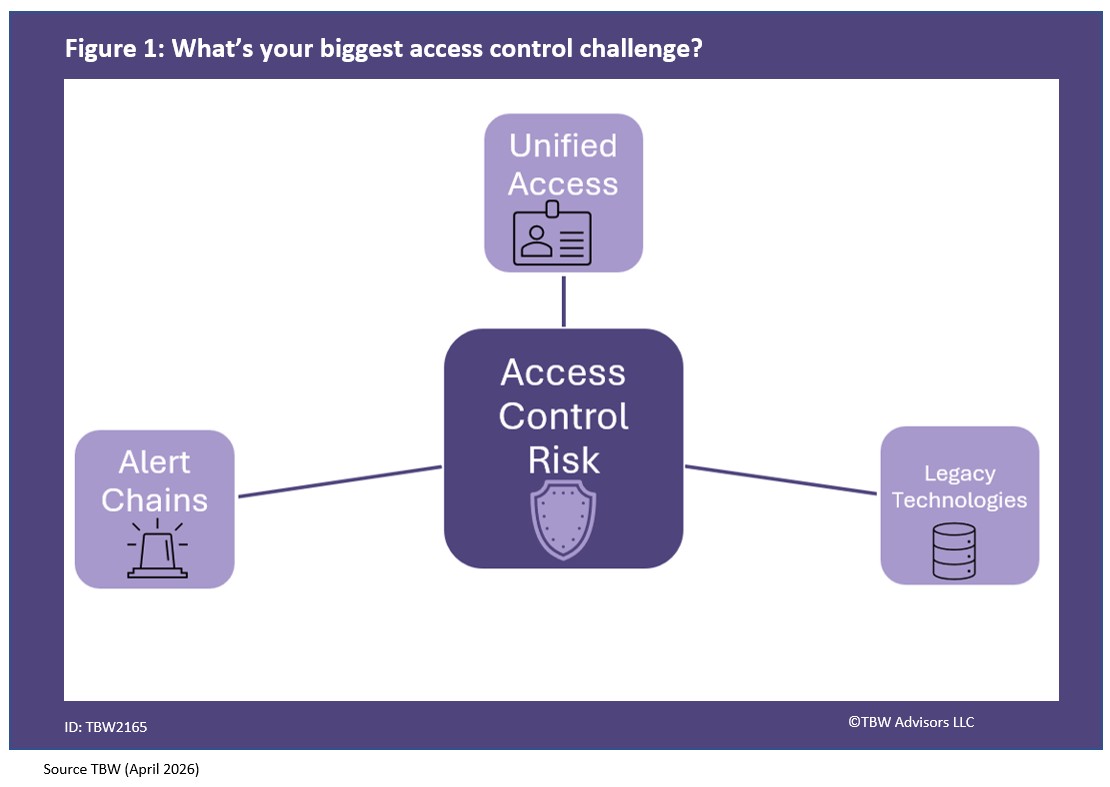
This Whisper Report investigates the question, “What’s your biggest access control challenge?” Researched at ISC West in Las Vegas, the report analyzes challenges driven by fragmented systems, persistent legacy technologies, and incomplete integrations. It finds that access control risk increasingly stems from interoperability gaps and response readiness rather than tool availability alone. Insights are drawn from Ed Hendricks of Keri Systems, Joshua Hartman of Hartman, and Peter Evans of Xtract One.
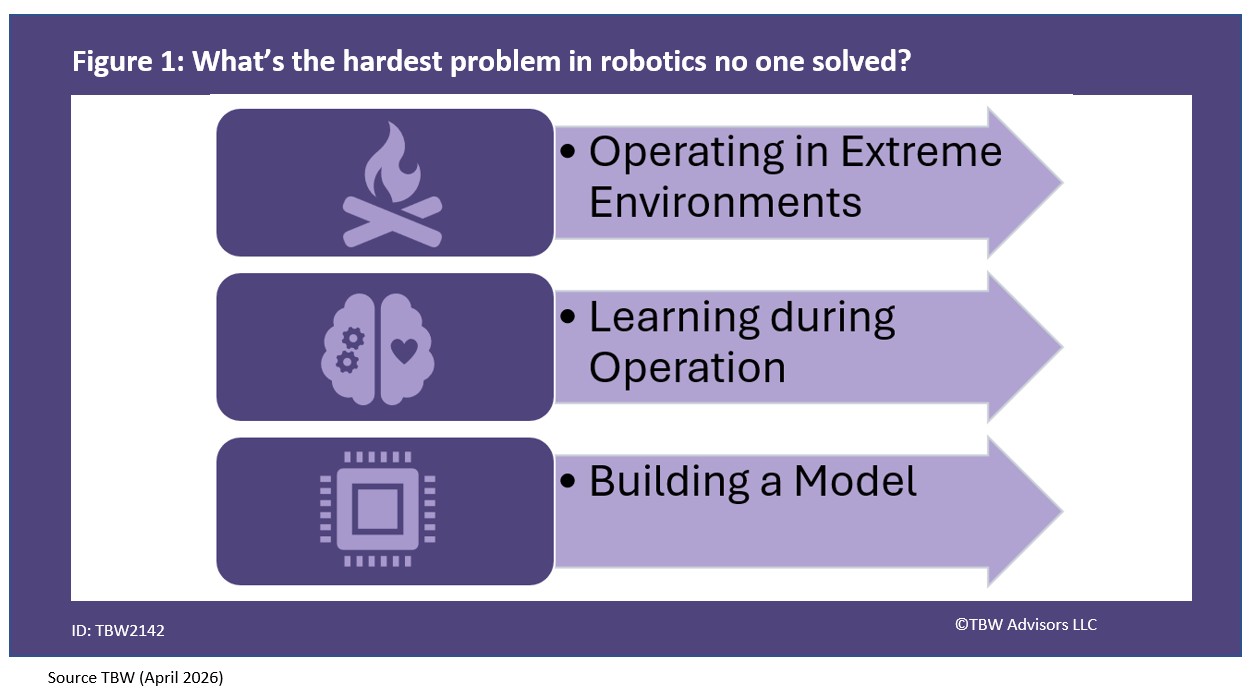
“This Whisper Report investigates what’s the hardest problem in robotics no one solved. It follows the technologists who reveal why extreme environments, continuous learning during operation, and the elusive quest for a universal foundational model still defy today’s best systems. The full story hints at breakthroughs but leaves the biggest twist ahead. Cited experts: Dr. Yuxin Zhang, Widemount Dynamics Tech Limited; Pai-Heng Hsiao, “Memorence “AI; Anson Yuen, Scanbotics.”
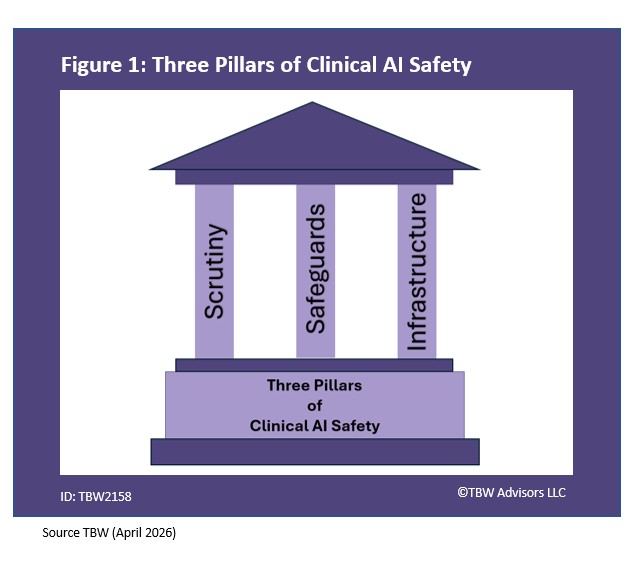
“This Whisper Report investigates when clinical artificial intelligence becomes unsafe, signaling where scrutiny, safeguards, and infrastructure begin slipping across clinical environments. Readers will discover the pivotal checkpoints leaders watch to protect patients, preserve trust, and steer responsible adoption without stalling innovation. Cited experts: Hal Wolf, HIMSS; Scott Francis, Ricoh Document Scanners; Joe Graw, ImageTrend; Braheem Santos, Schneider Electric.”
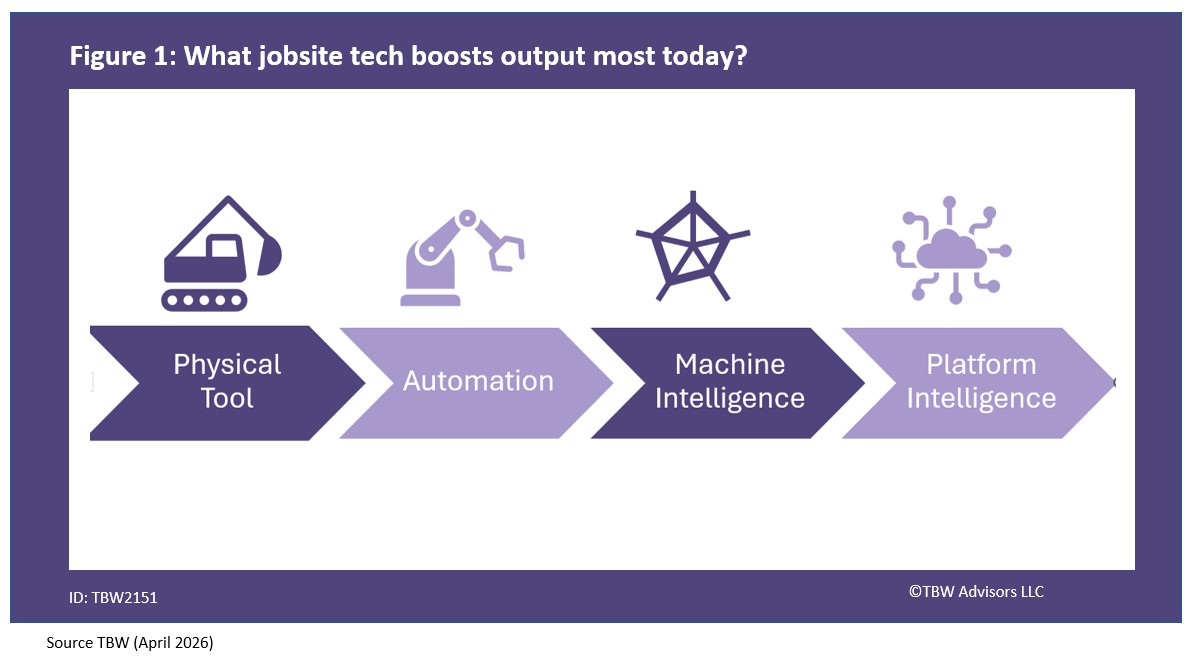
This Whisper Report investigates what jobsite tech boosts output most today? At CONEXPO‑CON/AGG, practitioners surface where productivity truly moves—beyond hype—highlighting overlooked levers shaping cycle time, safety, and uptime this year. Read on for the signals that matter now. Cited experts: Nate Jones (Weir–Esco Division), Christopher Sommer (MOBA Automation), Joel Honeyman (Doosan Bobcat), Nicolas Legrand (John Deere).
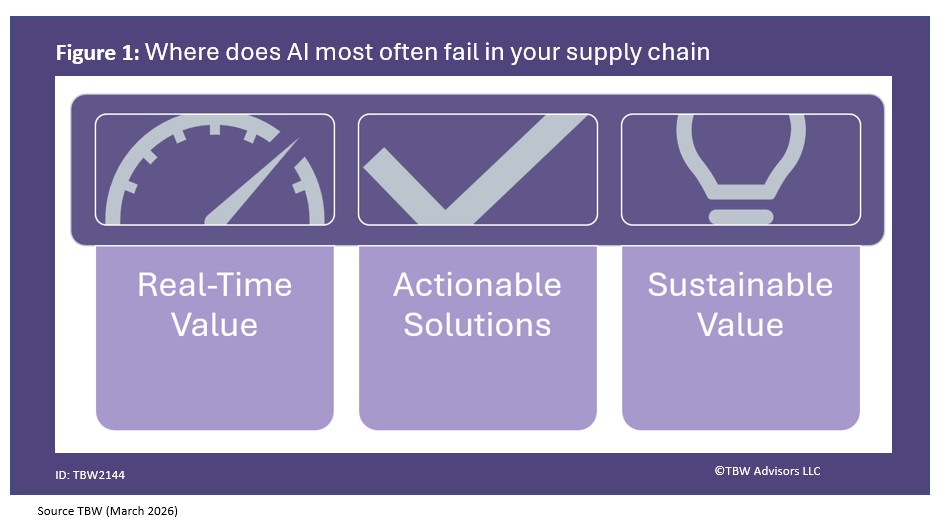
“This Whisper Report investigates where AI most often fails in ones supply chain. It synthesizes expert perspectives gathered at Manifest 2026 on the recurring breakdown points. Areas affected span logistics and operations, including real‑time data limitations, challenges translating analytics into actionable decisions, and the need for measurable business value. The report incorporates insights from Asendia’s Michael Lorentzen, Rufus Lab’s Gabe Grifoni, and Aptean Supply Chain’s Allan Dow.”
“This Whisper Report investigates what mobile tech trend will blindside CIOs next? Researched on‑site at MWC in Las Vegas, it brings together firsthand perspectives from mobility leaders shaping the next wave of disruption. Insights include GetWireless’ Anthony Besett, Comfone’s Randall Peterson, Canoga Perkins’ Siddharth Khattar, and Schneider Electric’s Katie Boeh, each offering a distinct view into the forces set to catch CIOs off‑guard.”
Target Audience Titles:
Chief Technology Officer, Chief Information Officer, Chief Digital Officer, Chief Innovation Officer
Director of Mobility Strategy, Director of Network & Edge Systems, Director of Wireless Architecture, Product Manager Connected Platforms
Mobile Systems Engineer, Edge/IoT Integration Engineer, Wireless Network Engineer, Firmware & Device Engineer
Key Takeaways
Many CIOs will be blindsided by delaying 5G modernization as networks and modules evolve rapidly.
Travel eSIMs will radically simplify international roaming and cut global mobility costs.
Exploding densities of mobile and robotic assets will outpace current enterprise readiness.
IT–OT misalignment on power and infrastructure planning will create critical edge‑computing bottlenecks.
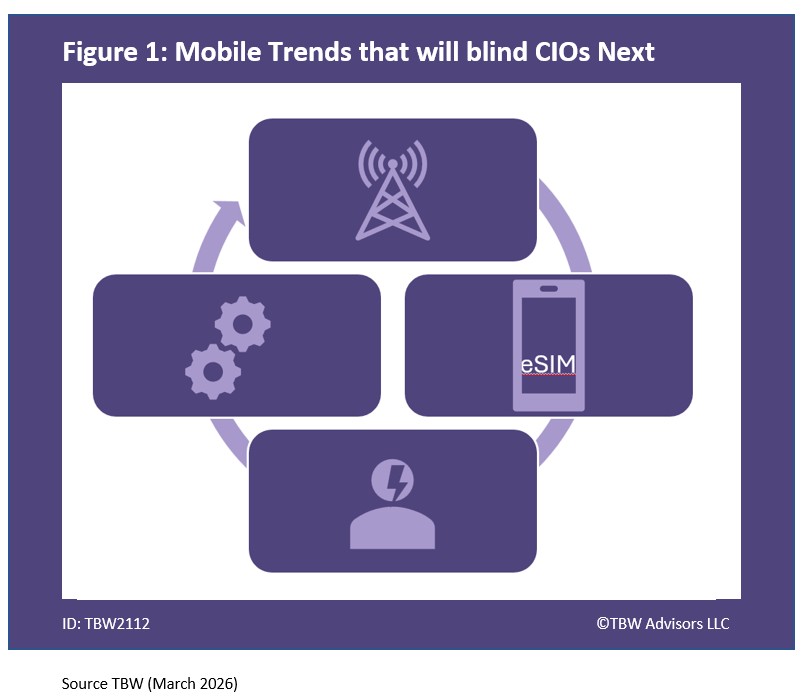
We took the most frequently asked and most urgent technology questions straight to the mobility and wireless experts gathering at the MWC Las Vegas held at the Fontainebleau. This Whisper Report addresses the question regarding what mobile tech trend will blindside CIOs next as depicted in Figure 1.
Figure 1. Mobile trends that will blindside CIOs next
With more than five years since 5g started rolling out it is easy to ignore the trend of moving to 5G yet many organizations are not paying attention to its growing maturity. As GetWireless’ Anthony Besett denoted, “Potentially not moving to 5G soon enough is going to blindside a lot of CIOS, right? Just because, the industry is evolving really fast. The module manufacturers are pumping out new modules all the time, telling SEC are leading that charge. But more than that is the also the carriers. Their networks are changing and they’re rapidly evolving and they’re moving fast. And so not moving our solutions and not moving new designs to that soon enough it’s definitely going to blindside them.” If you have not yet updated our strategies and architectures to accommodate and leverage all 5g has to offer, be sure to schedule your inquiry with your TBW Advisors LLC analyst.
Does your organization have team members regularly traveling international? If so, managing roaming costs is a common fiscal nightmare. Hopefully this positive blindside revealed by Comfone’s Randall Peterson will make your day. “Travel eSIMs in the roaming business. It’s going to change how people roam internationally. Is going to change how people get their service.” Imagine the same rates as if you bought a disposable phone with local access SIM in every location you travelled? Now image that flexibility without the complexity of sending your teams to a store every time they land in a new country due to software and programmable SIMS?
One blind spot heading like a freight train towards many Chief Information and Chief Technology Officers is highlighted by Canoga Perkins’ Siddharth Khattar. “The fact that so many of the assets and so many of our sensors and everything that we want to work with are actually going to be mobile. We talk about robotics so much and I see that you know in other countries in Asia for instance there are you know people are talking about a density of robots of 500 plus for every 10,000 manufacturing workers in China today when we look at those numbers in the US and in Europe we’re so far behind we’re at about 300 plus 350 robots as compared to 500 plus in other areas.”
But the incoming massive density of connected assets is not the only concern. These assets coming in from the information technology (IT) side but also the operations technology (OT) side as we saw during our research on the Commercial UAV Expo. There is one huge problem. As Schneider Electric’s Katie Boeh highlighted, “The IT side doesn’t necessarily talk to the facility side that may manage their data center infrastructure if they have a legacy on premise data center. And what happens is, hey, we’re making this new technological advancement or we’re making this big investment. can you get me x amount of kilowatts of power and it’s going to be in this form factor in this rack. Those conversations need to start happening earlier because most data centers like legacy brown what we call brownfield data centers don’t have the capacity or maybe even the architecture and power distribution and cooling architecture to support a very high density powered load that’s associated with an AI solution especially like a training solution.”
IT not knowing about OT’s incoming data storage requirements and OT not knowing about IT’s power requirements. OT and IT not communicating is unfortunately a very common trend across all interfaces and integration points between the two parts of an organization. But this problem is magnified in the world of mobility. Katie explained further. “There are analysts in our industry that talk about how by 2030, 50% of the power consumption could be at the edge. What we call the edge as in not in the mega data centers. So think about that, right? How huge we know that these data centers are and how much power they consume and it’s in the news. You hear about it all of a sudden. People who have nothing to do with the data center industry know about these giant data centers. But what they might not realize is that even with all of that that is known, there’s going to be just as much power being consumed at the edge across lots of different devices. So I think that’s something that CIOS need to be prepared for when they’re thinking about their strategy. Is it hybrid? Is it all in the cloud? Is it some combination? Regardless, you need to understand what the power requirements are going to be and you need to start bringing in your facilities people that are responsible for answering those questions of do we have the capacity? What’s possible? Bring them in soon.”
That’s correct. If you are a tech leader, the power problem is also yours to ensure it is solved. Power engineers, engineers in OT, and the engineers in IT all want the same thing. To delight the company’s customers with a successfully working product and/or service. That takes everyone keeping all in the loop from the beginning.
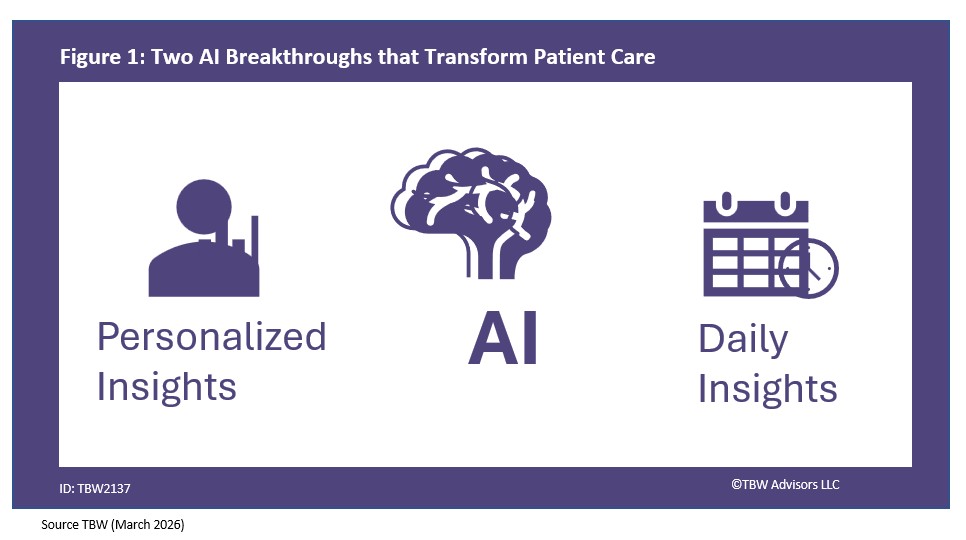
“This Whisper Report investigates what AI breakthrough will transform patient care next. Researched on‑site at CES 2026 in Las Vegas, it explores how AI is reshaping patient care through personalization and continuous insights. The report brings forward perspectives from Dentomi’s Dr. Chun Wang, PointFit’s Kenny Octavius, and Abbott’s Alexander Davies, each emphasizing how individualized measurements and daily health data are transforming how patients understand their conditions and make healthier decisions.”
“This Whisper Report address the question regarding the best practices for integrating AI and ML into our security Systems. It highlights how leaders emphasize protecting PII, using selective data movement, optimizing hardware, choosing the right models, and knowing when AI should not be applied. Insights come from LVT’s Steve Lindsey, Safr’s John Cassise, 360 Privacy’s Trinity Davis, Intel’s Mike Nielsen, RightCrowd’s Jason Bohrer, Bioconnect’s Edsel Shreve, Vaidio’s Marshall Tyler, and Databuoy’s Kathleen Griggs. “
Target Audience Titles:
Chief Technology Officer, Chief Security Officer, Chief Information and Security Officer, Chief Trust Officer, Chief Compliance Officer, Chief Risk Officer
Head of Product, VP of Product, Chief Marking Officer, Data Protection Officer,
Enterprise Architect, Director of Data Protection, Director of Data Governance, Chief Privacy Officer
Key Takeaways
Protect PII rigorously, as regulations vary widely and AI accelerates exposure risks.
Use selective data movement and confidential computing to minimize PII transfer and strengthen security.
Apply the three‑way test: AI must improve speed, accuracy, or cost efficiency to justify deployment.
Choose NDAA‑compliant, learning‑capable hardware to ensure secure and adaptive edge performance.
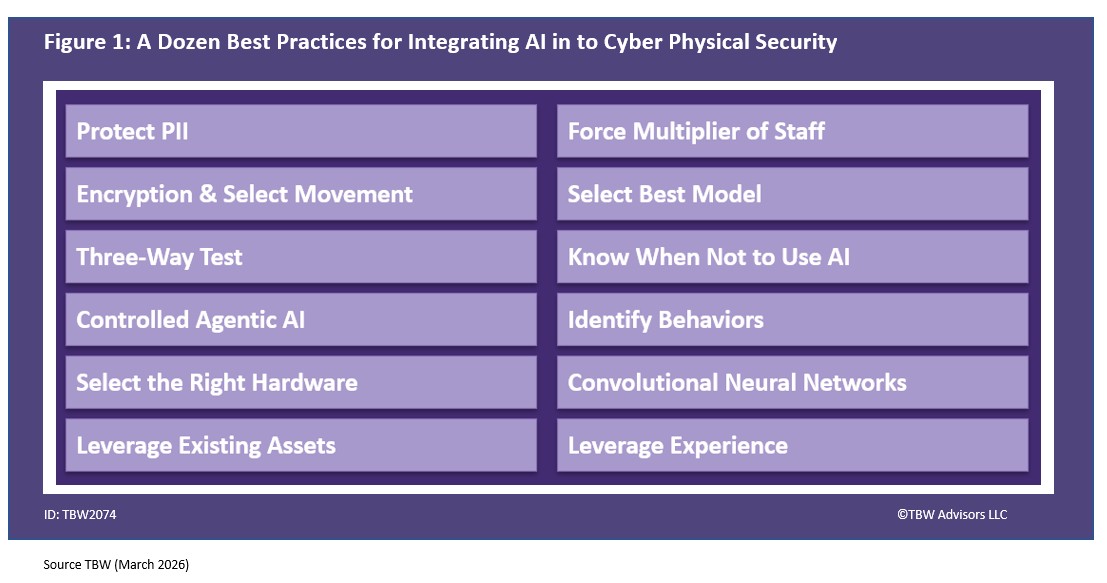
We took the most frequently asked and most urgent technology questions straight to the cyber physical security experts gathering at ISC West 2025. This Whisper Report addresses the question regarding what are the best practices for integrating AI and machine learning into our security systems as depicted in Figure 1. Just in case anyone is not sure that AI has a place in security, LVT’s Steve Lindsey said it best, “physical security and the problems and threats we’re dealing with are just increasing and increasing the problem is our budgets to deal with those are staying the same so the mathematical equation says that we have to do more with less.” It’s a matter of simple math. Since we are dealing with the cyber physical world at ISC West, we will start with cautions specifically regarding PII information (personally identifiable information) and then highlight best practice recommendations.
When it comes to the cyber physical security world and AI, one must keep in mind that some data is PII data. One cannot do anything with AI unless the PII data is protected. As Safr’s John Cassise called out, “we are talking about PII so that means that we’re dealing with people’s personal information and this is a situation that that changes from state to state sometimes even county to county so you need to have a platform that is flexible enough to accommodate.” At the same time, keep in mind as 360 Privacy’s Trinity Davis cautions, “we’re super concerned about AI. AI is actually bit driven by Big Data we’re actually seeing a lot of these language models actually turn up they expedite the process in which somebody can identify your PII.” Thus, the environment for PII is dynamic that varies by location while at the same time is increasingly under attack due to AI.
Safr’s John Cassise was quick to point out that it is about, “how we transmit data? Is it secured? Is it secure at rest in transit but also do I have the flexibility to decide that this particular piece of information isn’t necessary so I don’t need to move that around my system?” To that we would like to remind clients and subscribers, it is possible to do better than only encryption at rest and in transit. Specifically, it is possible to also be secure while computing leveraging confidential computing available in most public clouds. For additional research on confidential computing see, Industry Whispers: Public is Private – Confidential Computing in the Cloud | TBW ADVISORS.
In terms of selecting what data to move, Cassise goes on to further explain, “for instance the human readable face I don’t necessarily need to move for my system to operate so do I choose an a variation that allows me to not move that around but just the biometric signature.” This approach is also supported by Intel RealSense’s Mike Nielsen. “Authentication without distributing PII.. about 512 bytes that’s irreversible back to a human image now I would then go back to that camera it would evaluate me again generate a new template and then we compare those templates so we’re not comparing my face we’re comparing a template generated as 80 points and the relational distances of those points on my face.” While this is part of the standard, we heard about it often during our coverage for Conference Whispers: ISC West 2025 but did not hear about it during our coverage for Conference Whispers: Identiverse 2025. That said, once I inquired if the PII information was transferred to the badge or a hash – all confirmed the solutions kept to the standard.
LVT’s Steve Lindsey got right to the point in terms of how he recommends selecting AI projects. “It has to make things faster, more accurate, and lower cost and if technology isn’t solving one of those three questions, then it’s really not useful to us.” Now those are three business problems most organizations can appreciate. As we have repeatedly advised, AI project must solve business problems – it is not just about using ‘AI’. If you are unsure if your project is a great candidate to solve with current technology, be sure to schedule your inquiry so a TBW Advisors expert can advise you appropriately.
RightCrowd’s Jason Bohrer recommends the ever-growing area of Agentic AI with a bit of caution. “There’s a lot of unique opportunities around how you best adopt some of the agent capabilities associated with AI right. It all has to be controlled and approved through the proper channels to make sure you’re driving efficiency, but it also has the proper approval processes associated with it too and we also have Incorporated that some of that into our platform as well.” Before one can dive into Agentic AI, one’s processes must be optimized and data cleaned. If this challenge is your Mt. Everest, be sure to schedule your inquiries with your analyst. At TBW Advisors we offer a lot of firsthand experience and expertise in process optimization and the creation and optimization of advanced data mesh.
If your hardware can compromise your solution, this is a problem anywhere in IT. In the cyber physical world where the hardware can be located out on remote edges, hardware selection becomes even more critical. As Safr’s John Cassise stated, “number one we need to make sure that we’re using chipsets that are NDAA compliant right because we’re talking about privacy and we can’t be using chips from Chinese manufacturers that potentially are giving vulnerabilities.” But the hardware can do more than just stay compliant and secure. As Bioconnect’s Edsel Shreve declared, “these devices .. are learning devices they have an NPU chip whether you call it API AI or machine learning one of the things these devices do is every single time you use them they’re actually improving the template they’re learning and so over time you just get a stronger and stronger template.”
The best practice in any organization is to leverage existing organizational assets. For example, as Bioconnect’s Edsel Shreve explains, “We see AI tools and machine learning coming into place is taking all of the telemetry and data from these systems right just in terms of just this performance of the system or any issues about how they react on a network if servers or readers are dropping offline.” Leveraging existing organizational data particularly telemetry data, is a great practice for any organization. It is important to ensure the data has quality before looking for patterns or making decisions based on the data.
One great practice when deploying AI within your organization particularly in the space of cyber physical security is ensuring the ROI. Specifically, as LVT’s Steve Lindsey pointed out, “what AI is helping us to be able to do is to start being a force multiplier for our people. And it doesn’t limit itself to just computer vision models being able to detect things. There has to be intelligence that consumes those detections and now can intelligently make a decision on what should I do with this. As intelligence gets smarter it can actually help deter and do things for us before humans get
involved in fact at LVT we find that up to 90% of the time an effective deterrence that is believable will get the person to go away which means that five 5 to 10% of the time we’re dealing with somebody who’s desperate or not lucid and they’re going to do it anyway.” Only bothering human security agents in 10% of the incidents when they are needed? That will enable staff to do more with less.
Selecting the best model for your use case sounds like an obvious best practice but it is more nuanced than one might think. As Viadio’s Marshall Tyler articulated, “technology takes different resources and there are a lot of different models out there you want tried and true model optimization based on your needs for how accurate how quickly and how cost effectively you want to be able to respond to different types of incidents. Technology takes different resources and there are a lot of different models out there. You want tried and true model optimization based on your needs for how accurate how quickly and how cost effectively you want to be able to respond to different types of incidents.” Its about accommodating the entire solution needs and how a given model fits into the solution requirements.
Kathleen Griggs from Databuoy shared a brilliant best practice regarding the use of AI for security. “When it comes to a life safety situation, we’ve designed our system to get it right. To filter it out based on physics and what we know about the signal and that’s where we feel like it’s not the best place to put AI really.” In other words, when the exact precise math of physics can give you an exact answer, why use AI to approximate. This is particularly true in life and death scenarios.
We often advise, it is never about if a specific model meets your needs. AI models will fail. It is about bringing together a collection of models to achieve the solution. It is always about the soluton succeeding. One valuable model to add into a solution is one that can identify behaviors. As Intel’s Mike Nielsen reportedv, “we’re seeing the industry do now is using some of the same techniques to
identify behaviors and objects and “ in the context of physical security to identify bad stuff that could be happening is it actually a gun that’s that there’s a high fidelity way to determine a weapon by looking at a weapon against a database of weapons behaviors like am I reaching for a gun that’s a much lower fidelity thing to do but it still allows Security Professionals to act and respond if a machine detects that somebody may be taking something out of a pocket that they should be doing so those same techniques that we apply to facial Biometrics we are seeing the same techniques being applied in the industry to detect objects detect behaviors and then detect emotions pull those three together and evaluate what action should be taken as a result.”
A true best practice for layering together various models or algorithms is one commonly referred to as CNNs. As Intel’s Mike Nielsen highlighted, “we apply convolutional neural networks which is a classic but Advanced technique of evaluating an image through layers partitioning that to multiple algorithms to determine things like is it a human being face is that face an actual person is it a mask are they wearing glasses are they wearing a hat are they wearing a Covid mask and we use multiple layering technique with CNNs that allows the machine to learn exactly what is on the face is it an actual face and then applying additional techniques to determine whose face it belongs to.”
Last but definitely not least, Vaidio’s Marshall Tyler gave some really sound advice for a must follow best practice. “It’s really important you’re looking at one the pedigree of the company that’s been doing the AI. Is this something they just started are they trying to use fancy new Technologies? Make sure that you’re thinking about how fast you can get answers, how accurate those answers are, how efficiently and cost effectively you can drive those answers.” TBW Advisors LLC has witnessed countless examples of AI projects that wasted millions and months because they didn’t work with someone with extensive true experience. Reduce your risk and increase your success by scheduling your inquiry with your TBW Advisors expert to get the best advise available before charging ahead.
“This Whisper Report investigates how Gen AI will reshape enterprise finance operations. Researched on‑site at Money 20/20 USA 2025 in Las Vegas, it examines how financial operations are evolving under accelerating automation and intelligence. The report highlights perspectives from AutoRek’s Nicholas Botha, Veratad’s Thomas Canfarotta, Globant’s Erin StillWell, Oracle’s James Calise, Zoominfo’s Brandon Tucker, localpayment’s Ezequiel Israel, and IPQS’ Shea Craft.”
Published to clients: February 24, 2026 ID: TBW2115
Published to Whisper Club: February 24, 2026
Analyst(s): Dr. Doreen Galli
Photojournalist(s): Dr. Doreen Galli
Abstract:
“This Whisper Report investigates how will AI change warehouse architecture. Researched at the Retail, Supply Chain and Logistics Expo in Las Vegas, it highlights how AI boosts worker guidance, accelerates operations, improves predictive decisions, and reshapes automation across physical and digital systems. It also stresses fragmented tech stacks and future robot‑centric warehouse design. Quoted: Steve Harris (Warehouse Craft), Priya Katyal (PGS360), Petros Dertsakyan (oloround), Rodrigo Hernandez (Bazarup), Sean Elmurib (Backops AI), Naushad Ahmed (MetaOption), Ingo Pietruska (Lufthansa).”
Chief Technology Officer, Chief Information Officer, Chief Supply Chain Officer, VP of Warehouse Operations, Director of Logistics Strategy, Head of Automation & Robotics
Machine Learning Engineer, Applied Scientist, Robotics Engineer, Computer Vision Engineer, Data Engineer, Data Scientist, AI Solutions Developer, Automation Controls Engineer, Embedded Systems Engineer, Platform Engineer, AI Agent Developer
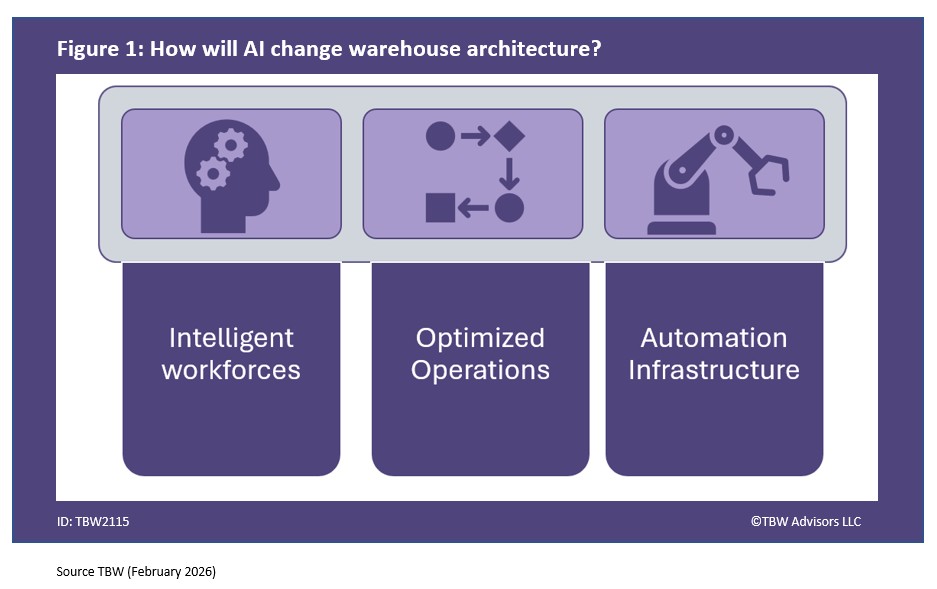
We took the most frequently asked and most urgent technology questions straight to the professionals gathering at the Las Vegas Convention Center for the Retail, Supply Chain, and Logistics Expo. This Whisper Report addresses the question regarding how will AI change warehouse architecture? as depicted in Figure 1.
Figure 1. How will AI change warehouse architecture?
The first change is suggested by Warehoues Craft’s Steve Harris. “It actually will change quite a few of the functions as far as directing employees. It will never replace employees. There’s always going to be a hands-on aspect as aspect to a warehouse. AI though will allow you to use some of those employees. It makes those employees smarter. For instance with our specific software allows them to if they don’t understand a process to ask a pro about a process and get clarification on that. So shortens the process requires them or doesn’t require them to go ask somebody else but takes a maybe a 5 or 10 minute delay and that AI is going to actually shorten that to just the time it takes to get the answer back from AI” Nothing like instant help from an expert while on the job to provide much needed clarity.
Beyond human collaboration, expect AI to show systemic gains. The second change is suggested by PGS360’s Priya Katyal. “The speed of delivery of different solutions, different problems that we have to solve for our customers to help make everything more efficient and fast track the solutions that we provide.” oloround’s Petros Dertsakyan couldn’t agree more. “Help with optimization and better operational flow. Make it lower cost, more efficient, but also there’s a lot of predictive information that Auwill come out of this that can’t be done individually now with the basic models that exist. So you’ll have better ability to like predict do predictive skew modeling uh reorder rates and inventory distribution also decide better on what will sell won’t sell and maybe even beforehand detect where you should have things go and where you should up marketing information for because you know it will sell better there and also seasonality. It’ll give you good seasonality, predictions, and potential future forcasts.”
Beyond collaboration and systemic changes, AI will also cause physical changes to the warehouse that affect the technical architecture as discussed by Bazarup’s Rodrigo Hernandez. “Automatization of processes, right? So AI will not only apply to to warehousing but really every process in terms of substituting with artificial intelligence manual processes that they exist. When we talk about warehousing, it goes even all the way to robots operating what people do today. And that’s not even futuristic. That’s happening today in bigger warehouses. So, at some point, it’s going to make processes more efficient. It’s going to make them cost saving as well. And you’re going to need less and less manual work to do better processes. So, I think that’s the best the best way to describe it.”
But the automation will not be restricted only to the physical warehouse. Backops AI’s Sean Elmurib Suggested. “a lot of parts of the supply chain, a lot of parts of the tech stack are very fragmented. Right? An operator can have four or five different software that they need to go pull data in from. And so what we realized is why not aggregate all that data into a centralized platform and then on top of that run agents against. So that’s kind of where I think uh you know supply chain type is headed and where warehouse automation is headed as well.” MetaOption’s Naushad Ahmed provide a more concrete example. “AI is going to do instead of user making a decision or predetermination user is making especially with the big warehouses where you have a 10,000 mains you have the multiple floors… AI is going to make those recommendations based on all the history and how exactly you are picking guys you are picking the product how the products are moving within the Warehouses.” Yet keep in mind. As Lufthansa’s Ingo Pietruska elaborated at some point in time, “warehouses will be built for robots, not for humans anymore.” For today, that is still a bit into the future.