Published to Whisper Club: July 6, 2026 ID: TBW2191
Analyst(s): Dr. Doreen Galli
Photojournalist(s): Dr. Doreen Galli
ABSTRACT:
“This Whisper Report investigates what data problem slows AI adoption most. Filmed at Informatica World 2026 in Las Vegas, it explores how trust, quality, governance, and data fit shape enterprise AI outcomes. Experts reveal why foundational data issues persist and continue to block progress. Cited experts: Rohit Meheta Accenture, Sourabh Arora Incept Data Solutions, Sumeet Agrawal Informatica, Sauvik Banerjee Cognizant.”
“Informatica World 2026 brought together enterprise visitors focused on data governance, AI readiness, and data management as Las Vegas hosted enterprise data and analytics conversations shaping how organizations prepare trusted data foundations, enable AI agents, and drive business impact through governed, high-quality data pipelines and scalable ecosystem execution across increasingly complex digital environments.”
The Conference
Informatica World brought a community of approximately 2000 data management and governance experts to discuss governance in the age of AI.
Cautions:
Friendly reminder: this research provides examples of what was shared with us at the event, not an evaluation, validation, or recommendation of the given technology.
Just because a technology can do something in general doesn’t mean it will work in your environment or in a governed fashion. It is critical to validate a technology including its false positive and error rates.
If one believes you can put garbage in an AI solution and magically with get Gospel out, AI will greatly disappoint you. In practice, thinking you don’t have to clean up your data before deploying AI doesn’t align with reality. TBW Advisors LLC was able to catch an exclusive interview with Informatica’s Keynote Speaker and VP of Product, Sumeet Agrawal. Specially we asked him what’s the most exciting news he had to share at this event. For those that know data, it was no surprise. It is all about Data Governance and their Informatica’s Cloud Data Governance Catalog (CDGC) and a system of truth. The intent of the CDGC is to enable metadata and catalog information directly to AI agents. Now AI agents can plug into and leverage the data governance solutions already in place.
If we cannot put garbage in, we must first fix that data problem so we are not starting with garbage. DataSwitch wants you to know, data migration doesn’t have to be painful. DS Data Maps focuses on data lineage and traceability. This enables one to have visibility during the migration. They also lean in on data democratization with their engineering agent. This agent is designed to streamline data access through simplifying complex data engineering tasks. Their Newest Innovation is ‘Switchi’. Switchi enables data migration into the Informatica Intelligent Data Management Cloud without Power Center being required.
Bringing their deep data experience based out of Washington DC Incept Data Solutions is an Informatica Platinum Partner. Their core focus is all about data management including governance and data quality. Whether your organization need help with integration, or data governance or AI readiness, they are there to serve. Incept can engage through outsourcing, complimenting your team or staffing them with temporary or permanent staff.
Now that are data is AI ready, one can start thinking about business impact. Miracle Software Systems provides the Rapid Innovation Prototyping Service or RIPS. RIPS is designed to help your organization move from piloting to a prototype to less than 6 weeks. With a history of working with SMB all the way to Fortune 100, this Detroit based company also has your connector needs covered.
With over 1000 certified Informatica Professionals, Accenture was onsite and ready to help your business. Their portfolio of services spans data ingestion and integration, master data management (MDM), data curation and ensuring data products are ready for business. With today’s current data demands, they firmly believe this practice will continue to grow strong.
Cognizant was on hand to share their four key focus areas with Informatica’s clients needing assistance. Specifically, data management, outcome-based solutions, AI development and strategic collaboration. Their primary theme is focused on delivering outcome-based solutions. Now who doesn’t want an great outcome?
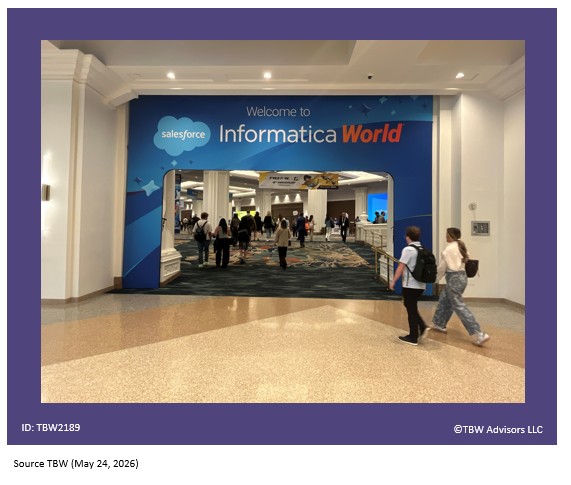
Taking a trip down memory lane, Informatica World brought us back to the very first TBW Advisors’s Conference Whispers: Informatica World 2019. In the meantime, we have grown by leaps and bounds and Informatica was just acquired by Salesforce. Gone were the orange competitions we were so touched to observe. In came the blue wash of Sales Force. Speaking to many attending during lunch, it seemed internally, the closer the employee is to hands on data engineering the more excited they were about the acquisition. Data governance and master data management have always been Informatica’s strength making them a great talent acquisition purchase. A majority of the customers also seemed quite excited about the acquisition. Being a vendor hosted event, registration was efficient and a full lunch was served! For those who were still hungry, Mandalay Bay Food Court was fully open. Enjoy the walkabout to and through expo hall. We always try to bring you fresh vendors in our coverage but you will recognize many brands in the walkabout from our coverage of other data events such as the Put Data First.
We once again live streamed from on site. On Wednesday requesting those attending to find me to answer Questions for Whisper Reports, to introduce all to TBW Advisors LLC, and requesting assistance. Specifically, I requested assistance on your favorite videos for my syndicated segment on the May 23rd nationally broadcast edition of Computer Talk Radio.
We conducted research for Six additional forthcoming Whisper Reports for our clients. The playlists are unlisted but available with the video version to be distributed via YouTube Whisper Club upper tier membership area on our YouTube Channel.
Readers and viewers wishing to experience the entire event are encouraged to view the Conference Whispers: Informatica World 2026 Playlist in its entirety. The playlist will be sited in the end screen, description, and as a pinned comment of the video edition.
The video edition will conclude with gratitude towards those that contributed and a montage of responses to Bonus Question, “What’s the best part about attending the Informatica World live in Las Vegas?”.
Informatica has been purchased by Salesforce and is being integrated into their Data 360. As such no word on if Informatica World will once again return to Las Vegas or if it will be folded completely into Dreamforce.
*When vendors’ names are shared as examples in this document, it is to provide a concrete example of what was on display at the conference, not an evaluation or recommendation. Evaluation and recommendation of these vendors are beyond the scope of this specific research document. Other examples products in the same category may have also been on display.
This Whisper Study demonstrates two “lift and shift” as organizations migrate their enterprise data warehouses to the cloud. The first is a “lift and shift” from Teradata Active Enterprise Data Warehouse on-premise to Teradata Vantage deployed in Amazon Web Service (AWS) leveraging the Teradata Everywhere license. The second is an update to near real-time product data on the web followed by a “lift and shift” from ETL jobs into Exadata to IPaaS integration storing in Amazon Redshift.
The Studies
Bayer Crop Science EDW Migration to the Cloud
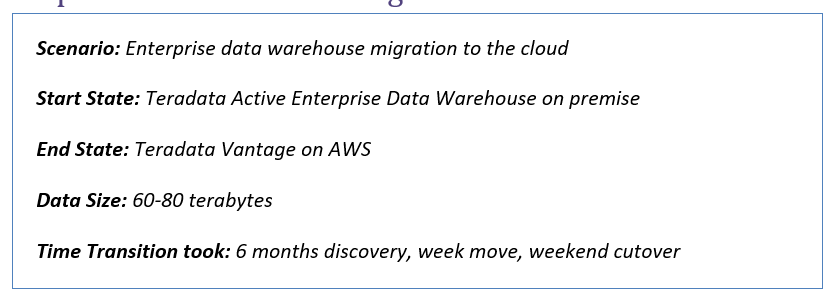
Scenario: Enterprise data warehouse migration to the cloud
Start State: Teradata Active Enterprise Data Warehouse on premise
When transferring large amounts of data, such as during a lift and shift, be sure to check your network packet size. Using a default packet size involves significant overhead creating network latency.
Leverage IPaaS to make up for the differences between on-premise data warehouses with integrity checks and a cloud data warehouse without integrity checks. IPaaS can also accommodate data format differences.
IPaaS templates with dynamic binding in the new world can make up for years of ETL jobs burdening older data architectures.
Organizations are regularly considering migrating to the cloud, which raises the question: how difficult is it to migrate an organization’s enterprise data warehouse (EDW) to the cloud? This Whisper Study examines how two organizations succeeded in this task that often seems insurmountable. The first case remains with the same data vendor after the cloud migration. The second case utilizes a different vendor on the cloud from on premise and follows a near real-time update of quality product information to the web application, which is also discussed.
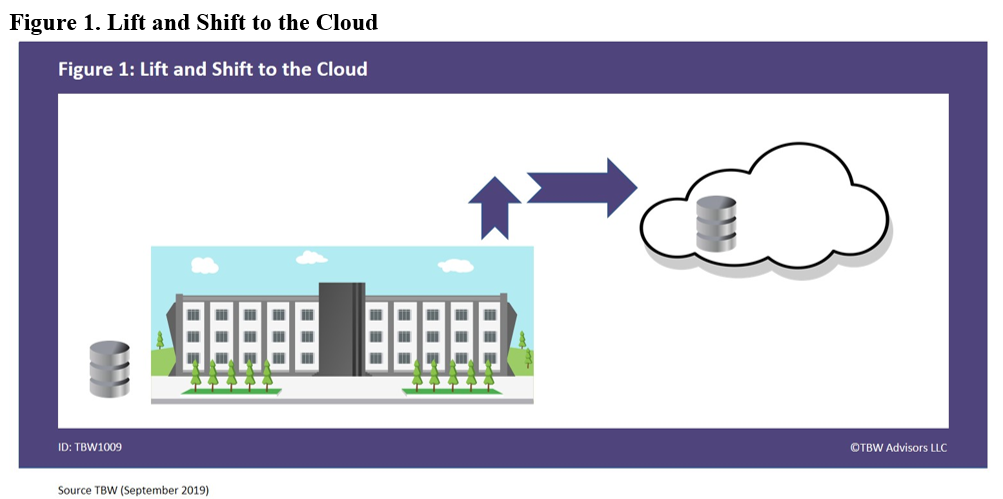
Bayer Crop Science was migrating its data warehouse to another location when they were approached to use Teradata Everywhere1 to migrate to the cloud. Teradata Everywhere is an approach that allows users the flexibility of leveraging the license on premise or in a cloud. At that point, Bayer Crop Science decided to go ahead and “lift and shift” data from the enterprise that was on premise in a Teradata appliance to Teradata Vantage on AWS, as depicted in Figure 1.
When the Teradata appliance was first stood up at Bayer Crop Science, it was directly connected to their ERP system. It operated near real time and included all major enterprise data from order processing to finance. Regions had their own data warehouse and data marts. Global functions leveraged the Teradata appliance since all data was already present in the appliance.
Bayer Crop Science planned to move the data in three phases. The first phase involved testing how the other two phases were going to be executed. The test had to be successful before they attempted to move development and testing environments’ data. Only after a successful test move and development move did they attempt to migrate production data.
The first hurdle was to execute a successful test data move to the cloud. The following approaches were made:
Amazon Import/Export Service2: This is a service provided by Amazon to assist clients in shipping their data to the cloud. Once received, the turn-around time to install the data is over 24 hours in addition to the transport time. Unfortunately, the ability to be down for several days was not an option. In addition, the data import did not check for errors, leaving the data unusable without extensive work.
Teradata Backup and Recovery (BAR)3: Backup and recovery is a common capability. It enables a system to quickly change from one copy of the data to another. As it is used for recovery from disasters, the second or back-up copy of the data is frequently at a different location in case the disaster was location based. Most organizations’ business continuity requires this capability to be somewhat seamless and regularly tested. This solution appeared to be straightforward until network latency issues were found while moving the data.
When transferring data over the network, it is easy to monitor the amount of data being transferred. Unfortunately, in the early test moves, data did not seem to be flowing. Instead, Bayer Crop Science experienced significant latency in the actual data coming across the network. This problem stumped the entire team for a couple of months. The team searched high and low to try to understand why the desired data wasn’t flowing to the cloud!
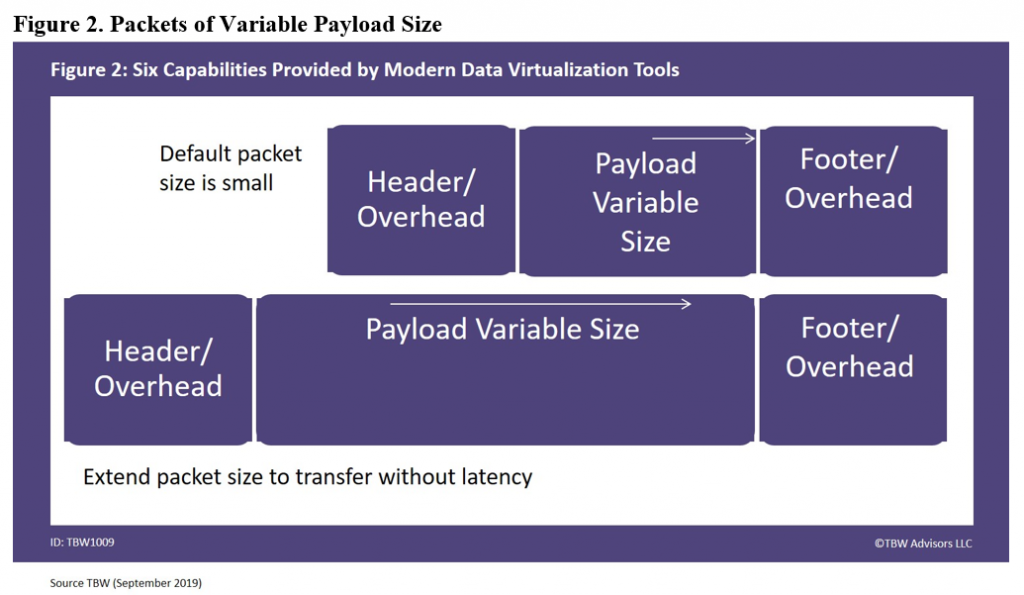
The problem causing network latency turned out to be the default TCP/IP packet size. Each packet has a header and footer with routing information and other overhead information to ensure the packet makes it to the destination. The payload is the portion where the data you are trying to transfer is put within each packet. Unfortunately, by using the default packet size, too much room was taken up in the overhead of the packet instead of the payload. By not enlarging the payload size in the packet, too high a percentage of the transferred data was the overhead vs the payload. Figure 2 depicts an example of the variable payload size within a packet. The payload can be increased up to the maximum segment size4.
With the data latency issue solved, the team verified the test move. With the success of the test data move, the team moved onto Phase 2: migrating the development environment. Success again. For the third phase, they told BAR to back up their production Teradata appliance to AWS. The team then kept track of all changes since the backups were created in AWS. These final changes were the only remaining updates required in order to officially have a full data set on AWS and were migrated over the weekend. It is valuable to note that a back-up copy of the logged changes was made prior to using the logs to update the AWS data version. Once the final changes were migrated to AWS, the switch was flipped to move the system to their backups. In this scenario, the backups on AWS were the new primary home. The cloud migration was complete.
Since the migration, the corporation was bought and changed its name to the form in this document. The acquirer was 100 percent on premise, and as such, the environment is now technically hybrid. The team plans on leveraging the success from their cloud migration to evolve their new enterprise.
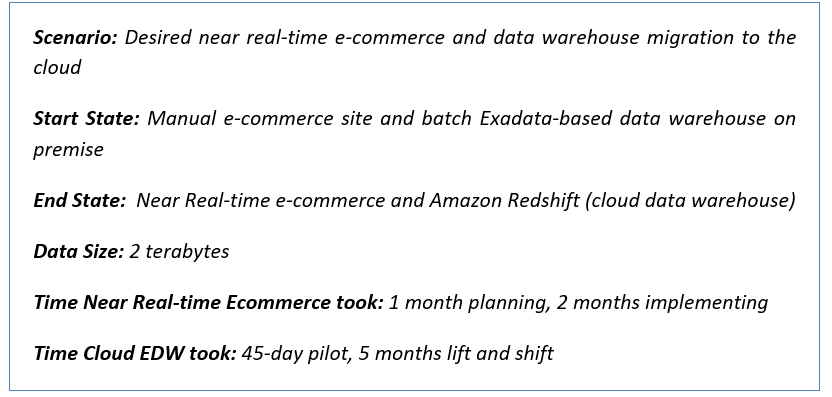
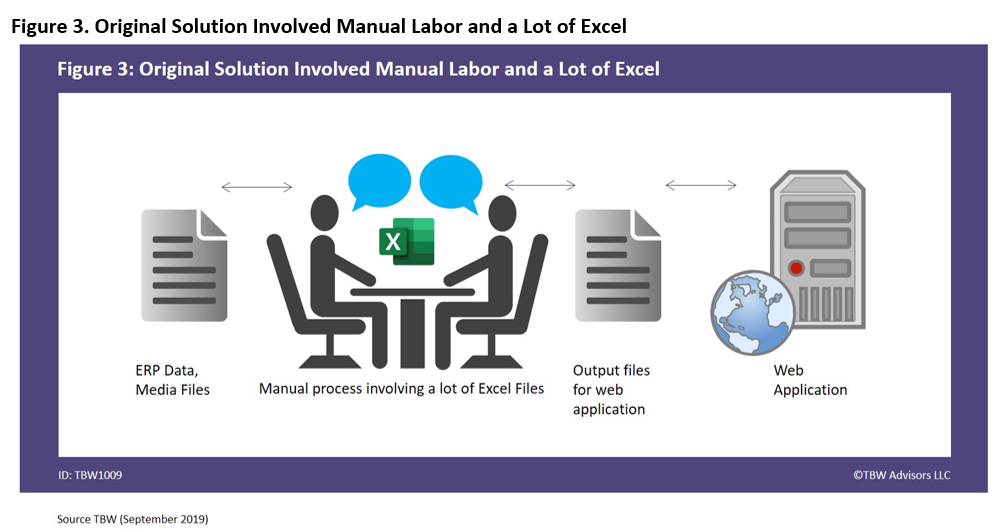
The second study involves a large retailer outside of North America that had the general business problem of being unable to update their full product catalog online for e-commerce. If a sweater only has two colors available for any size, the e-commerce site should never show all colors that were once available, only the current colors and sizes. Their solution was not real time as the website was not able to directly connect to the product information and provide complete, accurate, near real-time information. Instead, a highly manual process involving spreadsheets was used to get product information to the web application platform. Of course, once they updated their systems to real time, they desired near real-time analytics. As you might imagine, not only did their web application lack near real-time data, their data warehouse was also not in real time. Generally, it was an old-fashioned data architecture. The desire was to modernize, enable the e-commerce platform to become real time, and then transition the warehouse to near real time as well.
In the beginning, the web application lacked the ability to reflect current inventory levels, and the data was not fresh and accurate. In addition, the e-commerce site only represented a very small portion of their product portfolio – well below 25% of all potential products. They had a strong suspicion that representing their entire product line with near real-time data on their e-commerce site would result in revenue increases. In the beginning, the process for loading information to the web application was fundamentally manual involving a lot of Excel, as represented in Figure 3.
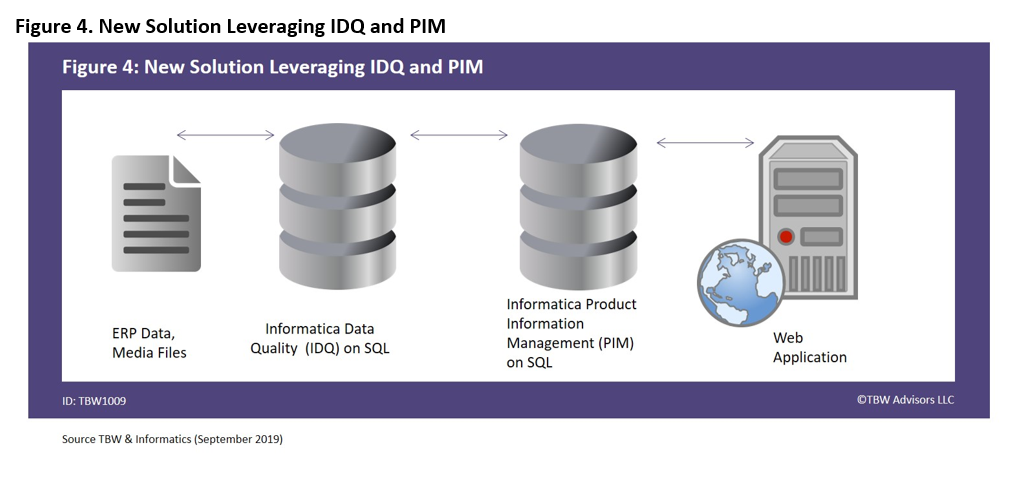
Of course, if it were easy to connect the ERP system to the web application directly, they would have likely already integrated the two systems. The first stop was to leverage Informatica’s Product Information Management Solution (PIM5) which is tailor-made to clean up your view of your product data by creating master data management (MDM) for your product data. As with most migrations and upgrades, there is always a surprise or two. In this scenario, once they had MDM, they realized that not all data sets used the same time standard, in addition to other data quality issues. By leveraging Informatica Data Quality (IDQ6), this problem was quickly and permanently solved. More important, within a quarter, they were able to successfully represent accurate inventory for 60% of their product portfolio. They were able to reach 100% online within one year of the project. The new solution is represented in Figure 4.
Now that their e-commerce site represented their entire product portfolio with accurate real-time information, the business desired a near real-time enterprise data warehouse for near real-time analytic insights to match. The largest difficulty was estimating how much work everything was actually going to take to accomplish the migration. Their existing data warehouse was an Exadata, on-premise warehouse they started creating 10 years ago. Like most data warehouses, their ETL developers were busy constantly adding new data combinations to the warehouse for the business.
The challenge was how to capture and reflect all these ETL jobs that took 10 years to create.
To address the differences and accomplish the migration with all ETL jobs represented without spending 10 years on the task, the team decided to leverage Informatica’s IPaaS (Integration Platform as a Service) solution, known as Informatica’s Intelligent Cloud Services (IICS7). Next, they leveraged IPaaS templates to represent the ETL jobs. These templates enable dynamic binding of specific jobs to the templates. Thus, the templates were simply called with the data set needing that template’s represented data transformation. Now, a single template could represent a thousand different ETL jobs from the old data warehouse. In addition, the use of IICS allowed the IT team to confirm success when data was transferred, as data integrity was not provided by Amazon Redshift.
To accomplish the lift and shift, each data source was first connected to the IPaaS platform. Next, the dynamic binding of the templates was used to create the new data warehouse for those data sets. In the beginning, they prototyped and tested a single topic over 45 days. The new solution was in the cloud and provided a continuous flow of data, thus enabling near real-time analytics. Not a single data model had to change. The new EDW being tested in the cloud ran concurrently with the on-premise, soon-to-be-retired EDW. This gave the business and IT time to verify the plan was working, and the new EDW was as expected.
After the first successful topic was in the new data warehouse, it took the team another five months to finish the “lift and shift.” No redesign of data models was required. In order to efficiently accomplish the “lift and shift,” multiple IPaaS accounts were leveraged, providing additional bandwidth for the project.