Published to Whisper Club: January 27, 2026 ID: TBW2095
Analyst(s): Dr. Doreen Gal
Photojournalist(s): Dr. Doreen Galli
Abstract:
This Whisper Report investigates how will drones change enterprise data strategy. It draws on insights gathered at the Commercial UAV Expo 2025 in Las Vegas, where UAV experts described the growing data volume, multi‑use potential, and rising compliance pressures shaping enterprise architectures. The report highlights strategic alignment, cross‑industry collaboration, and the challenge of converting drone data into actionable insights. It cites Barry Paul (Blue Nose Drones), Jason San Souci (Drone Ops USA), Kevin Teen (Aloft), Bill Reynolds (Central UAS Technologies), and Vik Chaudhry (Buzz Solutions).
Coverage on Computer Talk Radio.
Target Audience Titles:
- Chief Data Officer, Chief Information Officer, Chief Technology Officer, Chief Digital Officer, Chief Information Officer
- VP Data Strategy, VP AI & Analytics, VP Infrastructure/Cloud
- Enterprise Data Architects, Cloud Platform Engineers, AI/ML Engineers, Data Governance Leads, DataOps Engineers, UAV Program Managers, Geospatial Analysts, Security Architects
Key Takeaways
- Enterprises must begin with outcomes, not drone hardware, ensuring data strategy alignment before investing in UAV technologies.
- UAV operations generate massive, multi‑use data requiring scalable architectures and disciplined reuse across missions and time.
- Cross‑industry collaboration and regulatory data‑sharing mandates will reshape how organizations exchange, govern, and leverage drone‑collected information.
- Organizations need compliant, secure infrastructure capable of turning large, disparate drone data streams into actionable, time‑saving insights.
How will drones change enterprise data strategy?
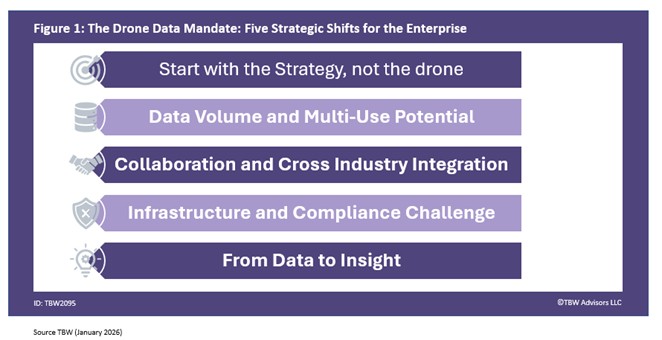
We took the most frequently asked and most urgent technology questions straight to the commercial UAV professionals gathering at Commercial UAV Expo 2025 held in Las Vegas. This Whisper Report addresses the question regarding How will drones change enterprise data strategy? Figure 1 represents the five strategic shifts coming for the enterprise due to the drone mandate.
1. Start with the Strategy, not the drone
Like many newer technologies, it is easy to fall into the trap of spending budget on the shiny thing everyone is talking about. But there is a reason the best CIOs and CTOs ask what you are trying to accomplish versus rubber stamping the technology acquisition. As Drone Ops USA’s Jason San Couci
contended, “So enterprises that are using drones are starting the wrong way. They’re starting with what equipment’s out there. They get they see the shiny things that are out here in this industry and they’re like, man, what can I do with that? No, they’re doing it wrong. They need to look at what outcomes that they need to actually that they’re doing it for. Right?” Drone Ops USA’s Jason San Couci went on to further explain. “I want to know what the data is going to be used for, what the analytics are going to be. So therefore, I can work backwards. What equipment do I need? What accuracy do I need? I can’t answer those questions at the beginning, right? It’s kind of like saying, I have this tool. I have a hammer. And I have a piece of wood. I want to go build a house. You’re not going to do that. You’re not going to build a house. You have to be like, you know what? I want to build a house. What materials do I need to be able to do that? What specialties do I need? What people what experts do I need? What subconscious do I need? What’s the timeline? What’s the budget? What’s all those things? That’s working the right way. People in this industry have been doing that wrong.”
But starting with the technology versus the problem isn’t the only issue. The existing data strategy might be outright ignored. Jason San Souci expanded further. “enterprise data strategy is something that’s been underlooked and underfunded for a long time because what they’re doing is they’re keeping a lot of this data in silos and they’re not using their existing enterprise data to augments or enhance the data that’s coming from any robotic system, drones, uncrewed systems, whatever it happens to be. So, they’re putting them in another silo and that’s a huge mistake.”
2. Data Volume and Multi-Use Potential
Most organizations do not really appreciate what big data truly is before they start working with the volumes of data that come from any sensor based solutions – including the numerous sensors on UAVs. Aloft’s Kevin Teen provided a meaningful example to demonstrate how the data volumes expand rapidly. “And so let’s say we send a pilot out for a survey or a construction update. While they’re out there, there are other opportunities. We don’t need to send another pilot out or launch a drone in the box or something like that to go look at something specific. Go inspect this bolt or go check this roof for leaks or, you know, where it might need paint or something along those lines. From that initial flight, from that initial data capture, we can then reuse a lot of that information and even kind of go back over time. Let’s say there’s a rust spot developing on an oil tank or something like that. we could go back and identify how frequently this happens, how long has this issue not been caught yet.” Kevin went on to further explain that optimizations are indeed possible. “I think the multi-use of the data that we’re collecting is going to be an important part of how we streamline and pull all that information out together.” Multi-use was a big term we heard repeatedly at the Commercial UAV expo during all conversations involving data. Barry Paul of Blue Nose Drones contended “not only can we do what the problem is that we need to solve right then, but there’s a lot of other things that can be utilized out of what a drone can collect for them. What kind of data? What other use cases or problems can we solve for a company.” As Central UAS Technologie’s Bill Reynolds nicely summarized, “The enterprise data demand that drones will put onto agencies and companies is immense in terms of the size both in imagery and aerial applications.” If you haven’t felt it yet, the data wave from UAV’s is coming to an enterprise near you.
3. Collaboration and Cross Industry Integration
Now that we realize the data will be voluminous and internally each organization should organize and efficiently, and repeatedly leverage data for multiple purposes, our next challenge arises. How do we get collaboration within an industry or sector or even cross-sectors? As Zepher’s Dustin Brewer noted, “going to take a collaborative effort between several of us that do collect data from our enterprise use cases like search and rescue, DoD, and being able to integrate those into other parts of the industry and have some of that cross communication. I think that’s going to increase collaborative efforts and more of a community effort in order to provide pilots the information that they need to either increase their skills or apply that to their industry that they’re either working towards or working within.” Identification of a lost child by drone has much in common with identification with a destructive and invasive animal in a massive crop.
But some sharing of the data may not be optional. Kenji Sugahara from the Oregon’s Department of Aviation clarified. “Drones will definitely change your data strategy, especially if you’re working in a government environment because all that data that is acquired is for the public record.” But what if you strictly work with private industry? Kenji has news for you as well. “With private industry, there will be increasing data storage requirements, especially under part 108 in the proposed rule that it that it is. What it proposes under part 108 is data retention. So there are will be data retention requirements. So not only for flight data, but you’re also talking about personnel data, you’re also talking about training data, you’re talking about maintenance data. So there’s going to be have to be a comprehensive data management strategy.”
4. Infrastructure and Compliance Challenge
All of this data and collaboration or regulatory sharing requirements create infrastructure and compliance challenges. As Buzz Solutions Vik Chaudhry emphasized, “they have purchased all these UAVs, aerial vehicles, drones. They’re doing a lot of with these kind of mobile sensors, there’s a lot of data that is generated. So at the enterprise level, utilities face a challenge on how to store and manage all that data. That’s where they are trying to build cloud infrastructure platforms within their systems. Obviously that has to satisfy their IT and cyber security compliance. But they’re also looking for software platforms that can visualize all this data especially imagery.” With the mountain of technical challenges, it is easy to lose sight of the goal. As Vik went on to further explain, “How can they make the system more robust but also how can they derive insights from that data because that’s where the real power is. Collecting the data is one piece. Flying your drones is one piece. But the whole of the challenge starts when you have to derive the insights from that data.” As summarized by FlytBase’s Deep Gupta, “The new strategy is what do I do with this much data?”
5. From Data to Insight
The problem, as articulated by Aloft’s Kevin Teen is here. “We are now just collecting a ton of more information, more data than we were getting before.” The challenge, as clarified by FlyteBase’s Deep Gupta is real. “How do I gather insights? How do I save time?” Our mission, as shared by Buzz Solutions’ Vik Chaudhry. “How can they make the system more robust but also how can they derive insights from that data because that’s where the real power is. Collecting the data is one piece. Flying your drones is one piece. But the whole of the challenge starts when you have to derive the insights from that data.”
If you are faced with data siloes and a fleet of drones and don’t know where to start or are not sure you are on the correct path. This is the exact time to schedule an inquiry with your analyst. Their first hand experience working with the complexities of voluminous disparate sensor data sets in creating a cohesive data fabric have immeasurable value on your success.
Related playlists and Publications
- Playlist for Whisper Report: What’s the biggest UAV threat CIOs aren’t ready for?
- Conference Whispers: Commercial UAV Expo
- Whisper Report: How will drones change enterprise data strategy?
- Whisper Report: What’s the most underrated UAV use case in industry?
Corporate Headquarters
2884 Grand Helios Way
Henderson, NV 89052
Downloading, re-uploading, or redistributing this file is not permitted under any license.
©2019-2026 TBW Advisors LLC. All rights reserved. TBW, Technical Business Whispers, Fact-based research and Advisory, Conference Whispers, Industry Whispers, Email Whispers, The Answer is always in the Whispers, Whisper Reports, Whisper Studies, Whisper Ranking, Whisper Club, and One Change a Month, Vegas Convention Library; Leading Professionals, Real Questions, Real Time, are trademarks or registered trademarks of TBW Advisors LLC. This publication may not be reproduced or distributed in any form without TBW’s prior written permission. It consists of the opinions of TBW’s research organization which should not be construed as statements of fact. While the information contained in this publication has been obtained from sources believed to be reliable, TBW disclaims all warranties as to the accuracy, completeness or adequacy of such information. TBW does not provide legal or investment advice and its research should not be construed or used as such. Your access and use of this publication are governed by the TBW Usage Policy. TBW research is produced independently by its research organization without influence or input from a third party. For further information, see Fact-based research publications on our website for more details.