Published to clients: September 9, 2025 ID: TBW2068
Published to Readers: September 10, 2025
Published to Email Whispers: TBD
Published Publicly with Video: TBD
Analyst(s): Dr. Doreen Galli
Photojournalist(s): Dr. Doreen Galli
Abstract:
“Trust in fintech isn’t just about compliance—it’s a multi-dimensional strategy. This report explores how transparency, privacy, and strong identity verification shape consumer confidence. Insights from Fintech Meetup 2025 reveal how leading firms are navigating open banking, fraud prevention, and data ethics to earn and retain trust. If trust is your brand’s currency, this report is your blueprint. “
How can we build and maintain consumer trust in Fintech solutions??
We took the most frequently asked and most urgent technology questions straight to the Fintech experts gathering at Fintech Meetup 2025. This Whisper Report addresses the question regarding how can we build and maintain consumer trust in fintech solutions? Trust is difficult to get and easy to lose. Trust is also one of those elements that frequently goes by other names.
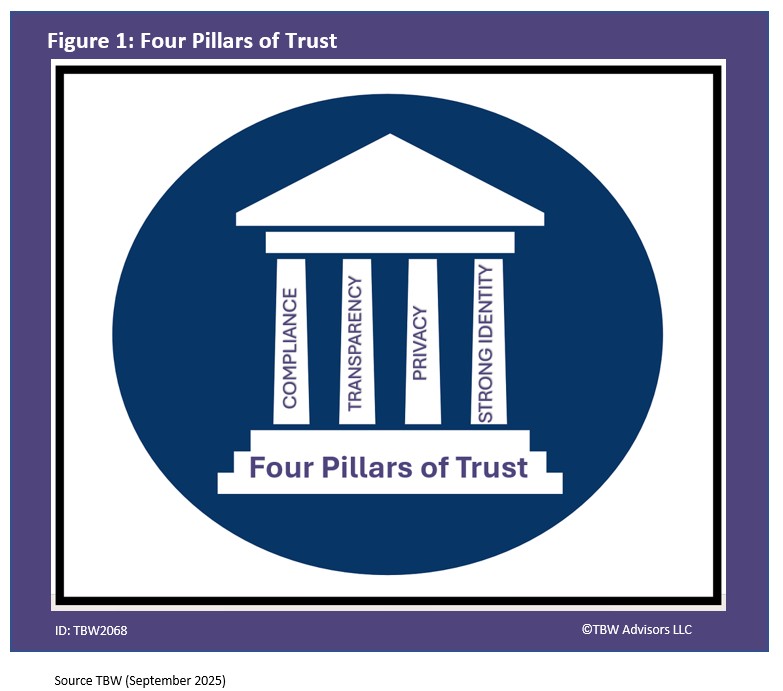
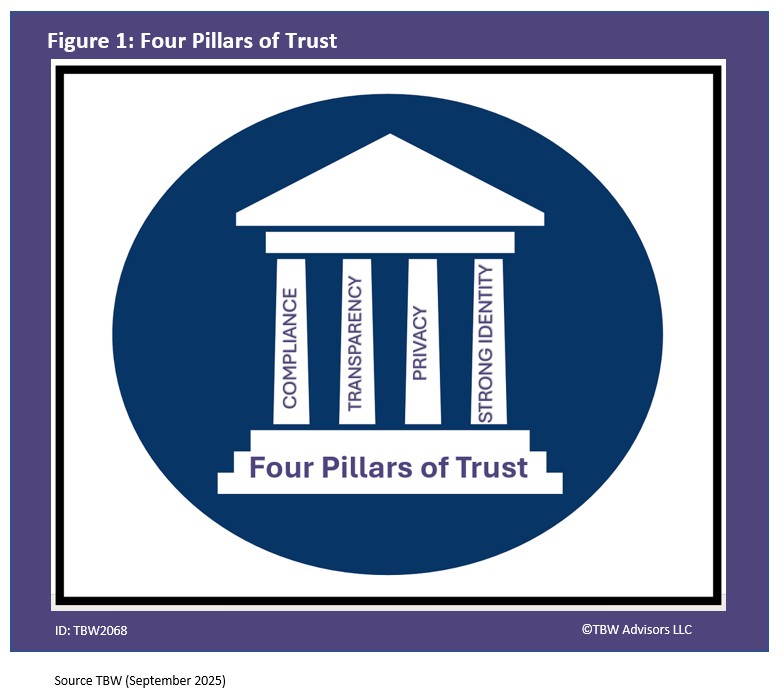
Figure 1. Four Pillars of Trust
1. Trust = compliance
Trust comes in many forms and dimensions. Any single dimension is broken and your trust with your customers may be broken. The first and most basic step you can take was best stated by SecurityMetrics’ Matt Cowart, “being able to show your customers that you are not only compliant but you are up to date on what is out there.” If you are Fintech you have industry specific regulations. If you want to maintain trust, be sure to publicly state that you meet the regulations. This statement could be a simply logo on your website. However, many organizations find it valuable to not only state that they are compliant – as required but they go above and beyond. Frequently, they will reiterate they importance they place on maintaining their compliance and yes – your trust.
2. Trust = transparency
The first dimension we explore is trust equals transparency. As Aries Fraud Solutions’ Lon Varns simply stated, “their solution does what it’s supposed to do. If you say you’re going to stop fraud you better stop fraud.” Furthermore, you should not do more than you said particularly when it comes to their data! Trustly’s Ross McFerrin put it, “it’s critical that that consumers understand that when they’re sharing their information by open banking we’re not accessing their information for any other reason than what they wish to do with that.” This transparency with data trust issue is not going to get any smaller. In fact, as Prove’s Zachary Finesilver put it, “as open banking becomes more important and our data becomes more accessible, how do we actually persist that trust among our .. consumers.“ Once again, the answer is transparency. “When breaches do happen and being able to be on top of that if a breach were to occur being able to get in front of that and be very transparent with those that were affected. That would help retain as much trust as possible,” Mathew Coward, SecurityMetrics.
3. Trust = privacy
While it would be easy to say it goes without saying it, but we are going to say it anyway. Trust means privacy. Trust is not just about transparency about what you will do and notification when you fail, it is about maintaining and protecting customer’s privacy. One of the best ways to do that was shared by Trustly’s Ross McFerrin, “we ensure that we keep consumer privacy top of mind.”
4. Trust = strong identity
If trust requires privacy, privacy requires strong identity. To protect a consumer’s information, a company must first ensure they are interfacing with the customer not an impostor during interactions. The technology to achieve these falls under the domain of Identity and Access Management or IAM. As Intellicheck’s Chris Meyer pointed out, “the biggest challenge right now that consumers face is the layer of friction that’s being added for that process to verify are they who they say they are.” We are all consumers in one aspect of our life. Let’s be honest, who wants to verify who you are 10 times every time you interact with a company? I sure don’t! After the first time or two, doesn’t it start to feel more like the company is incompetent as opposed to doing a great job verifying it’s you? One interesting identity solution leverages phone intelligence and complex algorithms about how you use your phone to understand if it is really you. As Prove’s Zachary Finesilver shared, “we’re tying that identity to a phone number we’re persisting that identity and making sure that we’re checking for major fraud vectors like has this phone been Sim swapped. Has it (the number) been ported? And a lot of other fraud vectors to make sure that your customer base is indeed the people are who they say they are.” See Conference Whispers: Identiverse 2024 and stay tuned for our coverage in 2025 for additional research on identity.
*When vendors’ names or quotes are shared as examples in this document, it is to provide a concrete example of what was on display at the conference or what we heard doing our research, not an evaluation or recommendation. Evaluation and recommendation of these vendors are beyond the scope of this specific research document.
Related playlists
- Whisper Report: How can AI be effectively integrated into healthcare systems?
- Conference Whispers: HIMSS 2025
Corporate Headquarters
2884 Grand Helios Way
Henderson, NV 89052
©2019-2026 TBW Advisors LLC. All rights reserved. TBW, Technical Business Whispers, Fact-based research and Advisory, Conference Whispers, Industry Whispers, Email Whispers, The Answer is always in the Whispers, Whisper Reports, Whisper Studies, Whisper Ranking, Whisper Club, Whispers, The Answer is always in the Whispers, Vegas Convention Library, and One Change a Month, are trademarks or registered trademarks of TBW Advisors LLC. This publication may not be reproduced or distributed in any form without TBW’s prior written permission. It consists of the opinions of TBW’s research organization which should not be construed as statements of fact. While the information contained in this publication has been obtained from sources believed to be reliable, TBW disclaims all warranties as to the accuracy, completeness or adequacy of such information. TBW does not provide legal or investment advice and its research should not be construed or used as such. Your access and use of this publication are governed by the TBW Usage Policy. TBW research is produced independently by its research organization without influence or input from a third party. For further information, see Fact-based research publications on our website for more details.