Published to clients: May 11, 2026 ID: TBW2103
Published to Whisper Club: May 11, 2026
Analyst(s): Dr. Doreen Galli
Photojournalist(s): Dr. Doreen Galli
Abstract
This Whisper Report investigates how will robotics in packaging reshape enterprise ops? It explores how flexibility, efficiency, and human–machine collaboration are quietly redefining operations on modern packaging floors, based on firsthand industry perspectives from the field. Cited experts: Mike DeGrace, Universal Robots; Mike Wolf, Signode; Rich Parkhurst, KUKA; Mike Renzetti, Robotunits Inc.; Brett Olson, SICK Sensor Intelligence; Brand Winer, Cognex.
Target Audience Titles:
- Chief Operations Officer, Chief Information Officer, Chief Supply Chain Officer
- Director of Operations, Director of Manufacturing Engineering, Packaging Engineering Manager, Robotics Engineering Manager
- Operations Engineer, Manufacturing Engineer, Packaging Engineer, Robotics Engineer, Automation Technician, Controls Engineer
Key Takeaways
- Packaging robotics are driving enterprise ops flexibility through rapid line reconfiguration, collaborative robots, and minimal hard guarding.
- Efficiency gains come from scalable automation that reduces labor risk, human error, floorspace, and time-to-changeover.
- Autonomous mobile robots replace fixed conveyors, enabling flexible logistics that adapt daily to production and shipping demands.
- Robotics first eliminate unsafe, ergonomically harmful tasks while enabling humans and machines to work side by side.
How will robotics in packaging reshape enterprise ops?
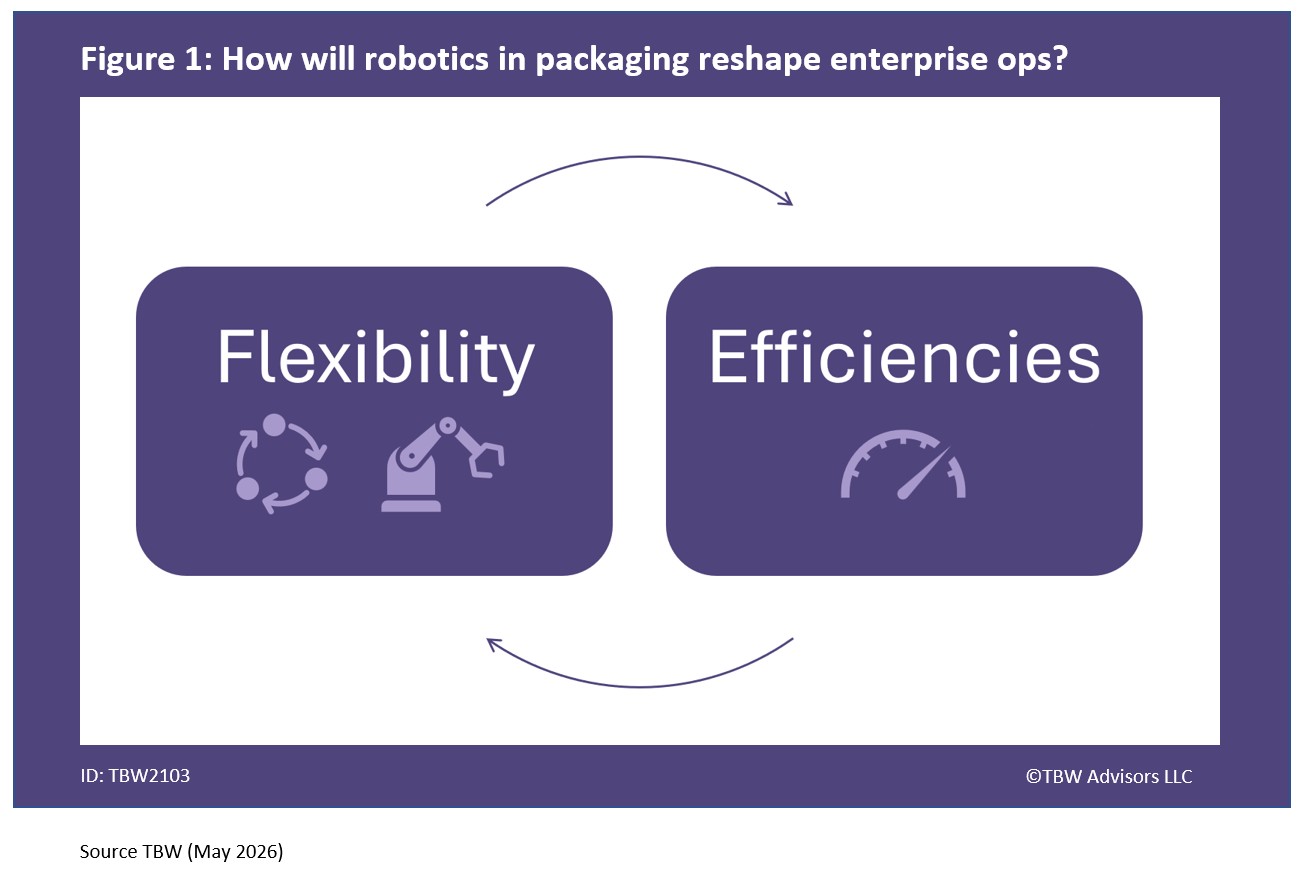
We took the most frequently asked and most urgent technology questions straight to the operation engineers and technology professionals gathering at Pack Expo Vegas 2025. This Whisper Report addresses the question regarding how will robotics in packaging reshape enterprise ops? In two words: Flexibility and Efficiencies.
How will robotics in packaging reshape enterprise ops?
We took the most frequently asked and most urgent technology questions straight to the operation engineers and technology professionals gathering at Pack Expo Vegas 2025. This Whisper Report addresses the question regarding how will robotics in packaging reshape enterprise ops? In two words: Flexibility and Efficiencies.
Flexibility
One of the key benefits of modern robotics is flexibility. Universal Robots’ Mike DeGrace had this observation, “We’re seeing a huge drive towards increased flexibility. One of the things that I’m noticing is obviously a greater adoption of technology like this, the Six-Axis collaborative robot.” Signode’s Mike Wolf provides context for the use of such robotics. “One of the things that robots are really transforming is the ability to reconfigure a line and make your facility flexible to what you need to do.” Universal Robots’ Mike DeGrace expands on this thought. “No need for hard guarding or caging in most applications. The other is the space savings. When you think about a contract manufacturer that has lines that change over, products that change over routinely. You need a product that can adjust as quickly as your lines do, right? And that’s what these new robots, these new technologies are bringing to enterprise ops.” Signode’s Mike Wolf commented on the flexibility specifically due to autonomous mobile robots or AMRs. “With autonomous mobile robots, you’re able to do a logistics planning where you don’t need to make conveyors all over your factory. You’re able to transport the goods from the final packaging station out to the truck bay in a flexible way that can reflect what is needed for that truck that day.”
Efficiency
When it comes to how robotics will change enterprise operations, many thought the answer was obvious. Per KUKA’s Rich Parkhurst, the answer is, “In a word its efficiency, right?” Robotunits Inc.’s Mike Renzetti went on to describe the many aspects of efficiency achieved. “If you think about scalability, something as small as this versus as large as full automation of using a robot to do the biggest tasks that may cut down your staff. It may save you money. It may save you time. It may save your production floor. The idea of human error. In reality, I think that robotics and automation as a whole is a never-ending enterprise and an ever growing industry.” SICK Sensor Intelligence’s Brett Olson knows exactly how many are achieving that efficiency. “Having robots like this, adding sensors to it, not only can you go in and access a cell, just to keep the efficiency up, but also safely.” But efficiency with robotics goes beyond the sensors as Cognex’s Brand Winer reported. “People in robots working side by side and really the big roadblock to that before was it need all needed to be safety guarded, right? It could, you know, physically hurt someone and that’s changed. So we’re kind of already seeing that, right? But it’s really a work side by side with the robots to build a more efficient system.” But it more than collaboration with humans, many whispered what Kuka’s Rich Parkhurst tactfully communicated. “We are we’re talking about roles that humans are doing today in the factory environment that are unsafe not good long-term ergonomically. Robotics are really what is going to change that and then also make the space more efficient and more productive over time.” In other words yes, robotics may replace jobs humans do today but the first to go will be the ones that are dangerous and known to sometimes cause life altering harm to the workers.
Analysis available only to clients at this time. Join the YouTube Whisper Club at the Whisper Club Level to get access to the video edition today.
Related playlists and Publication
- Playlist for Whisper Report: What’s the biggest packaging tech blind spot for CIOs?
- Playlist for Whisper Report: How will robotics in packaging reshape enterprise ops?
- Playlist for Whisper Report: What’s the most overlooked data source in packaging?
- Conference Whispers: Pack Expo Vegas 2025
Corporate Headquarters
2884 Grand Helios Way
Henderson, NV 89052
©2019-2026 TBW Advisors LLC. All rights reserved. TBW, Technical Business Whispers, Fact-based research and Advisory, Conference Whispers, Industry Whispers, Email Whispers, The Answer is always in the Whispers, Whisper Reports, Whisper Studies, Whisper Ranking, Whisper Club, Whispers, The Answer is always in the Whispers, Vegas Convention Library, and One Change a Month, are trademarks or registered trademarks of TBW Advisors LLC. This publication may not be reproduced or distributed in any form without TBW’s prior written permission. It consists of the opinions of TBW’s research organization which should not be construed as statements of fact. While the information contained in this publication has been obtained from sources believed to be reliable, TBW disclaims all warranties as to the accuracy, completeness or adequacy of such information. TBW does not provide legal or investment advice and its research should not be construed or used as such. Your access and use of this publication are governed by the TBW Usage Policy. TBW research is produced independently by its research organization without influence or input from a third party. For further information, see Fact-based research publications on our website for more details.