Published to clients: December 16, 2025 ID: TBW2118
Published to Readers: December 17, 2025
Whisper Email Release: TBD
Public and Video Release: TBD
Analyst(s): Dr. Doreen Galli
Photojournalist(s): Dr. Doreen Galli
Abstract
“This Whisper Report investigates the biggest fintech risk CIOs are underestimating. It captures urgent insights from Money 20/20 USA 2025, revealing why incremental improvements won’t protect enterprises from disruption. From rapid shifts in payment models to vendor lock-in, integration hurdles, and data complexity that derails AI ambitions—these risks demand immediate attention. Future-proofing architecture and optimizing data fabric are no longer optional. Read on to uncover strategies that redefine resilience before the next wave hits.”
What’s the biggest fintech risk CIOs are underestimating?
We took the most frequently asked and most urgent technology questions straight to the fintech professionals gathering at the Sands Convention Center in Las Vegas for Money 20/20 USA 2025. This Whisper Report addresses the question regarding the biggest fintech risk CIOs are underestimating as depicted in Figure 1.
Figure 1. Biggest fintech risks CIOs are underestimating
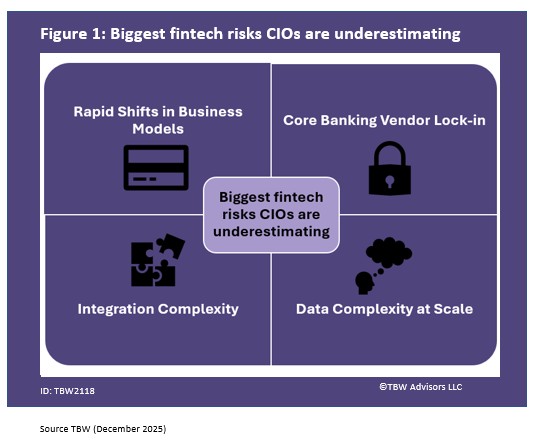
1. Rapid Shifts in Business Models
A very big issue, according to Globant’s Marc St. Pierre is, “is not looking ahead to future business models where instead of investing today and improving their existing infrastructure.” One does not need to improve an infrastructure that one will not be utilizing in a few years. Marc went on to provide a real-world example. “The best example I can give you is Pix down in Brazil. I was just at a meeting where I learned a statistic that today in Brazil, I think it’s only three years after they introduced Pix, 44% of volume transacted is credit card and 40% is Pix. That’s remarkable to think about and it’s not crazy to imagine the US or other markets in the world could get to that.” Wow 40% market dominance achieved in 3 years in the world of payments.
2. Core Banking Vendor Lock-in
With such rapid shifts in business models, it is no wonder Alacriti’s Jamie Harris sounded the alarm bringing us risk number 2. “The underestimation of their vendor dependency on the Core (Core banking) and the limitations of those Cores to meet their payment modernization needs.” Jamie suggests we should seek, “modernized payment architecture and infrastructure stack that’s API first, tech first, and really allows institutions to be very nimble and adaptable as they look at new business models build potentially new use cases for either their consumer or business segment.” It’s valuable to note that enterprises dependent on such vendors will land up with a bifurcated solution as they attempt to adopt and evolve to catch the market opportunities.
3. Integration Complexity
Risk number three comes from AutoRek’s Nicholas Botha. “The interoperability between systems within a tech stack and the relationship that those have in the cloud.” It is valuable to note that one should never select a technology just because it may be the best. A given organization and architecture have existing components. New technology that works great for organization A may or may not be able to deliver the same in your organization. Clients should always schedule an inquiry before expanding their technology footprint as well as annual reviews of your architecture, your strategy and road map. Future proofing your infrastructure today enables you to handle what suddenly arrives tomorrow.
4. Data Complexity at Scale
Our fourth risk comes from Zoominfo’s Brandon Tucker. “The complexity that’s added as data scales.” Brandon continued, “People are really excited about AI and the opportunity to leverage AI to derive new insights. I think businesses are expecting that AI is going to be able to solve a lot of their foundational data problems. That’s really not the case. You’ve got to be able to think about and understand what data is relevant, what insights are relevant, how are you going to save money rather than just re-summarizing and reanalyzing the same data over and over. I don’t think enough time is being spent thinking about optimizing the underlying data models to unlock AI to actually go and solve problems.” One can never emphasize enough, it is not about AI, it is about solving the business problem. To do that, one must have clean and organized data fabric to support all your business needs. Putting garbage data in will only provide results that lead your business to the dumpster. One must move past transformational patches and future-proof your organization at the data layer. Clients facing these challenges should schedule your inquiry immediately.
Related playlists and Publication
- International Pix: Payments for Brazilians Abroad | PagBrasil
- Whisper Report: What’s the biggest fintech risk CIOs are underestimating?
- Whisper Report: How will GenAI reshape enterprise finance ops?
- Whisper Report: What’s the most disruptive payment tech no one’s watching?
- Whisper Report: What’s the best part about attending Money 20/20 Live in Vegas!
Corporate Headquarters
2884 Grand Helios Way
Henderson, NV 89052
©2019-2026 TBW Advisors LLC. All rights reserved. TBW, Technical Business Whispers, Fact-based research and Advisory, Conference Whispers, Industry Whispers, Email Whispers, The Answer is always in the Whispers, Whisper Reports, Whisper Studies, Whisper Ranking, The Answer is always in the Whispers, and One Change a Month, are trademarks or registered trademarks of TBW Advisors LLC. This publication may not be reproduced or distributed in any form without TBW’s prior written permission. It consists of the opinions of TBW’s research organization which should not be construed as statements of fact. While the information contained in this publication has been obtained from sources believed to be reliable, TBW disclaims all warranties as to the accuracy, completeness or adequacy of such information. TBW does not provide legal or investment advice and its research should not be construed or used as such. Your access and use of this publication are governed by the TBW Usage Policy. TBW research is produced independently by its research organization without influence or input from a third party. For further information, see Fact-based research publications on our website for more details.