Published to clients: March 24, 2026 ID: TBW2111
Published to Whisper Club: March 24, 2026
Analyst(s): Dr. Doreen Galli
Photojournalist(s): Dr. Doreen Galli
Abstract:
“This Whisper Report investigates what mobile tech trend will blindside CIOs next? Researched on‑site at MWC in Las Vegas, it brings together firsthand perspectives from mobility leaders shaping the next wave of disruption. Insights include GetWireless’ Anthony Besett, Comfone’s Randall Peterson, Canoga Perkins’ Siddharth Khattar, and Schneider Electric’s Katie Boeh, each offering a distinct view into the forces set to catch CIOs off‑guard.”
Target Audience Titles:
- Chief Technology Officer, Chief Information Officer, Chief Digital Officer, Chief Innovation Officer
- Director of Mobility Strategy, Director of Network & Edge Systems, Director of Wireless Architecture, Product Manager Connected Platforms
- Mobile Systems Engineer, Edge/IoT Integration Engineer, Wireless Network Engineer, Firmware & Device Engineer
Key Takeaways
- Many CIOs will be blindsided by delaying 5G modernization as networks and modules evolve rapidly.
- Travel eSIMs will radically simplify international roaming and cut global mobility costs.
- Exploding densities of mobile and robotic assets will outpace current enterprise readiness.
- IT–OT misalignment on power and infrastructure planning will create critical edge‑computing bottlenecks.
What mobile tech trend will blindside CIOs next?
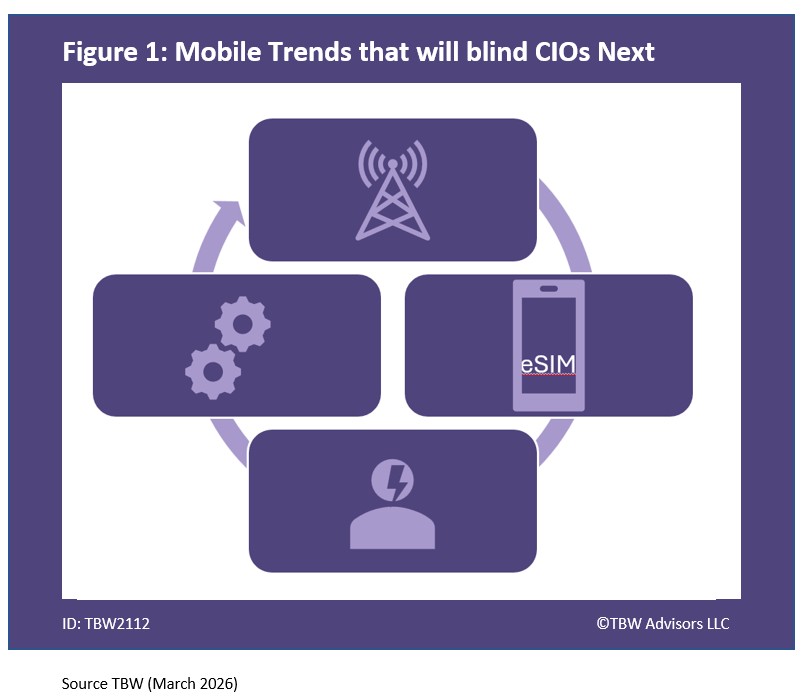
We took the most frequently asked and most urgent technology questions straight to the mobility and wireless experts gathering at the MWC Las Vegas held at the Fontainebleau. This Whisper Report addresses the question regarding what mobile tech trend will blindside CIOs next as depicted in Figure 1.
Figure 1. Mobile trends that will blindside CIOs next
Moving to 5g
With more than five years since 5g started rolling out it is easy to ignore the trend of moving to 5G yet many organizations are not paying attention to its growing maturity. As GetWireless’ Anthony Besett denoted, “Potentially not moving to 5G soon enough is going to blindside a lot of CIOS, right? Just because, the industry is evolving really fast. The module manufacturers are pumping out new modules all the time, telling SEC are leading that charge. But more than that is the also the carriers. Their networks are changing and they’re rapidly evolving and they’re moving fast. And so not moving our solutions and not moving new designs to that soon enough it’s definitely going to blindside them.” If you have not yet updated our strategies and architectures to accommodate and leverage all 5g has to offer, be sure to schedule your inquiry with your TBW Advisors LLC analyst.
eSIMS
Does your organization have team members regularly traveling international? If so, managing roaming costs is a common fiscal nightmare. Hopefully this positive blindside revealed by Comfone’s Randall Peterson will make your day. “Travel eSIMs in the roaming business. It’s going to change how people roam internationally. Is going to change how people get their service.” Imagine the same rates as if you bought a disposable phone with local access SIM in every location you travelled? Now image that flexibility without the complexity of sending your teams to a store every time they land in a new country due to software and programmable SIMS?
Density of connected assets
One blind spot heading like a freight train towards many Chief Information and Chief Technology Officers is highlighted by Canoga Perkins’ Siddharth Khattar. “The fact that so many of the assets and so many of our sensors and everything that we want to work with are actually going to be mobile. We talk about robotics so much and I see that you know in other countries in Asia for instance there are you know people are talking about a density of robots of 500 plus for every 10,000 manufacturing workers in China today when we look at those numbers in the US and in Europe we’re so far behind we’re at about 300 plus 350 robots as compared to 500 plus in other areas.”
But the incoming massive density of connected assets is not the only concern. These assets coming in from the information technology (IT) side but also the operations technology (OT) side as we saw during our research on the Commercial UAV Expo. There is one huge problem. As Schneider Electric’s Katie Boeh highlighted, “The IT side doesn’t necessarily talk to the facility side that may manage their data center infrastructure if they have a legacy on premise data center. And what happens is, hey, we’re making this new technological advancement or we’re making this big investment. can you get me x amount of kilowatts of power and it’s going to be in this form factor in this rack. Those conversations need to start happening earlier because most data centers like legacy brown what we call brownfield data centers don’t have the capacity or maybe even the architecture and power distribution and cooling architecture to support a very high density powered load that’s associated with an AI solution especially like a training solution.”
IT not knowing about OT’s incoming data storage requirements and OT not knowing about IT’s power requirements. OT and IT not communicating is unfortunately a very common trend across all interfaces and integration points between the two parts of an organization. But this problem is magnified in the world of mobility. Katie explained further. “There are analysts in our industry that talk about how by 2030, 50% of the power consumption could be at the edge. What we call the edge as in not in the mega data centers. So think about that, right? How huge we know that these data centers are and how much power they consume and it’s in the news. You hear about it all of a sudden. People who have nothing to do with the data center industry know about these giant data centers. But what they might not realize is that even with all of that that is known, there’s going to be just as much power being consumed at the edge across lots of different devices. So I think that’s something that CIOS need to be prepared for when they’re thinking about their strategy. Is it hybrid? Is it all in the cloud? Is it some combination? Regardless, you need to understand what the power requirements are going to be and you need to start bringing in your facilities people that are responsible for answering those questions of do we have the capacity? What’s possible? Bring them in soon.”
That’s correct. If you are a tech leader, the power problem is also yours to ensure it is solved. Power engineers, engineers in OT, and the engineers in IT all want the same thing. To delight the company’s customers with a successfully working product and/or service. That takes everyone keeping all in the loop from the beginning.
Related playlists and Publication
- Whisper Report: What’s the biggest 5G myth tech leaders still believe?
- Whisper Report: How will edge AI reshape enterprise architecture?
- Whisper Report: What mobile tech trend will blindside CIOs next?
- Whisper Report: What’s the best part about attending MWC live in Vegas?
- Conference Whispers: MWC Las Vegas
Corporate Headquarters
2884 Grand Helios Way
Henderson, NV 89052
©2019-2026 TBW Advisors LLC. All rights reserved. TBW, Technical Business Whispers, Fact-based research and Advisory, Conference Whispers, Industry Whispers, Email Whispers, The Answer is always in the Whispers, Whisper Reports, Whisper Studies, Whisper Ranking, Whisper Club, The Answer is always in the Whispers, and One Change a Month, Vegas Convention Library; Leading Professionals, Real Questions, Real Time, are trademarks or registered trademarks of TBW Advisors LLC. This publication may not be reproduced or distributed in any form without TBW’s prior written permission. It consists of the opinions of TBW’s research organization which should not be construed as statements of fact. While the information contained in this publication has been obtained from sources believed to be reliable, TBW disclaims all warranties as to the accuracy, completeness or adequacy of such information. TBW does not provide legal or investment advice and its research should not be construed or used as such. Your access and use of this publication are governed by the TBW Usage Policy. TBW research is produced independently by its research organization without influence or input from a third party. For further information, see Fact-based research publications on our website for more details.