Published to Whisper Club: August 17, 2026 ID: TBW2100
Analyst(s): Dr. Doreen Galli
Photojournalist(s): Dr. Doreen Galli
ABSTRACT
“This Whisper Report investigates what HR tech trend will disrupt engineering hiring next. Filmed at HRTECH2025 in Las Vegas, it explores how emerging technologies are reshaping how organizations evaluate, select, and develop engineering talent. Experts examine shifts that may redefine both hiring processes and workforce composition. Cited experts: Michael Dunn Eightfold AI, Nikos Livada HireRoad, Josh Adams RChilli, Sabashan Ragavan HeyMilo, Patrick Leddin FranklinCovey Leadership, Jeff Williams Aptia, Drew Lawrence Gem, Eli Kameron Darwinbox, David Pothier FitFirst.”
Analysis available only to Whisper Club at this time. Join the YouTube Whisper Club at the Whisper Club Level to get access to the video edition today.
Target Audience Titles:
Recruiters, HR Analysts, Talent Analysts, Recruiting CoordinatorsRelated playlists and Publication
Chief Human Resources Officer, Chief Talent Officer, Chief Technology Officer, Chief Digital Officer
Talent Acquisition Leaders, HR Technology Leaders, Engineering Hiring Managers, Workforce Strategy Leaders
Key Takeaways
- Agentic AI is transforming screening, assessment, and hiring speed across engineering roles.
- Skills-based hiring is replacing traditional role definitions with more dynamic capability mapping.
- Increased data transparency and AI productivity tools are reshaping hiring dynamics and entry-level pathways.
What HR tech trend will disrupt engineering hiring next?
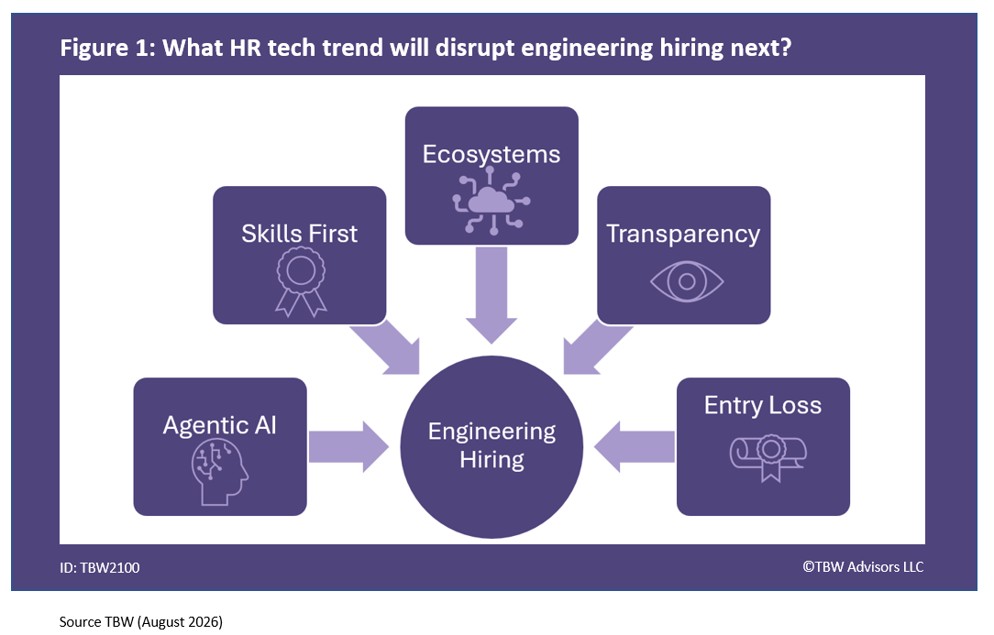
We took the most frequently asked and most urgent technology questions straight to the human resource technology professionals gathering at HRTECH held in Las Vegas. This Whisper Report addresses the question regarding what HR tech trend will disrupt engineering hiring next? Figure 1 displays the five HR tech disruptions engineering leaders can’t ignore.
Figure 1. What HR Tech trend will disrupt engineering hiring next?
1. Agentic AI
Eightfold AI’s Michael Dunn brings us the first disruption. “More agentic capabilities brought into play for either initial screenings or through walkthroughs in terms of the positions and the qualifications of the engineers as well as that you’ll see more coming into play with AI used for the assessments and bringing that all together for the hiring manager’s decision.” While creating all this friction during the hiring process Michael also has a friendly reminder. “There is a shortage for engineers in a lot of realms, but I think even with critical skills, people are taking more of a critical eye. I don’t think yet like the full force of say like candidate fraud will unfold. We are hearing stories about that. But what I do think is when it comes to hiring for engineers, they are going to be finding more of tools brought to play about screening interviews, assessments, and then also when you start going through more going over your proof of work and credentials. And that is one where they might have more like agents come into play.” But Michael was not along in recognizing the use of agentic AI. As HireRoad’s Nikos Livada simply stated, “agentic AI is what’s happening in our industry and it’s very important in what we do.”
Of course this raises the question, what is the net affect of all these agents in the process? RChilli’s Josh Adams provides clarification. “Reducing the amount of human interaction between you know candidate and recruiter. It’s going to help streamline and the major disruption is going to be time frame. People are going to be getting answers quicker. They’re going to be getting responses to their applications quicker. It’s a great thing we all want to see.”
With all this agentic AI use by recruiting it raises the question, what about its use by candidates? HeyMilo’s Sabashan Ragavan suggested this very disruption. “Identifying how candidates can actually use AI when they’re building. I think what we’re seeing is like AI is a tremendous accelerant to one’s productivity. I don’t think candidates should be potentially penalized if they’re using an AI tool to help them code more effectively. And I think there needs to be ways to assess the tenant’s ability to leverage these different tools.” In other words, the entire process from the organizations side as well as the candidate side will be touched by this agentic trend.
2. Skills First
Many believe the disruption will come from the requirements sought in candidates. HireRoad’s Nikos Livada brings us disruption number two. “Engineering hiring is heavily reliant on skills and skill sets and the analysis and the ability to get to the bottom of what skills a particular engineer has that will fill the need of a particular organization and I think the advent of skills hiring is really important and you couple that with people insight.” But skills for engineers are not as simple as a checklist for a given discipline. The systems must truly understand the skills required to accomplish the task. In addition, in the agent world, humans are about connecting things. As such FranklyCovery Leadership’s Patrick Leddin observed, “Historically engineers have been highly functional. I’m a mechanical engineer. I’m an electrical engineer. I’m whatever type of engineer I’ve been trained to be. And I’ve gone through that discipline very consistently from the first day I showed up in a college campus. That’s going to change dynamically because the expectation is going to be people can’t just know one thing. They’re going to need to know many things. So, how do we start cross-pollinating ideas across the engineers we recruit into our organizations?”
3. Ecosystems
One shift is sure to delight all of those in HR technology. Aptia’s Jeff Williams pointed out that, “It’s just going to be easier to stitch together an ecosystem of providers in order to deliver real business outcomes. Think about the complexity going on today around engineering a full ecosystem to provide an end-to-end tech solution. The way that these tools are evolving, the way that AI is generating answers and the way APIs are making systems talk to each other. I think a lot of the mystery in those connections is going to go away in favor of mining the actual information to provide the insights to drive the actions to create a better business. Less plumbing, more oversight and action.” Jeff was not alone in this observation. Gem’s Drew Lawrence also noted that many are “Taking a platform approach so that everything is in-house all in one place rather than trying to use a sourcing tool separate from an ATS with a separate CRM and everything like that. That ends up being really convoluted and disconnected.” Who doesn’t love one cohesive seamlessly integrated system?
4. Transparency
Our disruption was observed by Darwinbox’s Eli Kameron. “Employers will have more information than ever. For a while, top engineers sort of had their pick of the litter to go and do what they wanted. But as more information becomes accessible and the playing fields become more democratized, as we become more global, I think that engineers trying to do things like being over employed is going to be a thing of the past.” Evidently, many organizations are concerned with overemployed engineers even if they are delivering for them.
5. Entry Loss
One of the most concern of all disruptions was brought to us by FitFirst’s David Pothier. “We’ve seen the start of the Gen AI and the AI development assistants really changing the way that engineers work. I mean, rather than hiring junior engineers, we’re basically equipping software developers with a with AI, right? It’s the same thing. They’re having to review the code. They’re having to manage it. They’re having to sort of they’re really it’s really giving them the same productivity bump as adding a person. I don’t necessarily know if this is a good thing cuz how are we going to get great programmer the next generation of great programmers into the industry? But that’s the trend that I’m seeing sort of start to happen. I think we need to still bring people in because otherwise, you know, we’re going to create a problem because eventually.” Thus, entry level talent is going to need to be creative, independent, and tenacious to get the experience they need to burst into the industry. Concerning on a grand scale.
Related playlists and Publication
- Playlist for Whisper Report: What’s the biggest AI risk in HR no one talks about?
- Playlist for Whisper Report: How should CTOs rethink org design with GenAI?
- Playlist for Whisper Report: What HR tech trend will disrupt engineering hiring next?
- Conference Whispers: HR Tech 2025
TBW Advisors LLC retains full editorial independence. Supporters receive credit acknowledgment only and have no role in editorial decisions, content selection, or production.
Corporate Headquarters
2884 Grand Helios Way
Henderson, NV 89052
©2019-2026 TBW Advisors LLC. All rights reserved. TBW, Technical Business Whispers, Fact-based research and Advisory, Conference Whispers, Industry Whispers, Email Whispers, The Answer is always in the Whispers, Whisper Reports, Whisper Studies, Whisper Ranking, Whisper Club, The Answer is always in the Whispers, and One Change a Month, Vegas Convention Library; Leading Professionals, Real Questions, Real Time, are trademarks or registered trademarks of TBW Advisors LLC. This publication may not be reproduced or distributed in any form without TBW’s prior written permission. It consists of the opinions of TBW’s research organization which should not be construed as statements of fact. While the information contained in this publication has been obtained from sources believed to be reliable, TBW disclaims all warranties as to the accuracy, completeness or adequacy of such information. TBW does not provide legal or investment advice and its research should not be construed or used as such. Your access and use of this publication are governed by the TBW Usage Policy. TBW research is produced independently by its research organization without influence or input from a third party. For further information, see Fact-based research publications on our website for more details.