Published to Whisper Club: June 9, 2026 ID: TBW2081
Analyst(s): Dr. Doreen Galli
ABSTRACT:
“This Whisper Report investigates how can we leverage customer interaction data to drive business insights and innovation. Based on expert perspectives gathered at Customer Connect Expo held in Las Vegas, teasing how everyday conversations can become enterprise-wide signals—before the best opportunities and risks surface on their own. Cited experts: Siva Kannan Ganesan Macy’s, Dr. Kalifa Oliver at Ford, Sean Gigremoss at Claritiv, Atul Grover at Enthu.ai, Dayna Neumann at Unified Direct Solutions, Pedro Lopez Slevin at Mitrol, Alex Hamberger at Blitz, Zac Brooksher at Verse.ai and Patrick Reynolds Etech.”
Target Audience Titles:
- Chief Technology Officer, Chief Digital Officer,
- Chief Data Officer, Chief Marketing Officer, Chief Content Officer
- Head of AI and Machine Learning, Data Scientists
- Product Managers, Content Managers
Key Takeaways
- Customer interaction data is a “gold mine” only when captured, analyzed, and shared across sales, service, product, and leadership.
- Use interaction signals to deliver personalization at scale and continuously surface customer trends for faster decision-making.
- Detect dissatisfaction early, pinpoint root causes, and close training gaps by pairing customer interactions with employee feedback.
- Apply insights to operations and growth: anticipate inventory demand, feed product improvements, and reduce friction to improve sales outcomes.
How can we leverage customer interaction data to drive business insights and innovation?
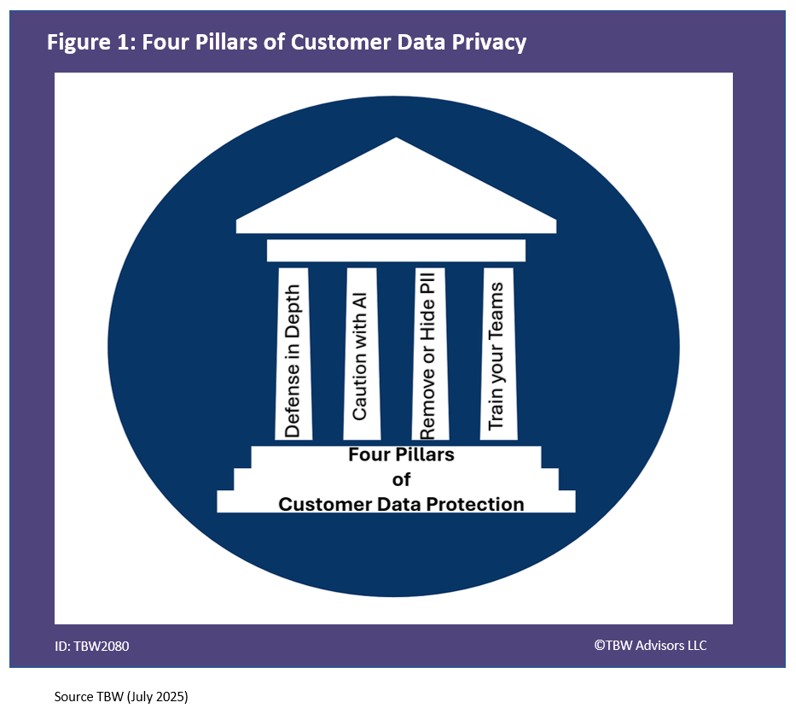
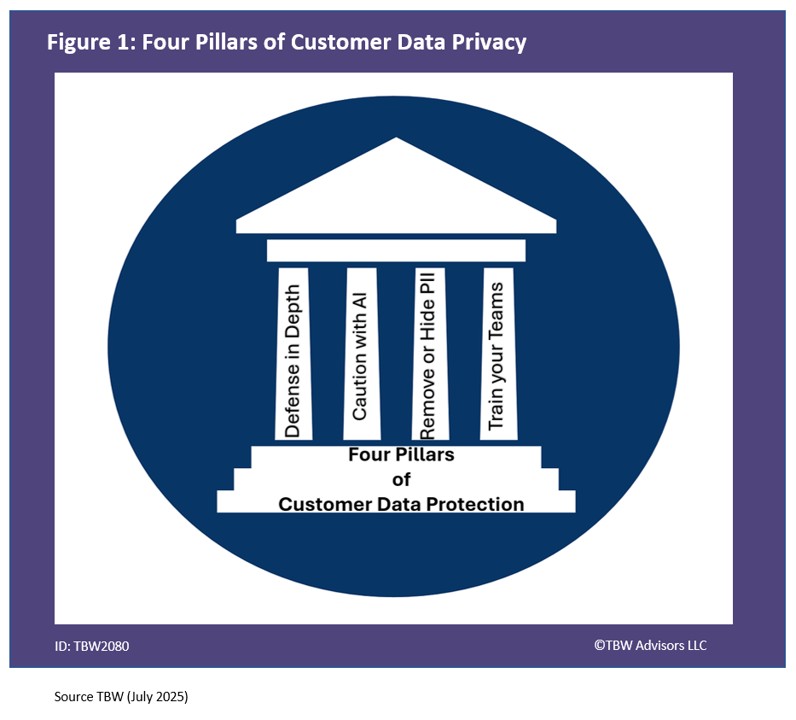
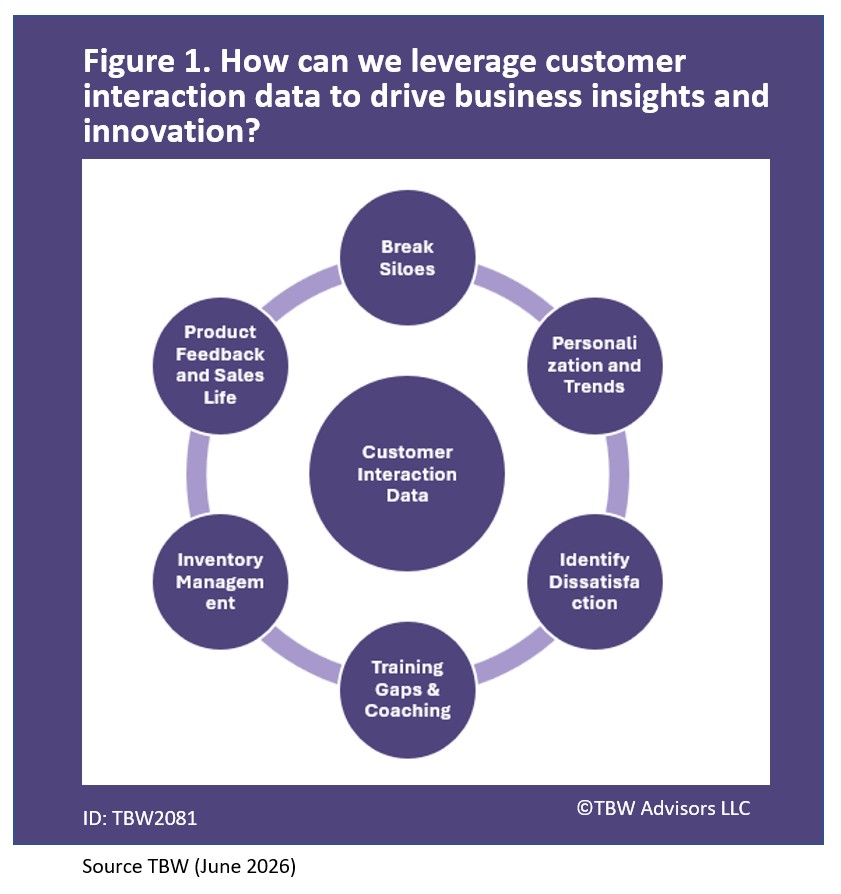
We took the most urgent industry questions to experts at Customer Connect Expo held in Las Vegas. Figure 1 summarizes how can we leverage customer interaction data to drive business insights and innovation.
As Macy’s Siva Kannan Ganesan stated, “The customer interaction data is a gold mine.” Unfortunately, as Ford’s Dr. Kalifa Oliver observed, “we don’t spend enough time on the content of the interaction.” Furthermore, there are many types of customer interactions that can maximize the potential. Claritiv’s Sean Gigremoss put it simply. “You can’t be everywhere at once. Your salespeople are talking to customers. Your product people are talking to customers. Your service people are talking to customers and even your leadership are talking to the leadership of those customers and a lot of times those in that that information that conversation is siloed based out of a sales process or a service process. You don’t really understand what’s really going on holistically.”
Plethora of Use Cases
Those gathering at CCE25 did not disappoint in suggesting ways to leverage customer interactions to drive business insights and innovation. As Enthu’ai’s Atule Grover said, “whether it’s through phone call chats web chats emails etc we find those insights and provide those actionable data.”
Personalization & Trends
As one might expect, the most prolific use case is personalization. The difference today is the ability for organizations to execute personalization at scale. As Macy’s Siva Kannan Ganesan explained, “Every navigation, every click of a customer, we read the data. That will help us to give the feedback loop to the recommendation engine and we do the recommendation engine with the two tower model like how the customer can be getting it more than the personal it’s like personalization is one end and analyzing the trends (on the other).” Unified Direct Solutions’ Dayna Neumann shared a similar thought regarding customer trends. “The number one way that companies can leverage the information they’re receiving from their customer call centers to innovate for the organization is to capture all of that conversation and package it up into a few key points and then and then use AI or use whatever tools you have available to watch for those trends.”
Identify Dissatisfaction
To be a business, one requires customers. If customers are unhappy or have a problem, they may not return or may spread the word on why they regret becoming a customer therefore scaring off future customers. Thus, it is quite valuable to understand when a company is missing the mark with its customers. As Enthu.ai’s Atul Grover stated, “if there’s any kind of dissatisfaction with the clients and the customers so our software will track those insights and provide those information to do so that our customers can take care of all the next best action what they need to do or what they need to basically handle in terms of coaching their agents in terms of coaching their sales representatives or coaching their customer services representatives to ensure that they know they are doing the right things in the right way next time.” Fortunately, as Ford’s Dr. Kalifa Oliver pointed out, “with customer interaction data is that it gives you an idea very quickly where the problems are.” Of course, as Mitrol’s Pedro Lopez Slevin said, “once we know how they work what they do what’s the main problem then we can go and search all the databases APIs or whatever they have to integrate that and get the best solution.”
ID Training Gaps
Sometimes, customer service is the problem! Not intentionally but sometimes there is just a gap of knowledge or capability between what your front line knows and has access to versus what is needed to succeed with the customers. As Ford’s Dr. Kalifa Oliver observed, “there a gap in the training that you’re giving people that’s actually frustrating your customers, so it helps you improve the experience for everyone at the end of the day.” Chances are, that training gap is also impacting your employee satisfaction. As such Dr. Oliver went on to further suggest, “balance the customer interaction data with the employee interaction data. What are the employees actually hearing? Does it match the interactions that people are having with the customer? so one it helps you with your product and your product business and it mitigates risk.” Anytime you can combine one data set with another data set with some overlap, you’re bound to find additional insights.
Inventory Management
As we shared earlier, the more data you can combine together that has a common connection point, the more insights you can garner to move your organization forward. One of those interesting use cases was shared by Macy’s Siva Kannon Ganesan. “You’ll be able to do more control over there how the inventory can be managed and this u with all these trends.” That’s right. One of the trends that can be observed through customer interactions are inventory demands.
Incorporate Customer Feedback into Products
One of the most exciting manners to leverage customer insights for innovation is straight back into product design. Blitz leverages video for customer interactions providing it a significant data set not customarily available to companies on their products. As Blitz’s Alex Hamberger suggested, “we see some real opportunity to leverage some of the customer data that is collected through our video calling is a real sort of ripe opportunity to visualize exactly how products are being used in the real world by customers. Where the points of failure are while also documenting what the common resolution steps are for different products within either a product line or across a different family of brands.”
Improve Sales
Top line growth is monitored by every senior executive. Leveraging customer insights for increased sales is always attractive but how exactly can it be done? The more we understand our best customers, the easier it will be to try to find more like them and grow revenues. Verse.ai’s Zac Brooksher has a recommendation on how the insights can reduce friction on the path to a sale. “we’re able to understand when companies are being communicated with from their prospective customers what time of day? What .. the next best call to action from that insight and that data as well and really driving the best way to minimize paths of resistance so how can we quickly address customer issues get them to the right department um without bogging down our people power internally.”
Unified Direct Solutions’ Dayna Neumann denoted, “package up all of those interactions bubble up the trends … and get even more dialed into what your current customers and of course when you’re doing modeling you know what current customers are asking for now you can improve what you’re saying to those prospective customers in your acquisition campaigns and hopefully all boats rise in the end. “ As Etech’s Patrick Reynolds suggested, “what we’re doing when we’re looking at that data is that we’re trying to find the unique attributes of that contact that are delivering the outcomes that you want the successful outcomes.” Thus they are using the data to find out patterns to succeed with customers on calls thereby increasing results = sales. Patrick went on to explain further. “What we’re doing when we’re looking at that data is that we’re trying to find the unique attributes of that contact that are delivering the outcomes that you want the successful outcomes.” In other words, what do our great customers look like? Once we know who loves our products, we can focus our attention on finding more loyal customers.
Related playlists
- Whisper Report: How can we integrate AI-driven customer service solutions with our existing IT infrastructure?
- Whisper Report: What are the most effective strategies for ensuring data security and privacy in customer interactions?
- Whisper Report: How can we leverage customer interaction data to drive business insights and innovation?
- Conference Whispers: Customer Connect Expo 2025
- Conference Whispers: Customer Connect Expo 2025 (the report)
Corporate Headquarters
2884 Grand Helios Way
Henderson, NV 89052
©2019-2026 TBW Advisors LLC. All rights reserved. TBW, Technical Business Whispers, Fact-based research and Advisory, Conference Whispers, Industry Whispers, Email Whispers, The Answer is always in the Whispers, Whisper Reports, Whisper Studies, Whisper Ranking, Whisper Club, Whispers, The Answer is always in the Whispers, Vegas Convention Library, and One Change a Month, are trademarks or registered trademarks of TBW Advisors LLC. This publication may not be reproduced or distributed in any form without TBW’s prior written permission. It consists of the opinions of TBW’s research organization which should not be construed as statements of fact. While the information contained in this publication has been obtained from sources believed to be reliable, TBW disclaims all warranties as to the accuracy, completeness or adequacy of such information. TBW does not provide legal or investment advice and its research should not be construed or used as such. Your access and use of this publication are governed by the TBW Usage Policy. TBW research is produced independently by its research organization without influence or input from a third party. For further information, see Fact-based research publications on our website for more details.