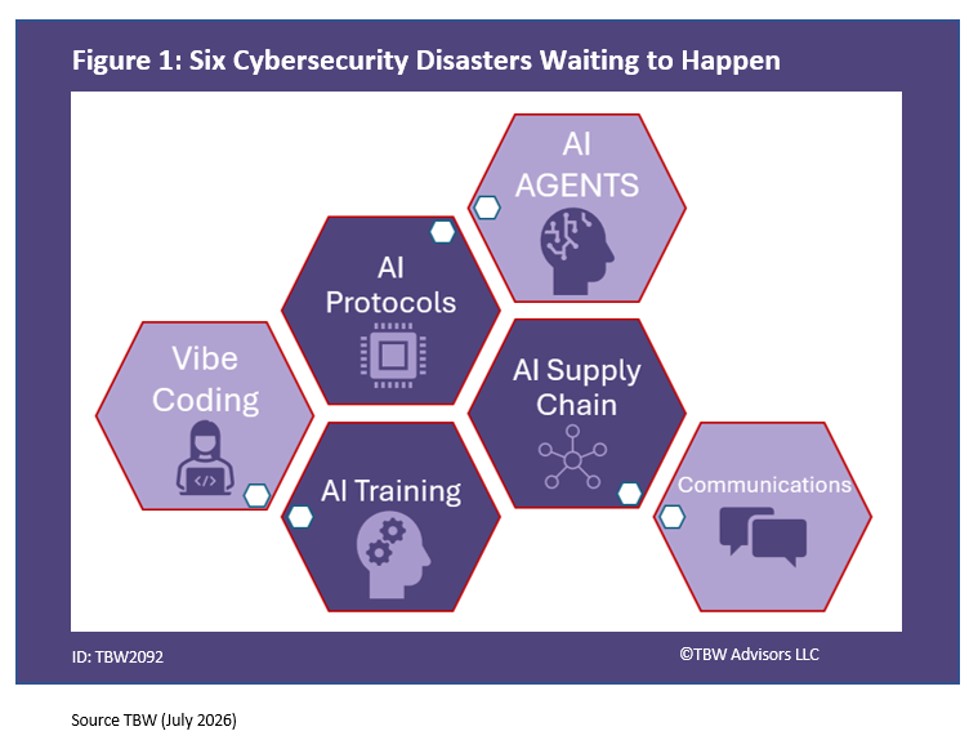
“This Whisper Report investigates what the next SolarWinds-level breach waiting to happen may be. Filmed at Black Hat USA 2025 in Las Vegas, it examines how rapidly evolving technologies are introducing new risks that organizations may not yet fully understand. Experts explore where these emerging vulnerabilities could surface at scale. Cited experts: Jonathan Rende Checkmarx, James Spiteri Elastic Security, Alex Lanstein StrikeReady, Brian Mehlman Cyber Innovate, Thomas Roccia Microsoft, Ariful Huq Exaforce, David DellaPelle Dune Security, Saket Bajoria Safe Security.”
Whisper Report:Can AI defend against AI-powered attacks?
Published to insiders: January 13, 2026 ID: TBW2091
Published to Whisper Club: January 14, 2026
Published to Email Whispers: April 20, 2026
Analyst(s): Dr. Doreen Galli
Photojournalist(s): Dr. Doreen Galli
Abstract
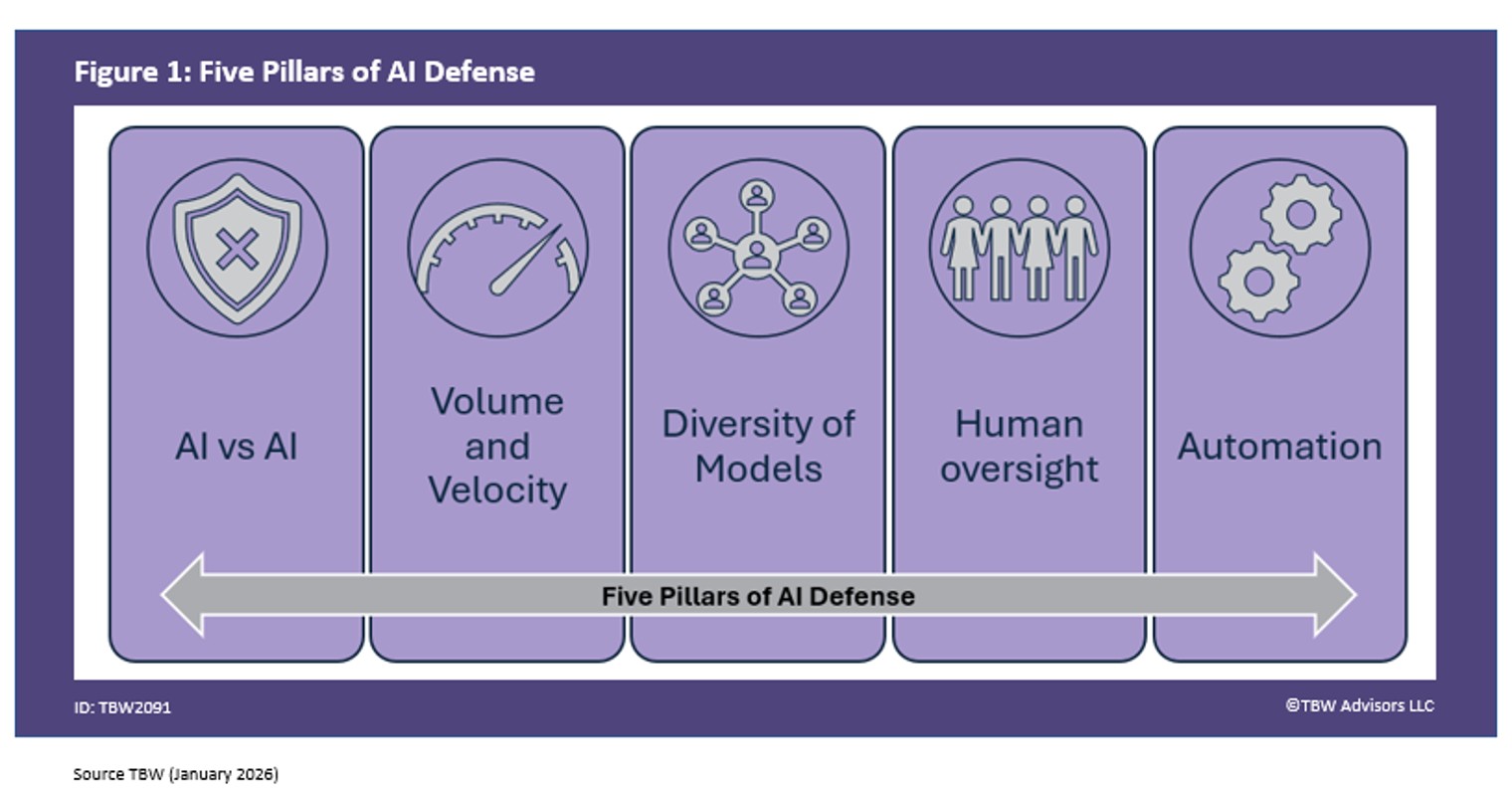
“This Whisper Report explores the evolving cybersecurity landscape where AI defends against AI-powered attacks. Drawing insights from Black Hat USA 2025, it outlines four foundational dimensions of AI defense—from scaling and automation to ethical oversight and model diversity—within the context of an escalating AI vs AI arms race. The report emphasizes strategic adaptation, human involvement, and the limitations of current technologies in this rapidly advancing domain. The analysis incorporates perspectives from leading experts and organizations featured at Black Hat USA 2025, including Elastic Security’s James Spiteri, Safe Security’s Saket Bajoria, Cymulate’s Avihai Ben Yossef, Exaforce’s Ariful Huq, Dune Security’s David DellaPelle, Netarx’s Sandy Kronenberg, Cyber Innovate’s Brian Mehlman, Checkmarx’s Jonathan Rende, and Microsoft’s Thomas Roccia.”
Target Audience Titles:
Chief Information Security Officer, Chief Technology Officer, Chief Digital Officer, Chief Information Officer
Chief Product Officer, Chief Experience Officer
IAM engineers, Security Architects, DevSecOps Engineers, IT Ops Managers, Application Security Architects, AI security specialists, Cyber Risk analysis
Key Takeaways
AI vs AI defines today’s threat landscape, requiring defenders to match attacker sophistication.
Attack volume and complexity are rising, demanding scalable, automated responses.
Multiple AI models are essential, as no single model can cover all threats.
Human oversight is vital, ensuring ethical use and contextual accuracy.
AI boosts efficiency, freeing experts from repetitive tasks.
Limitations remain, and defences must evolve with emerging threats.
We took the most frequently asked and most urgent technology questions straight to the Cybersecurity professionals gathering at Black Hat USA 2025 held in Las Vegas. This Whisper Report addresses the question if AI can defend against AI-powered attacks?
In the event it is not obvious yet, one must understand that the new battlefield in cybersecurity is AI vs AI. As Elastic Security’s James Spiteri shared, “I absolutely think AI can fight AI. We’re seeing this today. Uh there’s been a lot of investment in both AI offensive techniques as well as AI defensive techniques. You know, we’re on the defensive side of the house. So we’ve done a ton of research into how effective it actually is and it doesn’t work.” Safe Security’s Saket Bajoria couldn’t agree more. “The only way to combat that is through AI and the attacks is going to be between AI and AI. Humans are just going to be watching it right. So, so the sooner we accept the fact that it’s AI against AI and we do we do watch it ethically and all that like we are ready for that otherwise the more we deny that the more we’ll get impacted.” Or to quote a very famous Classic sci-fi superintelligence named the Borg, “resistance is futile.” Then again, its just an evolution of the traditional cat and mouse game within cybersecurity. As Cymulate’s Avihai Ben Yossef maintained, “I think AI powered attacks can also be protected by AI and vice versa. I think AI powered defense can also not be protected by AI powered attacks. It’s still an ongoing chase that will happen with AI. It happened before AI. It’s going to happen now with AI. The ongoing chase will keep on happening even in the AI world.”
Considering AI will be a required part of the solution for the AI vs AI battle, it is valuable to consider how AI will be leveraged. Exaforce’s Ariful Huq affirmed, “AI can help defend against AI based attacks because mostly from the volume of attacks that we’re going to start seeing because people are going to be leveraging AI to do all kinds of things and the barrier to entry to actually performing these types of attacks is going to be much lower. So you’re going to see a larger volume and that means you need a way you need machines to be able to detect, investigate and respond to these types of attacks because humans are not going to be able to keep up with them.” Coming from a similar angle, Dune Security’s David DellaPelle elaborated, “I think when you think about AI, there’s kind of two elements. There’s the quantity of attack and the quality of attack lead to to breach, right? It’s incredibly important for security companies and security organizations to have really foundational AI models that can help meet the scale right the increased quantity of attacks that are coming from AP groups like scattered spider as well as the quality of attacks.”
Understanding it will ultimately a battle of AI vs AI and AI is necessary to handle the quality and quantity of attacks, it is valuable to understand you will be leveraging multiple models. For anyone who has created AI products, this is common knowledge. The expression is any given model may fail but the product or the solution cannot. Netarx’s Sandy Kronenberg dove into this critical aspect. “AI can defend against AI attacks, but only if we’re using a multitude of AI inference models from many many different sources with which to defend against AI attacks. Social engineering that’s AI powered fraud as an example can only be defeated if you’re using inference models from every single source of metadata and or voice and video inference models. It’s a hard way to it’s very complicated.”
One always present question when it comes to AI is the line between automation – particularly with agents – and maintaining the human in the loop. Cyber Innovate’s Brain Mehlman and his AI Agent Ralph raises one very valuable question, “What is the AI powered attack? Am I doing AI where I’m actually poking into a system brute force or is actually an AI in the system doing something rogue?” Regardless of the scenario, Brain and his AI Agent Ralph went on further to explain, “You still need human oversight. You still need to understand the context. And you have to remember that an AI defending system can have its own blind spots and yes, AI can be a powerful tool for defense, but it’s part of a bigger strategy and it’s all about using it wisely and understanding that it’s a constantly evolving game.” This was best summarized by Microsoft’s Thomas Roccia, “there is no silver bullet. It’s all about building the right AI system to assist you. you and make sure that the result of an AI is accurate enough for your investigation.” In addition to accurate, we will also hope the AI solution is transparent enough that it obtains and maintains trust amongst its human users.
As discussed many times during our coverage of the media industry, AI has two strengths. It eliminates tedious and mundane tasks from humans and allows them to focus on the other parts. Same can be said for AI in cybersecurity. As Checkmarx’s Jonathan Rende observed, “eliminating mundane toil like repetitive error prone human tasks that we can just take away and allow the experts with their hand on the wheel to actually better use their time in more valuable activities.” Of course this automation doesn’t just benefit the White Hats or those trying to defend people and organizations. Jonathan went on to further explain, “ AI raises the bar both for attackers, but it raises the bar for defenders as well. So, both have to make use of this.”
Cyber Innovate’s Brain Mehlman and his AI Agent summed it up. “So from our perspective, the short answer is yes. AI can defend against AI powered attacks, but with some caveats. Essentially, it’s a kind of arms race. The same technology that can be used to launch AI driven attacks can also be used to build defenses. So we’re seeing AI being used to detect patterns, to automate responses, and to kind of keep up with the speed and scale of AI driven threats. But the nuance here is that it’s not a silver bullet. It’s not like you can just drop in AI and it will perfectly defend against everything.” As Microsoft’s Thomas Roccia reminded us all, it is an evolving landscape. “We are probably not there yet. I think we are started to see some interesting attack with AI such as malware which will embed some LLM prompt and some automatic generation of command inside the bridge the infected machines. I think it’s still the beginning.” And so the game of cat and moues of cybersecurity continues now including AI vs AI.
Whisper Report:What’s the biggest cybersecurity myth in 2025?
Published to clients: August 19, 2025 ID: TBW2090
Published to Readers: August 20, 2025
Whisper Email Release: TBD
Public and Video Release: TBD
Analyst(s): Dr. Doreen Galli
Photojournalist(s): Dr. Doreen Galli
Abstract:
This Whisper Report identifies eight persistent cybersecurity myths in 2025, from the belief that threats can be fully stopped to misconceptions about AI’s role in security. Experts from Black Hat USA 2025 clarify that resilience, strategic investment, adaptive training, and human oversight remain essential. AI is powerful but not a plug-and-play solution, nor a replacement for human judgment. Understanding these myths helps organizations build more realistic, effective cybersecurity strategies.
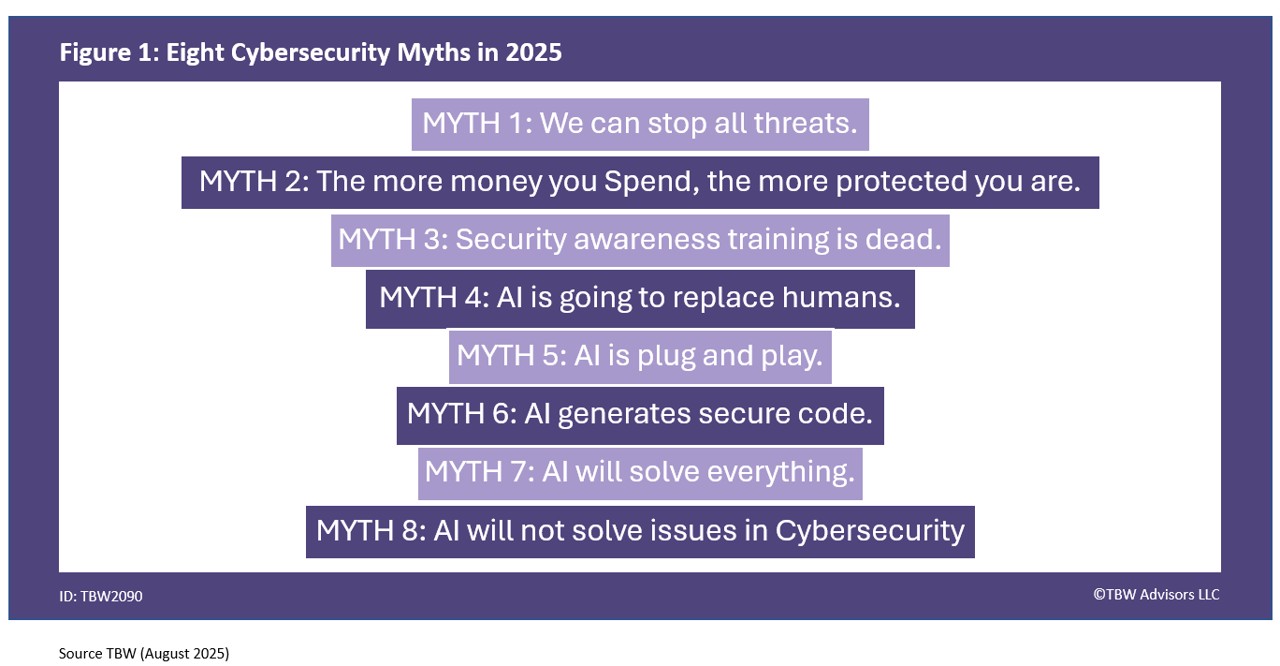
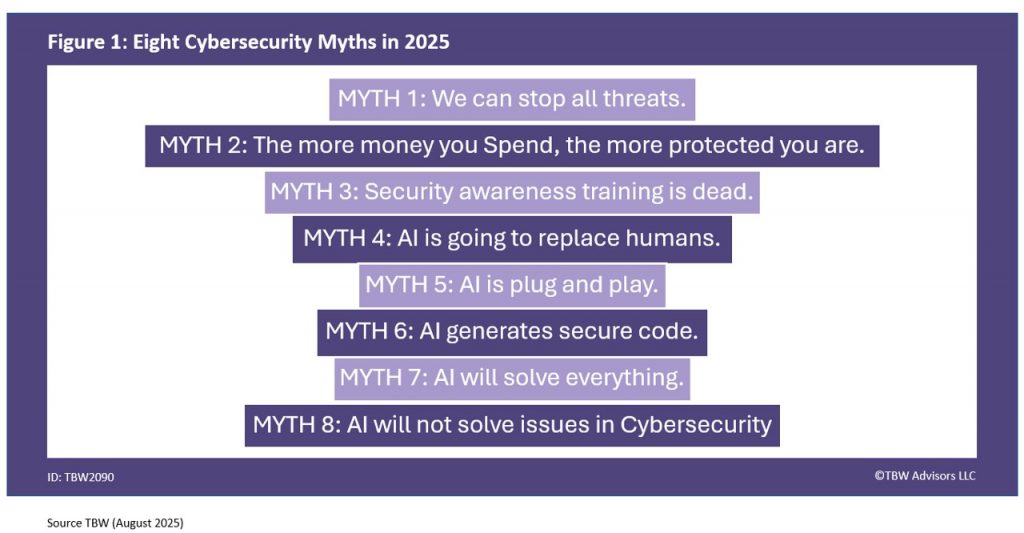
We took the most frequently asked and most urgent technology questions straight to the Cybersecurity professionals gathering at Black Hat USA 2025 held in Las Vegas. This Whisper Report addresses the question regarding what’s the biggest cybersecurity myths in 2025? Figure 1 displays the eight cybersecurity myths we uncovered we will now discuss.
MYTH 1: We can Stop all Threats
The first myth comes from Trustmi’s Corey Sienko and is that “we can stop every single threat from entering the organization” This may come as a surprise to some executives particularly those outside of cybersecurity but the expression used is always when not if you have an incident. No Need to fret, Trustmi’s Corey Sienko continues. “It’s about how do we respond to those threats and make sure that we protect the organization from losing valuable information and cards.” I believe all appreciate that clarification. Cybersecurity involves defense but it is also a game all about preparation for when and resiliency after. This topic is further discussed in Conference Whispers: Black Hat USA 2025.
Cymulate’s Avihai Ben Yossef brings us myth number two, “The more money you spend on cyber security the more protected you are.” Ben goes on further to explain. “I think in order to really be protected in cyber security from cyber attacks is by actually knowing what you need to do in order to make sure you are protected and when once you know that you don’t need to spend too much money you need to spend you know a very focused amount of money in what matters most.” If you are surprised by this, you really need to book an inquiry with TBW Advisors so we can help you review your cybersecurity strategy. Additional research regarding critical observations on cybersecurity spend can be found in the keynote covered within Conference Whispers: Identiverse 2024.
Cybersecurity Myth number three comes to use from Dune Security’s David DellaPelle. “Security awareness training is improving readiness and reducing risk. Security awareness training is dead.” Intrigued? Let’s hear more from David. “Security awareness training as it exists today, meaning legacy security awareness training technologies are not effective at reducing risk and create friction and an adversarial relationship between the security organization and the end users. The problem is if you think about a doctor who is looking to solve a patient’s problem, the first thing they would do is take in a lot of data and run tests to exclude the possibilities. They quantify the risk before they prescribe a medicine or a surgery. And so if there’s a security awareness training solution that doesn’t automatically provide uh user adaptation, it’s uh it’s kind of falling flat on its face. Every piece of security control or adaptation should be relevant to the individual user’s risk profile and that training or that security measure should be applied automatically based on the risk profile.” Training employees only on what that specific employee personally need to get better at? Sounds optimized.
Bringing us cybersecurity Myth 4 is StrikeReady’s Alex Lanstein. “AI is going to replace humans.” Alex further clarifi:ed, “AI is always going to augment humans. Anybody who’s ever leveraged any AI system, any generative AI system. You see that it makes mistakes. Sometimes those mistakes are obvious, sometimes they’re subtle. And no one is ever going to turn anything over to an AI when it’s making such obvious or subtle mistakes without a human in the loop.” Or as Elastic Security’s James Spiteri further explained, “we’re thinking about this fully autonomous security operations team. I don’t think that’s going to happen. I don’t think even think it’s the right approach to think about these things. AI and agents are phenomenal, but they are the perfect compliment to humans. They’re not they’re not there to replace humans. They’re there to make humans lives better. eliminate the stuff that humans don’t want to do and let humans do the fun things like make people excited about wanting to work in cyber and that’s what the AI is allowing us to do.”
of my agents, and his name is Ralph. Ralph, can you answer the question as you see it in our world view? What’s the biggest cyber security myth here in 2025? Absolutely, Brian. Happy to jump in here. So, from our perspective, the biggest cyber security myth of 2025 is probably the idea that AI is just a plug-and-play solution, that it’s kind of a one-size fits-all magic bullet.” Ralph and Brian went on to further explain, “In reality, the myth is that AI will handle everything securely on its own. But the truth is it needs a lot of oversight, a lot of transparency, and people often underestimate the complexity inside the machine. So that’s the big myth that AI is just simple and straightforward when really it’s a lot more nuanced. And that’s my take. Uh I would add my answer. I would extend onto yours is I agree, but um I’m used to systems that have access controls, authentication controls, and audit. Uh inside the black box, we don’t have any of them. Once I log in and I authenticate, it’s a wild wild west. That has to change. Immutable logs within the system is probably something that’s going to happen at some point. Uh or some other unique uh solutions to the problem.”
Interestingly, Ariful Huq from Exaforce observed a similar concern. “Trying to build an LLM wrapper is what I call it without really understanding the data related to the problems that you’re trying to solve. LLMS can only get you so far, right? They are large language models and summarization and contextualization but at the end of the day if you want to solve problems related to say detections investigations LLMS can only get you so far right you really need to go back to the data go back to the fundamentals and then layer on a large language model on top of it to solve some of the problems that around like you know summarization um you know building agent workflows.” In other words, solutions are custom crafted – NOT plug and play.
Checkmarx’s Jonathan Rende brings us Myth 6, “AI generates secure code.” That myth should grab the attention all organizations leveraging coding agents to quickly advance their product. Jonathon continues, “It doesn’t. It doesn’t. And it will probably get better over time. And will it do a better job than a junior developer in simple mistakes that can cause vulnerabilities? Heck yeah, of course it will. But for the more complex issues, it’s not there yet. AI is not there yet.”
Let’s hear Myth 7 from Booli’s Joe Schorr, “the biggest cyber security uh myth is that AI is actually going to solve everything.” Joe went on to further explain, “I think if you judiciously apply AI, machine learning and very discreet task and things, it’s fantastic. I think it’s being overblown quite a bit right up at the myth level. I think that if you treat it like we treat it in Booli, we’ve got AI built in, but we don’t publish it all over everything we’ve got, but we treat it kind of like an idiot savant. It’s it does one to ask really well or does a discrete set to ask really well. It may not actually behave well in church, but you can get it to do what you want for something very very specific, which is how we do it. I think the myth is that AI is going to solve everybody’s problems.” Brian Sledge of imPAC also believes that AI will solve everything is a myth. “I think AIis best positioned more like a forcemultiplier, but I don’t think it solvesthe problems, the core problems of cybersecurity today. Um cyber security stillrequires context. It requirespolicy driven control and those thingsstill require human in the loop. And Ithink the best way to leverage AI isn’t so much in solving for cyber security,but it’s more for helping multiply andscale out what humans still need andwe’re required to do. So I don’t think Idon’t think customers should sleep onthe idea that humans still need to be very much engaged as part of cyber security. Because cyber security AIis only as good as the algorithms andthe models and the data it’s getting.” Thus believing in 2025 AI will solve everything is a stretch but will it solve something?
Microsoft’s Thomas Roccia brings us Myth 8. “right now I think most people in in the industry in the security industry doesn’t yet believe in this technology (AI) and that’s maybe one of the one of the myths that AI will not really solve issue in cyber security. We have and I think that’s a mistake it’s probably something which is changing the way we are doing and all the past work that we did for the past 20 or 30 years uh is going to be changing and evolving thanks or because to AI so that’s something to consider.” Thus, while it may not solve everything today, it is changing how the industry works and what it is fighting against.
*When vendors’ names are shared as examples in this document, it is to provide a concrete example of what was on display at the conference, not an evaluation or recommendation. Evaluation and recommendation of these vendors are beyond the scope of this specific research document. Other examples products in the same category may have also been on display.
After 61 videos including 4 first ever onsite livestreams, 150 minutes of recording including multiple exclusive shots – our coverage of Black Hat USA 2025 closes. Black Hat USA 2025 featured over 100 briefings and 120 sponsored sessions, with coverage spanning keynote presentations, technical sessions, and exhibit hall innovations. Topics ranged from AI-driven threat detection and agentic SOC platforms to identity verification and proactive risk management. Trends in cybersecurity regarding defence, use of AI agents, and focus on resiliency continue to grow.
Coverage on Computer Talk Radio August 2, and August 9.
The Conference
Black Hat USA 2025 featured over one hundred briefings and 120 sponsored sessions. Attendance numbers are forthcoming. 2024’s edition featured over 20,000 in person attendees.
Cautions
Black hat is not a conference to attend without preparation. All of one’s technology should be up to date. One should ensure they are leveraging a VPN and a RDID wallet when intentionally going around black hat. If not using one’s phone, a portable faraday pouch is always beneficial.
Friendly reminder: this research provides examples of what was shared with us at the event, not an evaluation, validation, or recommendation of the given technology.
After 61 videos and related fact checks, over 150 minutes of recording including for the first time ever – four onsite LIVESTREAMS – our coverage of Black Hat USA 2025 closes. Black Hat featured over one hundred briefings and 120 sponsored sessions. Clients may recall the expo hall restrictions during our coverage of HIMSS which treated the entire expo hall like a surgical operating room from a privacy perspective. Guess what? It was even tighter at Black Hat. Nonetheless, we were able to capture the energy as Expo Hall was opening. Not only that, for the first time ever, Informa (who owns Black Hat) gave permission to someone to do a walkabout in Expo Hall prior to its opening for the day. That’s right – enjoy your exclusive look at Black Hat USA 2025 Expo Hall. Not only that, we were able to capture the mouthwatering lunch served on Wednesday. Once again, unlike most events, the What’s To Eat? Video does not include any attendees enabling us to really get a great shot of the food! A first for TBW Advisors LLC – we did four livestreams while on site. One live stream on Tuesday, Wednesday, and Thursday morning. One final livestream went out on Thursday as I requested assistance on your favorite videos for my segment on the August 9th broadcast edition of Computer Talk Radio.
While at Black Hat USA 2025, we conducted research for three additional forthcoming Whisper Reports for our clients. The playlists are unlisted but available and will eventually fill in with the video version of the report so you may wish to bookmark these playlists.
Kicking off in dramatic fashion, the conference kicked off with an amazing keynote from non-other than the most famous virus hunters – Mikko Hypponen and father of the Hypponen law of IoT security – one of our favorite coverage spaces. Specifically, Mikko said that if a device is smart, it is vulnerable. It was amazing to hear his story.
On the bleeding edge of things, we received two session summaries from Microsoft’s Thomas Roccia. The first session was his Black Hat session on NOVA – Prompt Pattern Matching regarding a new type of threat gaining traction. The second session is actually at DEFCON – the sister conference where no one would be ignorant enough to bring in modern technology outside of a faraday cage. Fortunately, we caught Thomas while at Black Hat. IN this talk Thomas shared that they are releasing an AI Agent to track crypto currency’s movements including visualization to combat crypto money laundering. The final Microsoft session itself that we captured is the Unmasking of Cyber Villains. I always love when engineers get a very loud boastful ovation from the audience. This stage featured the heroes of MISTIC and Dart who shared how they leverage each other’s strength. MISTIIC stands for Microsoft Threat Intelligence Center while Dart stands for Microsoft’s Diagnostics and Recovery Toolset. In this session, the Microsoft team emphasized that incidents require empathy, speed, and precision. The Darth team is on the ground delivering the empathy and getting the data to MISTIC. MISTIC in turn, provides the cheat codes to the Darth rescue team to quickly combat the incident.
On the topic of using AI Agents on a team of humans in wish SOC, James Spiteri from Elastic Security shared a summary of his session. “AI without Borders: Extending analysts capabilities in a modern Soc” dove into details how Agents and humans can successfully interoperate in a SOC. James also covered critical questions you need to think about in order to truly operationalize this type of situation.
As with many events, some exhibits span outside of the formal expo hall. We were invited to the Dune Security Command Center on site where we heard about their solution. Their adaptive training uses a personal credit risk scoring model. It targets each employee’s risky actions and knowledge gaps with customized, targeted, proactive program. The goal is to elevate them to meet corporate standards. This theme of preparation, training, and doing things up-front was definitely a theme. Cumulated shared how their solution focuses on resiliency. Given that the proper way to discuss it is always when and not if, it is wise to ensure a quick recovery when it occurs. This preparation and looking out for the threat aligned with Qualys’s Risk Operations Center. This center is focused on assisting organization proactively identify, prioritize, and finally remediate identified risks. Covering all five personas in a SOC (alerts, vulnerabilities, threat intel, case management and DFIR (digital forensics/incident response )) StrikeReady’s platform integrates with 800 tools and is focused on removing each role’s pain points. Continuous Threat Exposure Management or CTEM is the area addressed most recently by Safe Security. Booli also moves things earlier in the process, in their case identity stitching. Specifically at the very beginning of the process including score carding the identity and providing the information back to the identity service. Ensuring stolen credentials are changed once they have been phished and the criminals attempted to leverage them, Mokn was on site to tell attendees about their solution.
If your organization would prefer to fix vulnerabilities instead of the common security software composition analysis, Heeler Security was the booth to visit. Feeling overwhelmed, by cloud configurations in your organization? imPac Labs was on site talking about their expertise. Admittedly, given my Microsoft Patent application on Policy Profiles, cloud configurations is a problem space on our radar at TBW Advisors. Speaking of high availability environments, HAProxy Technolog exhibited their platform that brings enterprise security performance and configurability into packaged software.
An area we have discussed in Conference Whispers: Money 20/20, Conference Whispers: HIMSS 2025, and Conference Whispers: Fintech Meetup 2025 – verifying the hardware device is a valuable defence vector for fighting fraud. At Black Hat USA 2025 we met SmallStep that enables device identity with cryptographic identity ensuring corporate devices are used to perform work. Leveraging device identification to eliminate deepfakes within a corporation, Netarx leverages multiple models to ensure your corporate communications are safe from deep fakes. Elastic Search – an open-source project known for search – found itself building native security and analytics due to popular demand.
Moving into the agentic side of things, Microsoft’s AI Agent Challenge was a big hit. Their booth had plenty of specialists on site to answer any of your questions. Focusing exclusively on AI Agents for the Red Team, Mindgard’s solution keeps probing to find vulnerabilities, filters through them based on your target and context. Finally, remediation advise is dispensed. Cyata built a built a control plane for Agentic Identity and includes policy enforcement. Addressing the full lifecycle above and beyond triage, Exaforce shared their Agentic SOC Platform. A demo of Exaforce was also captured. Finally, if you are unfamiliar with the current state of agents or have never seen an agent in action, enjoy the video with Ralph. Ralph comes from Cyber Innovate; a think tank focused on stopping threats from AI Agents themselves.
Black Hat USA 2026 will once again return to Las Vegas and will be held at Mandalay Bay Convention Center in August 2026. The exact dates have yet to be announced at time of publication.
*When vendors’ names are shared as examples in this document, it is to provide a concrete example of what was on display at the conference, not an evaluation or recommendation. Evaluation and recommendation of these vendors are beyond the scope of this specific research document. Other examples products in the same category may have also been on display.