Published to clients: October 27, 2025 ID: TBW2094
Published to Readers: October 28, 2025
Whisper Email Release: TBD
Public/Video Release: TBD
Analyst(s): Dr. Doreen Galli
Photojournalist(s): Dr. Doreen Galli
Abstract
This Whisper Report investigates the biggest UAV threat CIO’s are not ready for. CIOs are underestimating the scale and urgency of UAV-related risks. From electric infrastructure and jamming threats to data overload and geopolitical embargoes, this Whisper Report captures the 10 most pressing vulnerabilities revealed at CUAV Expo 2025 — and what enterprise leaders must do next.
Target Audience Titles:
- Chief Information Officer, Chief Technology Officer, Chief Information Security Officer, Chief Architect, Chief Data Officer, Chief Product Officer, Chief Experience Officer
- VP Infrastructure, VP Security Operations, VP Data Strategy, Director of Physical Security, Director of Edge Computing, Director of OT Security
- Red Team Lead, Incident Response Lead, Security Architects, DevSecOps Engineers, IAM Engineers, Penetration Tester
Key Takeaways
- Impending bans on Chinese UAVs and rising tariffs are forcing urgent supply chain pivots.
- Electric and communications infrastructure gaps are exposing UAV fleets to operational and security risks, especially in GPS-denied environments.
- Most enterprises lack formal flight departments, leaving safety, training, and compliance dangerously underdeveloped.
- Data volume and interoperability challenges are overwhelming existing IT systems, requiring new cloud and API strategies.
- CIOs must prepare for regulatory volatility, secure delivery protocols, and the full replacement of helicopters in logistics.
What’s the biggest UAV threat CIOs aren’t ready for?
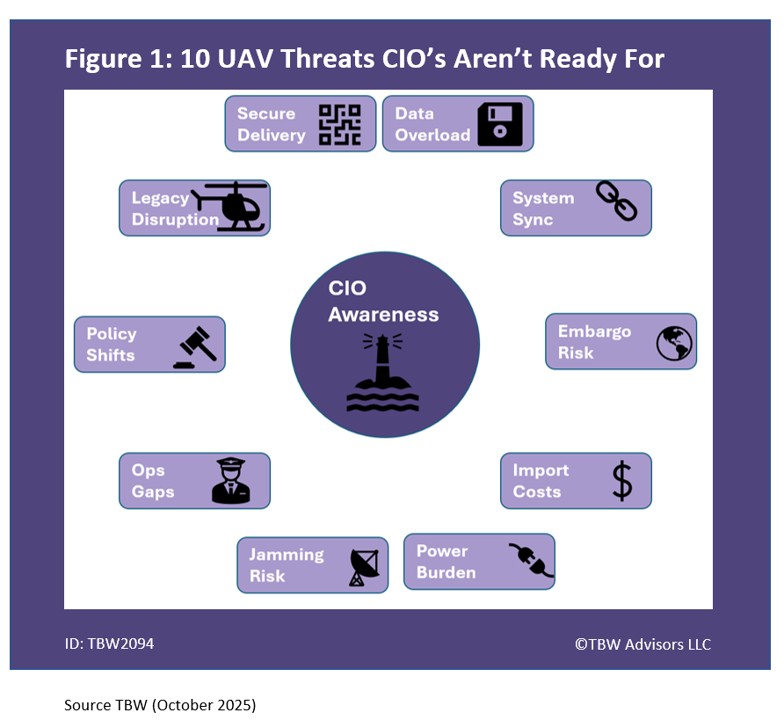
We took the most frequently asked and most urgent technology questions straight to the commercial UAV professionals gathering at Commercial UAV Expo 2025 held in Las Vegas. This Whisper Report addresses the question regarding what’s the biggest UAV threat that Chief Information Officers are not ready for? Figure 1 contains an image of the 10 UAV Threats that CIO’s aren’t ready for.
1. Embargo Risk
The first threat was the absolute talk of the show held in Las Vegas. As GEODNET’s Amr Elkordy observed, “most people don’t realize that with the bill that passed last year, DJI might be fully banned from the US.” Or as Frontier Precision’s Wyatt Robbins shared there is a, “potential shift away from Chinese manufactured drones.” Of course, once they hit expo hall and spoke to distributors they learned the truth about their fleet. This created a flurry of activity as Wyatt went on to further explain, “companies and government agencies trying to find alternatives to maybe a DJI system or other Chinese manufacturing systems that they’re already currently buying.“
2. Import Costs
If your organization still wants to purchase drones from the Asian region, you may be artificially scared off by the Tariffs. IPET’s Joy Jiang is there for you. “Tariff strategies. We are an Asian company. Our products to some company like the North American or the Europe we still have some strategies about the tariff.” In other words, don’t assume anything about the impact to cost of their products based on the Tariffs. Rather speak with those deep in the details of the manufacturers before ruling out those manufacturers. Time will tell if they will be allowed in the future US or European airspace.
3. Power Burden
Our 3rd UAV threat arriving at our organizations’ Chief Information Officer’s door comes from Sarah Abdi at Parallel Flight Technologies. “The infrastructure that is required with all electric platforms.” Intrigued, let’s hear more! “ So if you have a remote logistics application for an application and you have an electric platform, you have to have your generator, you have to have fuel to power your generator, you have to have extra batteries on hand, which actually are extremely heavy. There’s a whole lot of infrastructure required with all electric platforms, which is why we’ve taken an approach of parallel hybrid. Um, all you need is a gas tank and you refuel this aircraft and you’re back up and running.” Thus hybrid drones share the same benefits many are familiar with in hybrid cars.
4. Jamming Risks
UAV’s require communication. It tells them where the controller wants them to go, it is used to send information back. It underlies the very purpose the drone was flown to begin with in many use cases.
As Teal.io’s Robb Monkman observed, our next threat is all about the, “invisible threat of connectivity.” Robb further explained, “more recently, people are starting to talk about the need for redundancy and failover.” TUALCOM’s Nicolas Speroni was more specific. “I believe the biggest threat is jamming. And then if a UAV needs to go through a totally GPS denied environment, TUALCOM USA has solutions for both of those and the anti-jamming and terrestrial navigation products.” For additional methods of handling GPS Denial see Conference Whispers: CUAV 2025.
5. Ops Gaps
Threat number 5 comes with an alert from USI’s Brad Tucker. “If you have a fleet of drones, you have a flight department.” That’s right. The only question is if you recognize and organize it. Brad continued, “that may not be something that is fully embraced as of yet, it needs to be pretty quickly, especially with the release of 108, obviously that’s going to be coming within the next 12 to 24 months. More than likely part 108 is coming in the next 12 months. So that means you have to be prepared for obviously safety protocols. You have to be prepared for training your workforce and certifying your workforce with the appropriate credentials.”
6. Legacy Disruption
Now you have your flight department. Perhaps you organized your drone related employees with your Helicopter Pilots. Federico di Napoli from FlyingBaket has an update for you. “CIOS are not ready to hear about the drone is to the moment when the drone will completely substitute the helicopter for transport materials.” That is correct. For non-human cargo, the go forward solution is the simpler drone regardless of your cargo weight. So before that next expensive mechanical update to your helicopter – you may want to re-evaluate if that is the best solution based on current technology available via drones. Heavy cargo even for long periods of time is now possible. For additional information on the variety of commercial drones now available see Conference Whispers: CUAV Expo.
7. Secure Delivery
Removing the human in the helicopter to send cargo can create some complexities with certain cargo. blueflite’s Ross Davis brings our next threat. “chain of custody in drone delivery”. Interesting! Let’s hear more about this challenge from Ross. “Imagine if you have a really high value item such as prescription medication or perhaps like organ. When that’s delivered to a hospital or to a patient, we need to make sure that that person is actually receiving the person we intend to receive the object is the person who’s picked it up. So, you know, as how we address that is through scanning, QR codes, and authentication on the phone to make sure that that person is who they say they are. We could do facial recognition on the phone to basically sign into their account and we take ownership of that package.” Thus even a drone solution can require an advanced identity and access management solution to authenticate recipients and ensure proper, secure, operations. For additional research on identity and access management, see Conference Whispers: Identiverse.
8. Data Overload
Aloft’s Kevin Teen highlighted one of the most overwhelming threats. “the amount of data. All the different data points.” Kevin continued to provide context, “One drone flight, you’re producing four frames a second for as long as that drone’s in the air, altitude, speed, heading, hundreds of different variables. Once you start scaling that across dozens, hundreds of pilots now include videos that we’re taking. now include survey photos. You can just imagine the scale of the data and so dealing with different buckets you know whether that’s in SharePoint or S3 and now all we have disconnected processes.” But it is not just about collecting the data as Buzz Solutions Kaitlyn Albertoli emphasized. “Once we start to scale it and embed it more into the workflows, I don’t think utilities are ready for how much that data is going to be an impact to them. But it’s an exciting problem to have.” If you find yourself overwhelmed by all the data or lost in a data silo situation, be sure to schedule an inquiry with your analyst at TBW Advisors LLC. Having advised over 1100 organizations on their transformation, We have dealt with data volumes as large as zettabytes per day.
9. Systems Sync
Central UAS’ Bill Reynolds contends that the largest threat, “is the demand for interoperability and integration with uh APIs for the massive amount of data exchange between the unmanned aircraft and the applications and the grower and farmer.” Having just been warned about the volume of data, the last thing a CIO and their team want to be concerned with is the interoperability of all the systems. This is a call to the CUAV industry to ensure standardization where possible and appropriate.
10. Policy Shifts
We will conclude with threat 10 and the other most talked about topic at CUAV Expo held in fabulous Las Vegas. Pelican Wire’s Frank Balsamo revealed threat number ten as, “the changing regulations in the environment that are out there from country to country.” While many are fretting FAA proposed Part 108, USA is only one country in a web of regulations. Frank went on further to explain, “as the technology evolves and becomes more available in the public to see how that plays out. in real time. So, I think as a business case, that’s going to be very interesting to watch.” In other words, it’s a nascent industry and the regulations are in the name of safety. Safe operations builds trust and helps the industry to expand. Helping the UAV industry expand is something everyone’s interest at the Commercial UAV Expo.
Related playlists and Publications
- Playlist for Whisper Report: What’s the biggest UAV threat CIOs aren’t ready for?
- Conference Whispers: Commercial UAV Expo
- Conference Whispers: Identiverse
Corporate Headquarters
2884 Grand Helios Way
Henderson, NV 89052
Downloading, re-uploading, or redistributing this file is not permitted under any license.
Downloading, re-uploading, or redistributing this file is not permitted under any license.
©2019-2026 TBW Advisors LLC. All rights reserved. TBW, Technical Business Whispers, Fact-based research and Advisory, Conference Whispers, Industry Whispers, Email Whispers, The Answer is always in the Whispers, Whisper Reports, Whisper Studies, Whisper Ranking, Whisper Club, and One Change a Month, Vegas Convention Library; Leading Professionals, Real Questions, Real Time, are trademarks or registered trademarks of TBW Advisors LLC. This publication may not be reproduced or distributed in any form without TBW’s prior written permission. It consists of the opinions of TBW’s research organization which should not be construed as statements of fact. While the information contained in this publication has been obtained from sources believed to be reliable, TBW disclaims all warranties as to the accuracy, completeness or adequacy of such information. TBW does not provide legal or investment advice and its research should not be construed or used as such. Your access and use of this publication are governed by the TBW Usage Policy. TBW research is produced independently by its research organization without influence or input from a third party. For further information, see Fact-based research publications on our website for more details.