Published to Whisper Club: August 10, 2026ID: TBW2096
Analyst(s): Dr. Doreen Galli
Photojournalist(s): Dr. Doreen Galli
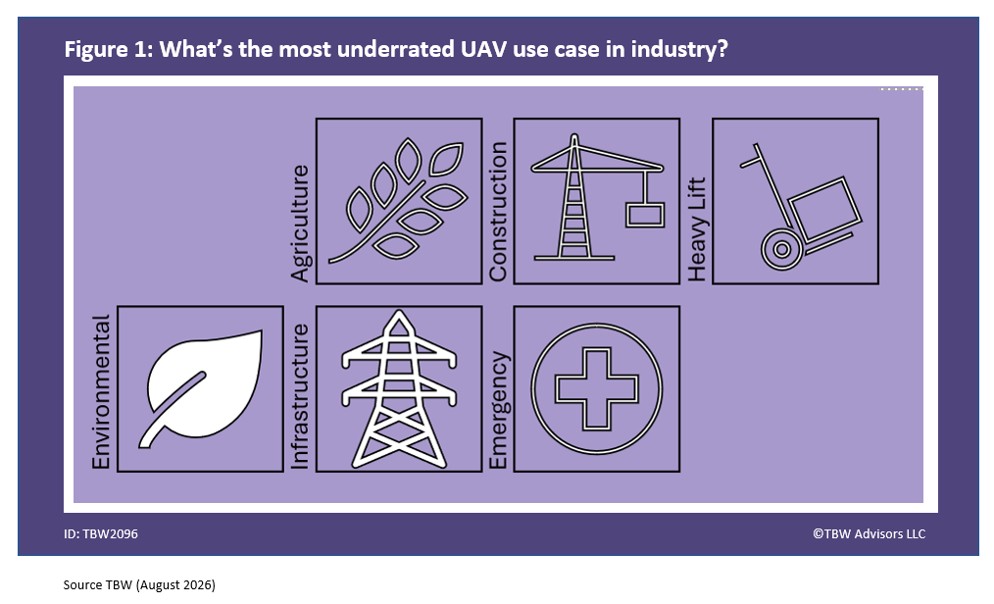
This Whisper Report investigates what the most underrated UAV use case in industry. Filmed at Commercial UAV Expo 2025 in Las Vegas, it examines how drone applications are expanding in ways many organizations are overlooking. Experts explore where these capabilities are delivering unexpected value across industries. Cited experts: Dustin Brewer Zepher, Josh Woodruf AirData UAV, Kaitlyn Albertoli Buzz Solutions, Robb Monkman Teal.io, Antonio Ruan Starling, Ross Davis blueflite, Kevin Teen Aloft, Vic Moss DSPA, Bill Reynolds Central UAS Technologies, Thad King Multicopter Warehouse, Sara Abdi Parallel Flight Technologies, Federico di Napoli FlyingBasket.
Published to Whisper Club: January 27, 2026 ID: TBW2095
Analyst(s): Dr. Doreen Gal
Photojournalist(s): Dr. Doreen Galli
Abstract:
This Whisper Report investigates how will drones change enterprise data strategy. It draws on insights gathered at the Commercial UAV Expo 2025 in Las Vegas, where UAV experts described the growing data volume, multi‑use potential, and rising compliance pressures shaping enterprise architectures. The report highlights strategic alignment, cross‑industry collaboration, and the challenge of converting drone data into actionable insights. It cites Barry Paul (Blue Nose Drones), Jason San Souci (Drone Ops USA), Kevin Teen (Aloft), Bill Reynolds (Central UAS Technologies), and Vik Chaudhry (Buzz Solutions).
Coverage on Computer Talk Radio.
Target Audience Titles:
Chief Data Officer, Chief Information Officer, Chief Technology Officer, Chief Digital Officer, Chief Information Officer
VP Data Strategy, VP AI & Analytics, VP Infrastructure/Cloud
Enterprise Data Architects, Cloud Platform Engineers, AI/ML Engineers, Data Governance Leads, DataOps Engineers, UAV Program Managers, Geospatial Analysts, Security Architects
Key Takeaways
Enterprises must begin with outcomes, not drone hardware, ensuring data strategy alignment before investing in UAV technologies.
UAV operations generate massive, multi‑use data requiring scalable architectures and disciplined reuse across missions and time.
Cross‑industry collaboration and regulatory data‑sharing mandates will reshape how organizations exchange, govern, and leverage drone‑collected information.
Organizations need compliant, secure infrastructure capable of turning large, disparate drone data streams into actionable, time‑saving insights.
How will drones change enterprise data strategy?
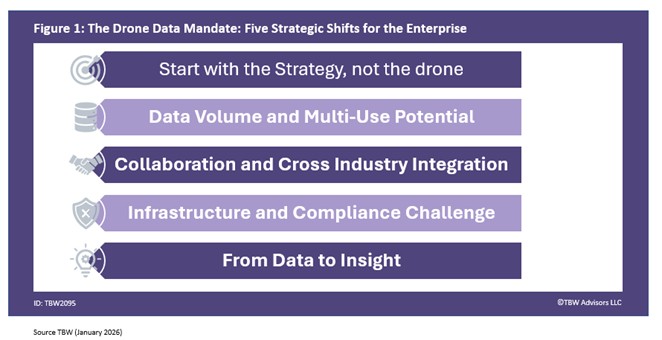
We took the most frequently asked and most urgent technology questions straight to the commercial UAV professionals gathering at Commercial UAV Expo 2025 held in Las Vegas. This Whisper Report addresses the question regarding How will drones change enterprise data strategy? Figure 1 represents the five strategic shifts coming for the enterprise due to the drone mandate.
Like many newer technologies, it is easy to fall into the trap of spending budget on the shiny thing everyone is talking about. But there is a reason the best CIOs and CTOs ask what you are trying to accomplish versus rubber stamping the technology acquisition. As Drone Ops USA’s Jason San Couci
contended, “So enterprises that are using drones are starting the wrong way. They’re starting with what equipment’s out there. They get they see the shiny things that are out here in this industry and they’re like, man, what can I do with that? No, they’re doing it wrong. They need to look at what outcomes that they need to actually that they’re doing it for. Right?” Drone Ops USA’s Jason San Couci went on to further explain. “I want to know what the data is going to be used for, what the analytics are going to be. So therefore, I can work backwards. What equipment do I need? What accuracy do I need? I can’t answer those questions at the beginning, right? It’s kind of like saying, I have this tool. I have a hammer. And I have a piece of wood. I want to go build a house. You’re not going to do that. You’re not going to build a house. You have to be like, you know what? I want to build a house. What materials do I need to be able to do that? What specialties do I need? What people what experts do I need? What subconscious do I need? What’s the timeline? What’s the budget? What’s all those things? That’s working the right way. People in this industry have been doing that wrong.”
But starting with the technology versus the problem isn’t the only issue. The existing data strategy might be outright ignored. Jason San Souci expanded further. “enterprise data strategy is something that’s been underlooked and underfunded for a long time because what they’re doing is they’re keeping a lot of this data in silos and they’re not using their existing enterprise data to augments or enhance the data that’s coming from any robotic system, drones, uncrewed systems, whatever it happens to be. So, they’re putting them in another silo and that’s a huge mistake.”
Most organizations do not really appreciate what big data truly is before they start working with the volumes of data that come from any sensor based solutions – including the numerous sensors on UAVs. Aloft’s Kevin Teen provided a meaningful example to demonstrate how the data volumes expand rapidly. “And so let’s say we send a pilot out for a survey or a construction update. While they’re out there, there are other opportunities. We don’t need to send another pilot out or launch a drone in the box or something like that to go look at something specific. Go inspect this bolt or go check this roof for leaks or, you know, where it might need paint or something along those lines. From that initial flight, from that initial data capture, we can then reuse a lot of that information and even kind of go back over time. Let’s say there’s a rust spot developing on an oil tank or something like that. we could go back and identify how frequently this happens, how long has this issue not been caught yet.” Kevin went on to further explain that optimizations are indeed possible. “I think the multi-use of the data that we’re collecting is going to be an important part of how we streamline and pull all that information out together.” Multi-use was a big term we heard repeatedly at the Commercial UAV expo during all conversations involving data. Barry Paul of Blue Nose Drones contended “not only can we do what the problem is that we need to solve right then, but there’s a lot of other things that can be utilized out of what a drone can collect for them. What kind of data? What other use cases or problems can we solve for a company.” As Central UAS Technologie’s Bill Reynolds nicely summarized, “The enterprise data demand that drones will put onto agencies and companies is immense in terms of the size both in imagery and aerial applications.” If you haven’t felt it yet, the data wave from UAV’s is coming to an enterprise near you.
Now that we realize the data will be voluminous and internally each organization should organize and efficiently, and repeatedly leverage data for multiple purposes, our next challenge arises. How do we get collaboration within an industry or sector or even cross-sectors? As Zepher’s Dustin Brewer noted, “going to take a collaborative effort between several of us that do collect data from our enterprise use cases like search and rescue, DoD, and being able to integrate those into other parts of the industry and have some of that cross communication. I think that’s going to increase collaborative efforts and more of a community effort in order to provide pilots the information that they need to either increase their skills or apply that to their industry that they’re either working towards or working within.” Identification of a lost child by drone has much in common with identification with a destructive and invasive animal in a massive crop.
But some sharing of the data may not be optional. Kenji Sugahara from the Oregon’s Department of Aviation clarified. “Drones will definitely change your data strategy, especially if you’re working in a government environment because all that data that is acquired is for the public record.” But what if you strictly work with private industry? Kenji has news for you as well. “With private industry, there will be increasing data storage requirements, especially under part 108 in the proposed rule that it that it is. What it proposes under part 108 is data retention. So there are will be data retention requirements. So not only for flight data, but you’re also talking about personnel data, you’re also talking about training data, you’re talking about maintenance data. So there’s going to be have to be a comprehensive data management strategy.”
All of this data and collaboration or regulatory sharing requirements create infrastructure and compliance challenges. As Buzz Solutions Vik Chaudhry emphasized, “they have purchased all these UAVs, aerial vehicles, drones. They’re doing a lot of with these kind of mobile sensors, there’s a lot of data that is generated. So at the enterprise level, utilities face a challenge on how to store and manage all that data. That’s where they are trying to build cloud infrastructure platforms within their systems. Obviously that has to satisfy their IT and cyber security compliance. But they’re also looking for software platforms that can visualize all this data especially imagery.” With the mountain of technical challenges, it is easy to lose sight of the goal. As Vik went on to further explain, “How can they make the system more robust but also how can they derive insights from that data because that’s where the real power is. Collecting the data is one piece. Flying your drones is one piece. But the whole of the challenge starts when you have to derive the insights from that data.” As summarized by FlytBase’s Deep Gupta, “The new strategy is what do I do with this much data?”
The problem, as articulated by Aloft’s Kevin Teen is here. “We are now just collecting a ton of more information, more data than we were getting before.” The challenge, as clarified by FlyteBase’s Deep Gupta is real. “How do I gather insights? How do I save time?” Our mission, as shared by Buzz Solutions’ Vik Chaudhry. “How can they make the system more robust but also how can they derive insights from that data because that’s where the real power is. Collecting the data is one piece. Flying your drones is one piece. But the whole of the challenge starts when you have to derive the insights from that data.”
If you are faced with data siloes and a fleet of drones and don’t know where to start or are not sure you are on the correct path. This is the exact time to schedule an inquiry with your analyst. Their first hand experience working with the complexities of voluminous disparate sensor data sets in creating a cohesive data fabric have immeasurable value on your success.
Published to clients: October 27, 2025 ID: TBW2094
Published to Readers: October 28, 2025
Whisper Email Release: TBD
Public/Video Release: TBD
Analyst(s): Dr. Doreen Galli
Photojournalist(s): Dr. Doreen Galli
Abstract
This Whisper Report investigates the biggest UAV threat CIO’s are not ready for. CIOs are underestimating the scale and urgency of UAV-related risks. From electric infrastructure and jamming threats to data overload and geopolitical embargoes, this Whisper Report captures the 10 most pressing vulnerabilities revealed at CUAV Expo 2025 — and what enterprise leaders must do next.
Target Audience Titles:
Chief Information Officer, Chief Technology Officer, Chief Information Security Officer, Chief Architect, Chief Data Officer, Chief Product Officer, Chief Experience Officer
VP Infrastructure, VP Security Operations, VP Data Strategy, Director of Physical Security, Director of Edge Computing, Director of OT Security
Red Team Lead, Incident Response Lead, Security Architects, DevSecOps Engineers, IAM Engineers, Penetration Tester
Key Takeaways
Impending bans on Chinese UAVs and rising tariffs are forcing urgent supply chain pivots.
Electric and communications infrastructure gaps are exposing UAV fleets to operational and security risks, especially in GPS-denied environments.
Most enterprises lack formal flight departments, leaving safety, training, and compliance dangerously underdeveloped.
Data volume and interoperability challenges are overwhelming existing IT systems, requiring new cloud and API strategies.
CIOs must prepare for regulatory volatility, secure delivery protocols, and the full replacement of helicopters in logistics.
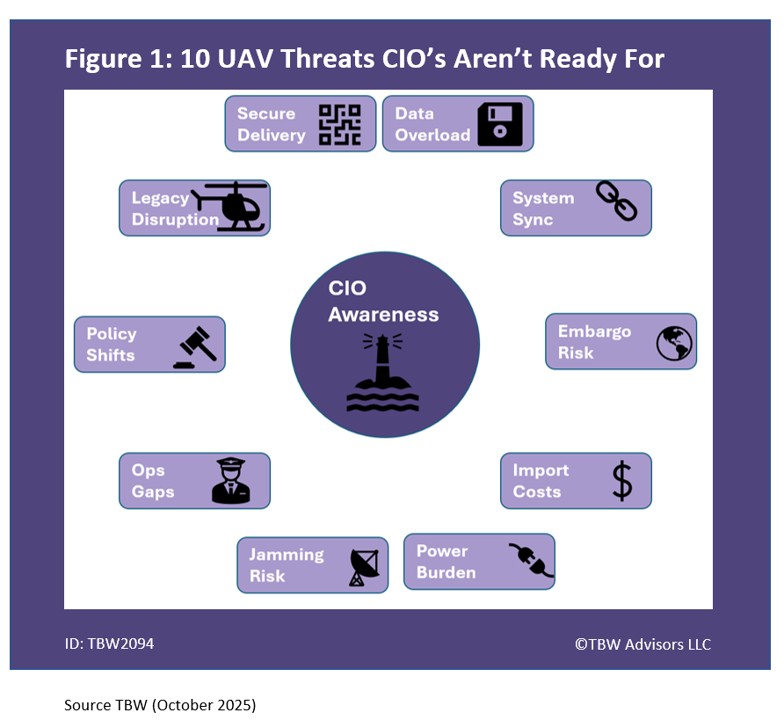
We took the most frequently asked and most urgent technology questions straight to the commercial UAV professionals gathering at Commercial UAV Expo 2025 held in Las Vegas. This Whisper Report addresses the question regarding what’s the biggest UAV threat that Chief Information Officers are not ready for? Figure 1 contains an image of the 10 UAV Threats that CIO’s aren’t ready for.
The first threat was the absolute talk of the show held in Las Vegas. As GEODNET’s Amr Elkordy observed, “most people don’t realize that with the bill that passed last year, DJI might be fully banned from the US.” Or as Frontier Precision’s Wyatt Robbins shared there is a, “potential shift away from Chinese manufactured drones.” Of course, once they hit expo hall and spoke to distributors they learned the truth about their fleet. This created a flurry of activity as Wyatt went on to further explain, “companies and government agencies trying to find alternatives to maybe a DJI system or other Chinese manufacturing systems that they’re already currently buying.“
If your organization still wants to purchase drones from the Asian region, you may be artificially scared off by the Tariffs. IPET’s Joy Jiang is there for you. “Tariff strategies. We are an Asian company. Our products to some company like the North American or the Europe we still have some strategies about the tariff.” In other words, don’t assume anything about the impact to cost of their products based on the Tariffs. Rather speak with those deep in the details of the manufacturers before ruling out those manufacturers. Time will tell if they will be allowed in the future US or European airspace.
Our 3rd UAV threat arriving at our organizations’ Chief Information Officer’s door comes from Sarah Abdi at Parallel Flight Technologies. “The infrastructure that is required with all electric platforms.” Intrigued, let’s hear more! “ So if you have a remote logistics application for an application and you have an electric platform, you have to have your generator, you have to have fuel to power your generator, you have to have extra batteries on hand, which actually are extremely heavy. There’s a whole lot of infrastructure required with all electric platforms, which is why we’ve taken an approach of parallel hybrid. Um, all you need is a gas tank and you refuel this aircraft and you’re back up and running.” Thus hybrid drones share the same benefits many are familiar with in hybrid cars.
UAV’s require communication. It tells them where the controller wants them to go, it is used to send information back. It underlies the very purpose the drone was flown to begin with in many use cases.
As Teal.io’s Robb Monkman observed, our next threat is all about the, “invisible threat of connectivity.” Robb further explained, “more recently, people are starting to talk about the need for redundancy and failover.” TUALCOM’s Nicolas Speroni was more specific. “I believe the biggest threat is jamming. And then if a UAV needs to go through a totally GPS denied environment, TUALCOM USA has solutions for both of those and the anti-jamming and terrestrial navigation products.” For additional methods of handling GPS Denial see Conference Whispers: CUAV 2025.
Threat number 5 comes with an alert from USI’s Brad Tucker. “If you have a fleet of drones, you have a flight department.” That’s right. The only question is if you recognize and organize it. Brad continued, “that may not be something that is fully embraced as of yet, it needs to be pretty quickly, especially with the release of 108, obviously that’s going to be coming within the next 12 to 24 months. More than likely part 108 is coming in the next 12 months. So that means you have to be prepared for obviously safety protocols. You have to be prepared for training your workforce and certifying your workforce with the appropriate credentials.”
Now you have your flight department. Perhaps you organized your drone related employees with your Helicopter Pilots. Federico di Napoli from FlyingBaket has an update for you. “CIOS are not ready to hear about the drone is to the moment when the drone will completely substitute the helicopter for transport materials.” That is correct. For non-human cargo, the go forward solution is the simpler drone regardless of your cargo weight. So before that next expensive mechanical update to your helicopter – you may want to re-evaluate if that is the best solution based on current technology available via drones. Heavy cargo even for long periods of time is now possible. For additional information on the variety of commercial drones now available see Conference Whispers: CUAV Expo.
Removing the human in the helicopter to send cargo can create some complexities with certain cargo. blueflite’s Ross Davis brings our next threat. “chain of custody in drone delivery”. Interesting! Let’s hear more about this challenge from Ross. “Imagine if you have a really high value item such as prescription medication or perhaps like organ. When that’s delivered to a hospital or to a patient, we need to make sure that that person is actually receiving the person we intend to receive the object is the person who’s picked it up. So, you know, as how we address that is through scanning, QR codes, and authentication on the phone to make sure that that person is who they say they are. We could do facial recognition on the phone to basically sign into their account and we take ownership of that package.” Thus even a drone solution can require an advanced identity and access management solution to authenticate recipients and ensure proper, secure, operations. For additional research on identity and access management, see Conference Whispers: Identiverse.
Aloft’s Kevin Teen highlighted one of the most overwhelming threats. “the amount of data. All the different data points.” Kevin continued to provide context, “One drone flight, you’re producing four frames a second for as long as that drone’s in the air, altitude, speed, heading, hundreds of different variables. Once you start scaling that across dozens, hundreds of pilots now include videos that we’re taking. now include survey photos. You can just imagine the scale of the data and so dealing with different buckets you know whether that’s in SharePoint or S3 and now all we have disconnected processes.” But it is not just about collecting the data as Buzz Solutions Kaitlyn Albertoli emphasized. “Once we start to scale it and embed it more into the workflows, I don’t think utilities are ready for how much that data is going to be an impact to them. But it’s an exciting problem to have.” If you find yourself overwhelmed by all the data or lost in a data silo situation, be sure to schedule an inquiry with your analyst at TBW Advisors LLC. Having advised over 1100 organizations on their transformation, We have dealt with data volumes as large as zettabytes per day.
Central UAS’ Bill Reynolds contends that the largest threat, “is the demand for interoperability and integration with uh APIs for the massive amount of data exchange between the unmanned aircraft and the applications and the grower and farmer.” Having just been warned about the volume of data, the last thing a CIO and their team want to be concerned with is the interoperability of all the systems. This is a call to the CUAV industry to ensure standardization where possible and appropriate.
We will conclude with threat 10 and the other most talked about topic at CUAV Expo held in fabulous Las Vegas. Pelican Wire’s Frank Balsamo revealed threat number ten as, “the changing regulations in the environment that are out there from country to country.” While many are fretting FAA proposed Part 108, USA is only one country in a web of regulations. Frank went on further to explain, “as the technology evolves and becomes more available in the public to see how that plays out. in real time. So, I think as a business case, that’s going to be very interesting to watch.” In other words, it’s a nascent industry and the regulations are in the name of safety. Safe operations builds trust and helps the industry to expand. Helping the UAV industry expand is something everyone’s interest at the Commercial UAV Expo.