Published to clients: December 23 2025 ID: TBW2128
Published to Readers: December 24, 2025
Whisper Email Release: February 9, 2026
Public Editions: February 12, 2026
Analyst(s): Dr. Doreen Galli
Photojournalist(s): Dr. Doreen Galli
Abstract
“Aftermarket innovation in 2026 faces three critical blind spots: workforce training lagging behind rapid tech adoption, supply chain visibility gaps impacting profitability, and misinterpretation of EV battery health undermining consumer trust. These challenges, identified through expert insights at AAPEX and SEMA 2025, demand proactive strategies to ensure sustainable growth and competitiveness in an evolving automotive landscape.”
Target Audience Titles:
- Chief Technology Officer (CTO), Chief Operations Officer (COO), Chief Supply Chain Officer (CSCO)
- VP of Aftermarket Strategy, VP of EV Programs, Director of Training & Development
- Supply Chain Data Analyst, EV Battery Diagnostics Engineer, Aftermarket Product Manager
Key Takeaways
- Workforce training lags behind rapid tech adoption, creating operational inefficiencies and slowing aftermarket innovation.
- Supply chain visibility gaps threaten profitability, requiring cleaner data and faster delivery strategies to stay competitive.
- Misinterpretation of EV battery health erodes consumer trust, impacting resale value and aftermarket growth.
What tech blind spot will stall aftermarket innovation in 2026?
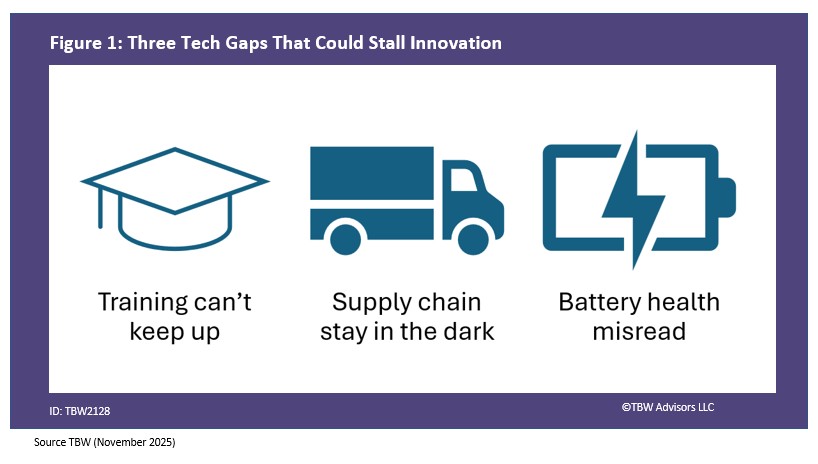
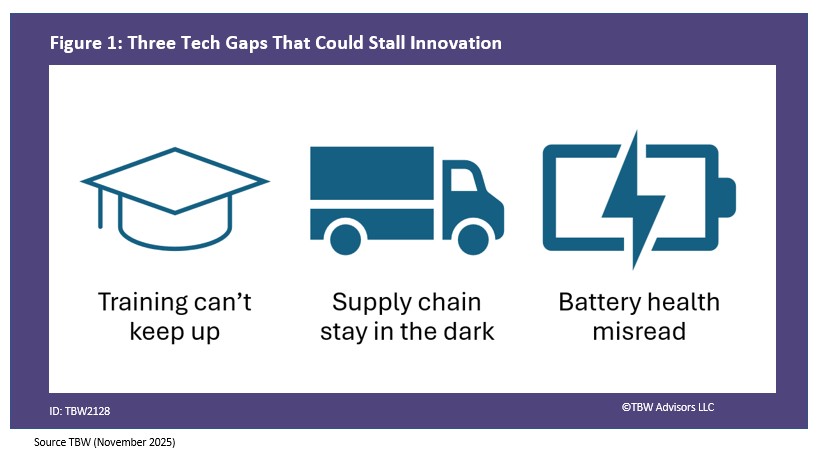
We took the most frequently asked and most urgent technology questions straight to the experts from the automotive sector gathering at the Venetian Convention Center AND Caesars Forum AND the Las Vegas Convention Center for AAPEX & SEMA 2025. This Whisper Report addresses the question regarding what tech blind spot will stall aftermarket innovation in 2026 as depicted in Figure 1.
1. Training Can’t Keep Up
New innovation is great but only if you know how to use and apply it. The first challenge isn’t as much as the tech as the ability for the employees in the organizations to use the tech as shared by Texa’s Fabio Mazzon. “Up to speed with new technology and be try to be trained as much as possible and follow everything that is new in the automotive world.” Sometimes, the technology changes come faster than the teams are ready for. Keeping up to date with the current speed of innovation is a common challenge of many today. Be sure to schedule your inquiry with your TBW Advisors LLC’s analyst to ensure your roadmap is futureproofed and ready for all the new innovations coming your way. For additional research on training technologies available see Conference Whispers: HR Tech 2025.
2. Supply Chain Stay in the Dark
One of the biggest challenges for those in the aftermarket industry is simply staying profitable with the greatest challenge being the supply chain. The tariffs alone have thrown global supply chain into a new environment. As Lynnco’s Andrew Yokiel emphasized, “Supply chain. Having greater data and visibility into everything from small parcel down to up to full truckload, LTL, and getting your product to your customers faster and having an idea where it is in the marketplace and having cleaner data to make business decisions to be profitable.” Profitability, much like having customers, is truly a key ingredient to staying in business.
For additional on data in supply chain and logistics see Whisper Report: What are the biggest challenges of using generative AI in Logistics and Whisper Report: Can generative AI prevent supply chain disruptions.
3. Battery Health Misread
In order for the used and aftermarket to flourish, the value of those components or in adding those components should be commonly agreed upon and understood. Unfortunately, this is a challenge particularly in the EV market as Midtronics’ Lance Losinski emphasized. “Consumer understanding and credibility of the value say the health of a battery pack. That drives the market prices down because the understanding versus mileage on a gas car versus what’s the state of health battery and how long is it going to last and how do you repair these things, creates the biggest gap for a consumer to be able to trust and utilize the vehicle despite having lower service costs long term and things like that. I think that’ll be the biggest blocker in the near term.”
Related playlists and Publication
- Whisper Report: What retrofit risk will stall EV adoption in 2026?
- Whisper Report: Which AI tool will disrupt diagnostics first?
- Whisper Report: What tech blind spot will stall aftermarket innovation in 2026?
- Whisper Report: What’s the best part about attending AAPEX and SEMA live in Vegas 2025?
- Whisper Report: What are the biggest challenges of using generative AI in Logistics
- Whisper Report: Can generative AI prevent supply chain disruptions
- Whisper Report: How can we manage tariff costs in our supply chain?
Corporate Headquarters
2884 Grand Helios Way
Henderson, NV 89052
©2019-2026 TBW Advisors LLC. All rights reserved. TBW, Technical Business Whispers, Fact-based research and Advisory, Conference Whispers, Industry Whispers, Email Whispers, The Answer is always in the Whispers, Whisper Reports, Whisper Studies, Whisper Ranking, The Answer is always in the Whispers, and One Change a Month, are trademarks or registered trademarks of TBW Advisors LLC. This publication may not be reproduced or distributed in any form without TBW’s prior written permission. It consists of the opinions of TBW’s research organization which should not be construed as statements of fact. While the information contained in this publication has been obtained from sources believed to be reliable, TBW disclaims all warranties as to the accuracy, completeness or adequacy of such information. TBW does not provide legal or investment advice and its research should not be construed or used as such. Your access and use of this publication are governed by the TBW Usage Policy. TBW research is produced independently by its research organization without influence or input from a third party. For further information, see Fact-based research publications on our website for more details.