Published to clients: December 23 2025 ID: TBW2128
Published to Readers: December 24, 2025
Whisper Email Release: TBD
Public and Video Edition: TBD
Analyst(s): Dr. Doreen Galli
Photojournalist(s): Dr. Doreen Galli
Abstract
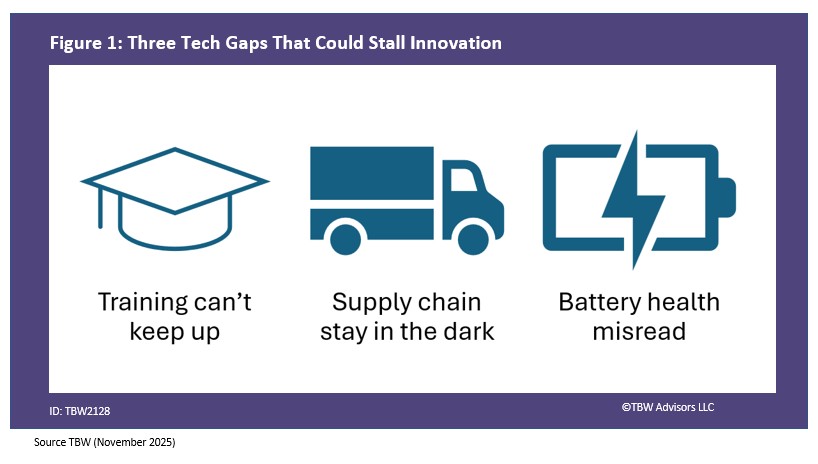
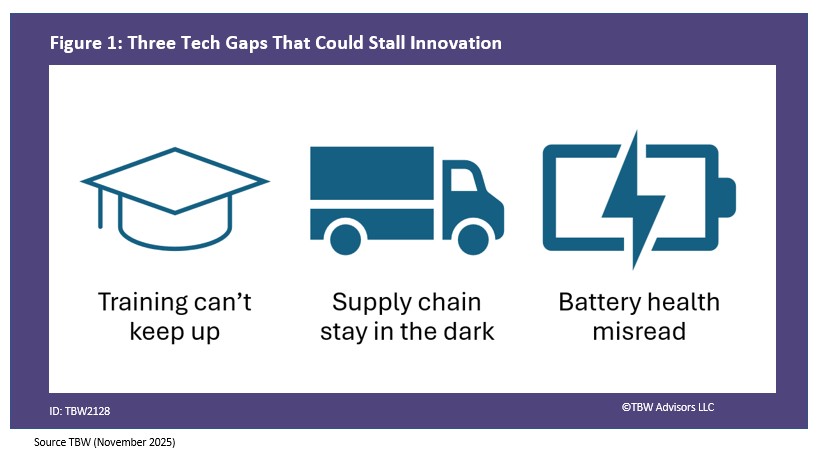
“Aftermarket innovation in 2026 faces three critical blind spots: workforce training lagging behind rapid tech adoption, supply chain visibility gaps impacting profitability, and misinterpretation of EV battery health undermining consumer trust. These challenges, identified through expert insights at AAPEX and SEMA 2025, demand proactive strategies to ensure sustainable growth and competitiveness in an evolving automotive landscape.”
oin us for “AI in Medicine: Promise or Peril?”—a candid discussion with leading experts on how artificial intelligence is reshaping healthcare. From groundbreaking diagnostic tools to ethical dilemmas and patient safety concerns, we’ll explore whether AI is the ultimate game-changer or a ticking time bomb. Gain insights into what’s real, what’s hype, and what’s next for medical innovation. Don’t miss this chance to separate fact from fiction and prepare for the future of healthcare.
Research Code: TBW2129
Cannot make it live? Register and submit your question. The answer will be in the video on TBW Advisors’ YouTube Channel.
NO AI note takers allowed. Event copyrighted by TBW Advisors LLC All Rights Reserved.
BIOS
Doreen Galli, PhD MBA
Doreen Galli, PhD MBA is the Chief of Research at TBW Advisors LLC and regular contributor to Computer Talk Radio. She’s led significant and measurable changes as an executive at IBM, DPWN, Dell, ATT, and most recently Microsoft. Dr Galli was Chief Technology and Chief Privacy Officer in Azure’s MCIGET. Gartner recognized Dr. Galli as an expert in data ingestion, quality, governance, integration, management, and all forms and analytics including sensor data.
Barry P. Chaiken, MD, MPH
Barry P. Chaiken, MD, MPH is a physician, public health specialist, and internationally recognized expert in healthcare AI, clinical informatics, and digital transformation. Trained at SUNY Downstate Medical Center and the Harvard School of Public Health, Dr. Chaiken previously worked with the U.S. Centers for Disease Control and Prevention, experience that informs his expertise in public health analytics, system-level strategy, and the design of resilient, data-driven healthcare systems.
A former Chairperson of the Healthcare Information and Management Systems Society (HIMSS), he has served as a strategic advisor to healthcare IT companies, life sciences organizations, and health systems worldwide. Dr. Chaiken is the author of Future Healthcare 2050 and Navigating the Code, and is a leading keynote speaker on AI, trust, clinician workflow, and patient experience.
A two-time cancer survivor and 41-year rider in the Pan-Mass Challenge, Dr. Chaiken brings a unique perspective that connects clinical knowledge, policy insight, and human experience.
Susie Branagan BSN,RN
Susie Branagan is a highly experienced nurse and healthcare leader whose career spans 25 years of ICU, pediatric psychiatry, adult medical-surgical care, telemetry, perioperative services, and hospital leadership. She has served in roles from frontline clinician to Nurse Manager, gaining a deep understanding of patient care, caregiver well-being, and the operational realities that shape healthcare systems.
As the founder of Susie Branagan Consulting, Susie specializes in trauma-informed care, Just Culture principles, leadership development, communication strategies, and building safe, supportive care environments. She helps teams strengthen accountability, improve psychological safety, and respond to challenging situations with clarity, compassion, and evidence-based practice.
What sets Susie apart is that everything she teaches comes directly from real-life experience, not from textbooks or theory. Her coaching, trainings, and leadership support are grounded in decades of navigating complex cases, supporting distressed families, advocating for staff, and leading teams through high-pressure clinical moments.
Susie’s mission is to transform healthcare culture by empowering leaders and caregivers with practical, human-centered tools that create safer, stronger, more resilient organizations.
Chris Hutchins
Chris Hutchins is the Founder & CEO of Hutchins Data Strategy, a consultancy that helps healthcare organizations unlock the value of data, AI, and analytics with clarity, ethics, and measurable impact. A nationally recognized voice in healthcare transformation, Chris previously served as SVP and Chief Data & Analytics Officer at LifePoint Health, and prior to that, as Chief Data & Analytics Officer at Northwell Health, New York’s largest integrated delivery network.
Over the past two decades, Chris has led enterprise-wide initiatives in self-service analytics, ambient AI, digital governance, and workforce enablement, always with a sharp focus on care equity, operational sustainability, and trust. His leadership is grounded in building practical, inclusive strategies that bring technologists, clinicians, and operators into shared alignment.
Chris is also the creator and host of The Signal Room, a podcast platform amplifying leadership, ethics, and innovation in health. He is a frequent contributor to CDO Magazine, HIMSS, and other national forums, where he advocates for AI adoption that augments human care, not replaces it.
Chris holds a deep belief that every data strategy is ultimately a human strategy, and that transformation only succeeds when it is designed with care at the center.
*When vendors’ names are shared as examples in this document, it is to provide a concrete example of what was on display at the conference, not an evaluation or recommendation. Evaluation and recommendation of these vendors are beyond the scope of this specific research document. Other example products in the same category may have also been on display.

Published to clients: November 28, 2025 ID: TBW2098
Published to Readers: December 1, 2025
Whisper Email Release:
Public Release Date:
Analyst(s): Dr. Doreen Galli
Photojournalist(s): Dr. Doreen Galli
Abstract
This Whisper Report reveals nine overlooked AI risks in HR—from loss of human connection and identity challenges to compliance, data quality, and black-box concerns. Insights from HRTech2025 experts stress the need for ethical design, integrated systems, and AI literacy to safeguard trust and organizational resilience.
Published to clients: November 20, 2025 ID: TBW2107
Published to Readers: November 21, 2025
Whisper Email Release:
Public Release Date:
Analyst(s): Dr. Doreen Galli
Photojournalist(s): Dr. Doreen Galli
Abstract:
“This Whisper Report explores the most desired casino innovations identified at G2E 2025. Industry experts highlighted two key areas: operational improvements for casinos—such as seamless system integration and cross-platform play—and enhanced player experiences through biometric authentication, personalized VIP services, and engagement strategies. These insights reveal opportunities for transformation and differentiation in gaming technology.”
Put Data First’s Inaugural event brought together a few hundred ranging from deep learning AI experts and data enthusiasts for in-depth, detailed conversations. Sponsoring vendors had demonstrations on-site to enable tangibility to their product capabilities. The event featured 23 round tables as opposed to keynotes and speakers providing an intellectually satisfying and successful networking experience for those involved.
The Conference
The inaugural Put Data First made an impressive splash featuring AI experts with a long-standing track record in deep learning. This led to deep and insightful conversations by all.
Featuring 23 round tables, vendors at the show were prepared to show product demonstrations to attendees.
Cautions
Friendly reminder: this research provides examples of what was shared with us at the event, not an evaluation, validation, or recommendation of the given technology.
After 3,000 steps, 30 videos, over 30 minutes of content including demos and a livestream, and a handful of fact checks, our coverage of the inaugural Put Data First held at Planet Hollywood in Las Vegas closes. Registration was easy to find once inside the conference section of Planet Hollywood. Rather than endless keynote speakers, this event featured approximately 23 round tables. In addition, vendors had demonstrations so one could tangibly understand the products. What I enjoyed most was the fact that the event was full of those with deep expertise in deep learning leading to deep conversations about the state and future of various forms of AI in our enterprises and society at large. Enjoy the walkabout of the conference space.
We once again live streamed from on site. On Tuesday requesting those attending to find me to answer Questions 1-3, to introduce all to TBW Advisors LLC, and requesting assistance. Specifically, I requested assistance on your favorite videos for my segment on the November 14th broadcast edition of Computer Talk Radio.
While at Put Data First 2025, we conducted research for three additional forthcoming Whisper Reports for our clients. The playlists are unlisted but available and will eventually fill in with the video version of the report so you may wish to bookmark these playlists.
Readers and viewers wishing to experience the entire event are encouraged to view the Conference Whispers: Put Data First Playlist in its entirety. The playlist will be sited in the end screen, description, and as a pinned comment of the video edition.
The video edition will conclude with gratitude towards those that contributed and a montage of responses to Question 4, “What’s the best part about attending the combination event live in Vegas?”
As mentioned earlier, Put Data First vendors didn’t just show up, but showed up with demonstrations many of which we were able to capture. Kicking things off as many do with an Agentic Workshop for your leadership teams to get your organization on the right path. Led by established AI author, Neil W. Smith, his demonstrations were live conversations with those that attended and at the round tables.
Putting data first, we will start with Mend.io whose platform can secure you application data. The demonstration shows how they help organizations pull back the shadows hiding what AI platforms are being leveraged withing their organizations. The platform monitors vulnerabilities in agentic and generative systems and tests them to ensure resilience against both known and emerging threats.
If you are seeking to secure you environment, above and beyond and including the latest threats? SafeBreach shared the details of their breach and attack platform. During their demonstration, their shared how one could drill into the various aspects of the score to identify the exact weakness to address. Not only were automated updated possible, but one could simulate a red team or blue team against their environment.
Enjoying all the newest forms of AI and convinced you want your own enterprise agentic solution? Lucky for you AnswerRocket was their to answer your need. If you have never seen or thought of the enterprise use case for the power of agentic AI, do enjoy their demo of its power.
Finally, and perhaps the star of the show, are you tired of your generative models hallucinating? Interested in a fact-based model? Well established deep-learning expert Herb Roitblat, Ph.D. was there to share Reliath AI. The demonstration of his fact-based system quickly reveal the differences behind his straight forward concept. Answer based on building up from known facts. I look forward to watching how fast and far they can run and to discover where it shines most.
Either way, fact-based models will be a critical model type to leverage in solutions that must be relied upon. Experienced AI solution developers know it’s not about a single model. The product/end result is about how a combination of models, methods, and agents are orchestrated to deliver the desired customer experience and required business outcomes that matter most.
If you are embarking on any type of data journey, be sure to schedule your inquiry with your TBW Advisors LLC analysts. You can leverage our first-hand experience through-out your transformation and future proofing processes.
We do not have exact dates for Put Data First 2026 at the time of publication; however, it is scheduled to be mid-to-late July 2026 in Las Vegas.
*When vendors’ names are shared as examples in this document, it is to provide a concrete example of what was on display at the conference, not an evaluation or recommendation. Evaluation and recommendation of these vendors are beyond the scope of this specific research document. Other examples products in the same category may have also been on display.
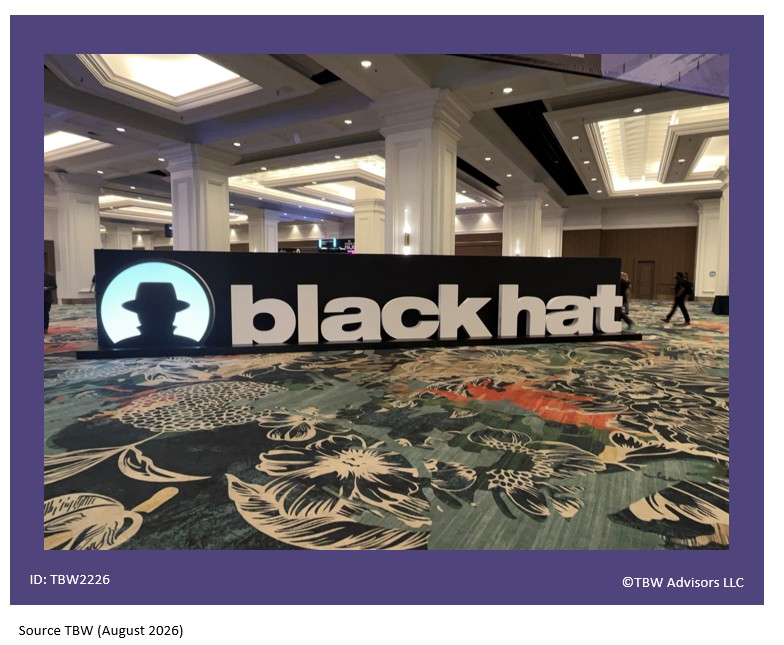
After 61 videos including 4 first ever onsite livestreams, 150 minutes of recording including multiple exclusive shots – our coverage of Black Hat USA 2025 closes. Black Hat USA 2025 featured over 100 briefings and 120 sponsored sessions, with coverage spanning keynote presentations, technical sessions, and exhibit hall innovations. Topics ranged from AI-driven threat detection and agentic SOC platforms to identity verification and proactive risk management. Trends in cybersecurity regarding defence, use of AI agents, and focus on resiliency continue to grow.
The Conference
Black Hat USA 2025 featured over one hundred briefings and 120 sponsored sessions. Attendance numbers are forthcoming. 2024’s edition featured over 20,000 in person attendees.
Cautions
Black hat is not a conference to attend without preparation. All of one’s technology should be up to date. One should ensure they are leveraging a VPN and a RDID wallet when intentionally going around black hat. If not using one’s phone, a portable faraday pouch is always beneficial.
Friendly reminder: this research provides examples of what was shared with us at the event, not an evaluation, validation, or recommendation of the given technology.
After 61 videos and related fact checks, over 150 minutes of recording including for the first time ever – four onsite LIVESTREAMS – our coverage of Black Hat USA 2025 closes. Black Hat featured over one hundred briefings and 120 sponsored sessions. Clients may recall the expo hall restrictions during our coverage of HIMSS which treated the entire expo hall like a surgical operating room from a privacy perspective. Guess what? It was even tighter at Black Hat. Nonetheless, we were able to capture the energy as Expo Hall was opening. Not only that, for the first time ever, Informa (who owns Black Hat) gave permission to someone to do a walkabout in Expo Hall prior to its opening for the day. That’s right – enjoy your exclusive look at Black Hat USA 2025 Expo Hall. Not only that, we were able to capture the mouthwatering lunch served on Wednesday. Once again, unlike most events, the What’s To Eat? Video does not include any attendees enabling us to really get a great shot of the food! A first for TBW Advisors LLC – we did four livestreams while on site. One live stream on Tuesday, Wednesday, and Thursday morning. One final livestream went out on Thursday as I requested assistance on your favorite videos for my segment on the August 9th broadcast edition of Computer Talk Radio.
While at Black Hat USA 2025, we conducted research for three additional forthcoming Whisper Reports for our clients. The playlists are unlisted but available and will eventually fill in with the video version of the report so you may wish to bookmark these playlists.
Kicking off in dramatic fashion, the conference kicked off with an amazing keynote from non-other than the most famous virus hunters – Mikko Hypponen and father of the Hypponen law of IoT security – one of our favorite coverage spaces. Specifically, Mikko said that if a device is smart, it is vulnerable. It was amazing to hear his story.
On the bleeding edge of things, we received two session summaries from Microsoft’s Thomas Roccia. The first session was his Black Hat session on NOVA – Prompt Pattern Matching regarding a new type of threat gaining traction. The second session is actually at DEFCON – the sister conference where no one would be ignorant enough to bring in modern technology outside of a faraday cage. Fortunately, we caught Thomas while at Black Hat. IN this talk Thomas shared that they are releasing an AI Agent to track crypto currency’s movements including visualization to combat crypto money laundering. The final Microsoft session itself that we captured is the Unmasking of Cyber Villains. I always love when engineers get a very loud boastful ovation from the audience. This stage featured the heroes of MISTIC and Dart who shared how they leverage each other’s strength. MISTIIC stands for Microsoft Threat Intelligence Center while Dart stands for Microsoft’s Diagnostics and Recovery Toolset. In this session, the Microsoft team emphasized that incidents require empathy, speed, and precision. The Darth team is on the ground delivering the empathy and getting the data to MISTIC. MISTIC in turn, provides the cheat codes to the Darth rescue team to quickly combat the incident.
On the topic of using AI Agents on a team of humans in wish SOC, James Spiteri from Elastic Security shared a summary of his session. “AI without Borders: Extending analysts capabilities in a modern Soc” dove into details how Agents and humans can successfully interoperate in a SOC. James also covered critical questions you need to think about in order to truly operationalize this type of situation.
As with many events, some exhibits span outside of the formal expo hall. We were invited to the Dune Security Command Center on site where we heard about their solution. Their adaptive training uses a personal credit risk scoring model. It targets each employee’s risky actions and knowledge gaps with customized, targeted, proactive program. The goal is to elevate them to meet corporate standards. This theme of preparation, training, and doing things up-front was definitely a theme. Cumulated shared how their solution focuses on resiliency. Given that the proper way to discuss it is always when and not if, it is wise to ensure a quick recovery when it occurs. This preparation and looking out for the threat aligned with Qualys’s Risk Operations Center. This center is focused on assisting organization proactively identify, prioritize, and finally remediate identified risks. Covering all five personas in a SOC (alerts, vulnerabilities, threat intel, case management and DFIR (digital forensics/incident response )) StrikeReady’s platform integrates with 800 tools and is focused on removing each role’s pain points. Continuous Threat Exposure Management or CTEM is the area addressed most recently by Safe Security. Booli also moves things earlier in the process, in their case identity stitching. Specifically at the very beginning of the process including score carding the identity and providing the information back to the identity service. Ensuring stolen credentials are changed once they have been phished and the criminals attempted to leverage them, Mokn was on site to tell attendees about their solution.
If your organization would prefer to fix vulnerabilities instead of the common security software composition analysis, Heeler Security was the booth to visit. Feeling overwhelmed, by cloud configurations in your organization? imPac Labs was on site talking about their expertise. Admittedly, given my Microsoft Patent application on Policy Profiles, cloud configurations is a problem space on our radar at TBW Advisors. Speaking of high availability environments, HAProxy Technolog exhibited their platform that brings enterprise security performance and configurability into packaged software.
An area we have discussed in Conference Whispers: Money 20/20, Conference Whispers: HIMSS 2025, and Conference Whispers: Fintech Meetup 2025 – verifying the hardware device is a valuable defence vector for fighting fraud. At Black Hat USA 2025 we met SmallStep that enables device identity with cryptographic identity ensuring corporate devices are used to perform work. Leveraging device identification to eliminate deepfakes within a corporation, Netarx leverages multiple models to ensure your corporate communications are safe from deep fakes. Elastic Search – an open-source project known for search – found itself building native security and analytics due to popular demand.
Moving into the agentic side of things, Microsoft’s AI Agent Challenge was a big hit. Their booth had plenty of specialists on site to answer any of your questions. Focusing exclusively on AI Agents for the Red Team, Mindgard’s solution keeps probing to find vulnerabilities, filters through them based on your target and context. Finally, remediation advise is dispensed. Cyata built a built a control plane for Agentic Identity and includes policy enforcement. Addressing the full lifecycle above and beyond triage, Exaforce shared their Agentic SOC Platform. A demo of Exaforce was also captured. Finally, if you are unfamiliar with the current state of agents or have never seen an agent in action, enjoy the video with Ralph. Ralph comes from Cyber Innovate; a think tank focused on stopping threats from AI Agents themselves.
Black Hat USA 2026 will once again return to Las Vegas and will be held at Mandalay Bay Convention Center in August 2026. The exact dates have yet to be announced at time of publication.
*When vendors’ names are shared as examples in this document, it is to provide a concrete example of what was on display at the conference, not an evaluation or recommendation. Evaluation and recommendation of these vendors are beyond the scope of this specific research document. Other examples products in the same category may have also been on display.
Public and Video Edition Released: August 11, 2025 11am
Analyst(s): Dr. Doreen Galli
Photojournalist(s): Dr. Doreen Galli
Abstract:
“Integrating AI customer service with existing IT systems starts by setting clear business goals. AI should enhance, not disrupt, current workflows and streamline real-time support. Every organization has unique systems, so tailored integration is essential. A major challenge is fragmented data—making robust pipelines and clean, synchronized data critical. Accurate timestamps and system compatibility across platforms are key to ensuring effective AI performance and a smooth digital transformation journey.”
Target Audience Titles:
Chief Information Officer, Chief Technology Officer, VP/Director of IT Operations, Enterprise Architects
Chief Customer Officer, VP/Director of Customer Services/Success, Contact Center Operation Managers
Solution Architects, DevOps & IT Administrators, Customer Support Agents, Data Scientists and ML Engineers
Key Takeaways
Start with clear business goals so AI enhances workflows without causing disruptions.
Tailor integration to your unique tech environment to avoid inefficiencies.
Reliable, clean, and synchronized data pipelines are essential for effective AI-driven customer service.
We took the most frequently asked and most urgent technology questions straight to the technologists gathering at Customer Connect Expo 2025 held at the Las Vegas Convention Center. This Whisper Report addresses the question regarding how can we integrate AI-driven customer service solutions with our existing IT infrastructure? As Ford’s Dr. Kalifa Oliver shared, “first we need to break down our needs and our goals and figure out which pieces of AI actually build efficiencies in our IT systems because right now there are too many systems that are fragmented.” With ALL AI projects, it is best to start with the business goal not the technology. We do not want to spend resources to integrate technology that goes unused. Furthermore, the context of the business goal helps guide engineers when they have design choices to make.
AI in Customer Service is all about optimizing and improving the customer service workflow to lead to maximum customer satisfaction. As Zaon’s Jason Kaufman shared, “using artificial intelligence tools within the organization to actually help drive and make more efficient the processes that go into place in order to support good customer service. For example, leveraging artificial intelligence to actually analyze chats real time community forums real time. Actually monitoring that (the communities) helping to gain insights about what your customers have questions about so that you can leverage the AI to actually generate the knowledge on the fly to actually provide that (information removing confusion) back to them real time as if it’s another person on that community thread.” The nonobvious challenge in achieving this solution is best described by Claritiv’s CEO Sean Gigremoss. “Everybody has workflows. Every company is unique. What tools do they use? What products do they use now? Do we need to build it?” In other words, every organization has a unique, highly mixed environment with varying degrees of maturity both in the technology itself and the organization’s ability to deploy technology.
Verse.ai’s Zac Brooksher recommends focusing on complimenting the current workflows and processing. “We can integrate AI driven customer service solutions using full funnel metrics understanding all of the conversations the timestamps the channels the appropriate team members what next steps are all integrating into existing systems and processes just to complement what the current workflows and data processing is today like.” Any technology not realizing it is complimenting an existing process will instead create process interrupts. The distinction really is a big difference.
As Claritiv’s Sean Gigremoss shared, data is everywhere! “They make it so easy for us to integrate because in the end that’s important because all the data are in this different .. disparate systems. You need information from Salesforce you need information from zoom you need information from slack you need information from your database you need information from your customer’s database so to be able to do that you need to make sure that you’re using the tools or you’re partnering with companies that help you so that you can focus on what you do best.”
But the data isn’t just everywhere, it comes from everywhere. The first obvious location was shared by Enthu.ai’s Atul Grover, “we integrate with the telephony at the dialer.” And the rest such as the web and email communications, “we ingest that using an API driven environment.” Diabolocom specializes in capturing all that occurs between the customer and the organization on mobile devices. As Diabolocom’s Benjamin Shakespeare shared, “with our mobile solution that we are about to release
the market .. So all field reps anybody who is using a cell phone today with every interaction they have on their phone our AI will then score that call transcribe it and push it directly into the CRM So any lack of compliance that you are seeing today in your organization from people that are not sitting behind a computer that will be no longer.”
Now that we understand we are complimenting the existing customer experience workflows for the benefit of the customer experience and that data is everywhere, what can we do? As Macy’s Siva Kannan Ganensan shared, “you need to make sure your data pipeline is very robust when we talk about all this AI integration data is the core so make sure the data is cleansed and always readily available ready to serve with that we’ll be able to integrate an into your existing architecture or in your organization.”
Figure 1. Compliment Workflows & Leverage Robus Data Fabric
It’s all about the data infrastructure! You need robust data pipelines as part of your data fabric to seamlessly integrate any new AI offering as depicted in Figure 1. AND you must ensure data quality. For example, data quality is paramount when dealing with timestamps of customer communications. What time zone is your organizational standard? Do your IT systems work in that time zone, and do you know what systems provide timestamps in other formats or time zones? Is that true for any and all corporate acquisitions feeding data into the system? Is the system designed to handle the variety of daylight savings time scenarios? Are all the clocks adjusted for daylight savings automatically or manually? Finally, are the timestamp clocks aligned? To the second or to the minute? It’s valuable to know if you can look at time as fact or approximation in your organization. If your organization is going through any type of digital transformation, it is critical to get the best advice available to ensure your success. Ensure your success by scheduling your inquiry with a TBW Advisors advisor before starting any critical phase of your digital transformation journey. Get the smartest advice available and leverage our firsthand experience to your advantage.
To strengthen cybersecurity in FinTech, experts emphasize a layered approach that combines technology and human awareness. Rising threats like phishing, smishing, and fraud demand not just better tools but also vigilant, well-trained employees. Embedding security scans into software development, analyzing diverse data signals, and adopting a “defense in depth” strategy are all critical. Ultimately, staying curious, asking the right questions, and embracing evolving technologies—especially AI—can help organizations stay ahead of cyber risks.
Target Audience Titles:
Chief Technology Officer, Chief Security Officer, Chief Information and Security Officer, Chief Trust Officer, Chief Compliance Officer, Chief Risk Officer
Head of Product, VP of Product, Chief Marking Officer, Data Protection Officer, Director of Data Protection
Adopt a Layered Defense: Use a “defense in depth” strategy—combine multiple security measures and analyze broad data signals to stay resilient against evolving threats.
Train Your Team: Human error is a top vulnerability. Regular employee training helps prevent phishing, smishing, and social engineering attacks.
Build Security into Development: Embed security checks directly into software pipelines to catch issues early and reduce risk at every stage of development.
We took the most frequently asked and most urgent technology questions straight to the finance technology experts gathering at Fintech Meetup 2025. This Whisper Report addresses the question regarding what the best practices are for enhancing cybersecurity in FinTech. As SecurityMetrics’s Matt Cowart shared, there is a, “big rise that we’ve seen is fishing and smishing.” Your employees are getting targeted via email and SMS messages. But that is not the only threat. The user or customer angle also brings in cybersecurity issues. Incentiva’s Heather Alvarez shares, “fraud is something that is very big right now and (is something) that we’re trying to combat.”
Cybersecurity frequently feels like a game of whack-a-mole. Vulnerabilities seem to pop up in every dimension you explore but there is still hope. As Socure’s Matt Thompson shared, “creating layers and looking at lots and lots of data signal is important for protecting your Enterprise.” This is also known as defense in depth.
What might these layers include? Gitlab’s Field CTO, Joshua Carroll recommends, “making sure your code is secure and doesn’t have vulnerabilities by building the security scanners into your pipelines and do those as you build the software you can save yourself an awful lot of time.” Likewise, SecurityMetric’s Matt Cowart points out that it all, “comes down to training. The weakest link is where hackers get in. Being able to strengthen your entire area – all of your employees making sure they know what to do what not to do is going to be on of the biggest things that keeps your network safe.” Effective training can minimize phishing and smishing as well as positively impact fraud detection during customer interactions.
Thus to enhance your cybersecurity, ensure a depth in defense security strategy and that the strategy includes both technical aspects of your enterprise as well as your humans in the loop. But most important stay curious and keep building. As Incentiva’s Heather Alvarez shared, “ask the right questions .. continuing to push and look for new features look for to AI to help us because there are a lot of Technologies out there.”
If you are evaluating your cybersecurity environment, be sure to book an inquiry for timely advice.
*When vendors’ names or quotes are shared as examples in this document, it is to provide a concrete example of what was on display at the conference or what we heard doing our research, not an evaluation or recommendation. Evaluation and recommendation of these vendors are beyond the scope of this specific research document.
AI is transforming media and entertainment, reshaping workflows and automating the tedious. This shift isn’t new—it’s an evolution already well underway. While concerns about disruption persist, AI is proving to be a powerful tool that enhances efficiency, making content more accessible and refining quality. From metadata enrichment to streamlined production, AI empowers professionals by eliminating the mundane and allowing more focus on creativity. Rather than replacing jobs, it shifts how work gets done, seamlessly integrating with existing processes to unlock new possibilities in storytelling, production, and distribution. The industry is adapting, and AI is at the heart of that transformation.
Target Audience Titles:
Chief Technology Officer, Chief Supply Chain Officer, Chief Digital Officer
Chief Data Officer, Chief Marketing Officer, Chief Content Officer
Head of AI and Machine Learning, Data Scientists
Product Managers, Content Managers, Sound Engineers, Distribution Engineers
Production Technologists, Streaming Platform Developers
Chief Technology Officer, Chief Supply Chain Officer, Chief Digital Officer
Key Takeaways
AI is transforming workflows, automating the tedious, and reshaping media and entertainment.
Efficiency gains let creators focus on storytelling while AI enhances accessibility and searchability.
AI isn’t replacing jobs—it’s evolving how work gets done, integrating seamlessly into production processes.
We took the most frequently asked and most urgent technology questions straight to the Technology experts gathering at NAB Show 2025. This Whisper Report addresses the question regarding how can AI and machine learning transform media and entertainment?
As DeepDub’s Oz Krakowski stated, “We see is a lot of the work that was done before is now done in different.” These changes have already hit the headlines for as Dell Technologies’ Tom Burns pointed out, “Everybody’s all concerned with Gen AI but of course the writers and actors strikes were all about that.” Thus this AI transformation is not new but rather is currently underway. Latakoo’s Jade Kurian offered this perspective. “The question now is how do we do this thoughtfully? How do we do it in a way that we don’t compromise ethics – where we don’t compromise people’s jobs? How do we make it flow back and forth where we take advantage of AI and machine learning to make our lives easier, make our lives better, and make entertainment and media better.” Cinnafilm’s Dom Jackson suggests we take another step back to gain a larger perspective, “There’s a lot of fear around AI and those technologies and in that sense, I see those as part of a continuum of ongoing automation processes that have been going on since the industrial revolution. Everyone’s always scared when something new comes along and then very quickly it becomes normal and it empowers us to work in new and different and usually more efficient ways.” See Figure 1 for the Cornucopia of AI use cases suggested. Let’s explore some of those new, and different, more efficient ways.
One thing is for certain, there is no shortage of opportunity for AI to positively impact the media and entertainment sector. The favorite use case among all users, as Strada’s Michael Cioni put it, “AI is best for our industry as a utility form to do the mundane tasks .. we need AI that automates mundane tasks like color correcting sound noise reduction, video audio noise reduction, face tagging, locations, objects, emotions – those are all the things that no one wants to sit and log footage. AI can log it for us.” Or per Ross’s David Green, “AI is going to make us more efficient and more effective and let us focus on what we love doing which is creating amazing content.” No matter which perspective you prefer – the elimination of the mundane or the freeing up to do the fun parts – AI is here to stay in media workflows. As Dell’s Tom Burns observed, “Machine learning has already transformed media and entertainment in so many invisible ways from security to fixing single pixel defects to all kinds of low-level network functions and automated provisioning.”
When it comes to all that stored media, there are plenty of suggestions of how AI can assist as well. Per SNS’s Alex Hlavaty, “It actually can be an incredibly helpful buddy to sort through the stuff we don’t want to do parse through petabytes worth of information. Help us find assets more quickly and just interact with our data in a much more meaningful way while reducing man hours doing things that are laborious.” . Eon Media’s Greg Morrow observed, “our customers have large libraries of video files that only have a file name or have just a a small title. We really enriched those assets with information to make those assets more usable by identifying people places things emotional sentiment um ethnicity as part of those assets.” Dell Technologies’ Tom Burns denoted, “One of the GEN AI things that is proving to be useful is for companies that have large archives or studios that have that have the rights holders to a lot of content, using AI to extend the metadata and inform them of what they actually have in their archive allows them to make that more searchable and therefore more monetizable on.” Increasing metadata for the purpose of search and the related business cases that come from having truly searchable content is a common theme. As Axle.ai’s Sam Bogoch simply stated, if, “they can’t find it they can’t reuse it.”
In some of the use cases such as sound editing, it has completely transformed the task at hand. As DeepDub’s Oz Krakowski observed, “just like you cannot imagine a graphics designer not using Photoshop it’s unheard of right however 20 years ago this was extremely questionable nowadays thinking of doing voice design and editing dialogues without using AI.” Ross’s David Green offers additional suggestions, “things like camera tracking so instead of having to every single second manually figure out where things are and do manual keying you know markers and those sort of things we can use AI to automatically be able to do those things .. instead of having to flip through a manual.” Dell’s Tom Burns observed, “when you render your VFX AI upsampling has gotten so good now that you can render at 2K and up to 4K and it looks better than if you rendered at 4K in the first place.” Wow! Upsampling rendering better than if it was 4k in the first place – now that is an improvement – by definition. Localization is another area that has been drastically impacted by AI. Today, with AI tools such as Yella Umbrella are, “making content accessible to users that wouldn’t have access to it normally either because there’s no one to localize that content or just because the content that they want to access is not available in the accessibility form that they prefer.” If the form you prefer isn’t about language but more about duration, Magnify’s Ken Ruck shares today one can, “edit automatically (and) create clips automatically.” Clients may recall our coverage of Conference Whispers: NAB Show 2023 when automated shorts were first highlighted.
One of the most treasured advancements is that of workflow automation. As Eon Media’s Greg Morrow stated, “workflow automation to improve the efficiency of a media organization in order for the people in the organization to create higher value content and less of the drudgery work.” In other words, AI can transform Media and Entertainment by enabling all to do more with less. But if you are worried about your job, Cinnafilm’s Dom Jackson assured, “strangely ultimately people always end up having jobs they’re different jobs but people always end up with plenty of work.”
As cyber and physical security continue to merge, proactive, multi-layered strategies are essential to safeguard critical assets in interconnected environments. Secure data practices, including encryption for data in transit and at rest, during compute, and ensure compliance with high security standards. Architectural resilience is crucial, integrating cybersecurity from the outset rather than retrofitting outdated systems. Correlating physical and cyber events provides valuable context. Finaly, digitizing workflows streamlines response efficiency, minimizing the window of vulnerability during attacks.
Target Audience Titles:
Chief Technology Officer, Chief Security Officer
Chief Information and Security Officer, VP of Cybersecurity
Director Cyber Physical Security, Security Analyst
Cybersecurity Engineer, Incident Response Analyst
Key Takeaways
Data must be encrypted at rest, in transit, and during execution.
Cyber Physical security requires a securely designed architecture from the start.
Cyber and physical threats must be correlated.
Only a digitized workflow can respond with the required speed to cyber physical threats.
As with all security, cyber physical security must also be concerned with, “ data security and encryption … that’s data in the device, data in transit, data in rest at the servers, and so all of those things we have the highest level standards and we also meet more advanced requirements, “ Bioconnect’s Edsel Shreve. The solution should be flexible enough to enable any data protection requirements that come into play. Edsel Shreve went on to further explain, “for example you need to do certificate rotation for things like TLS encryption So we can do those things not every customer wants them but those are the things that we’ve actually got in our system for the folks that have those higher level requirements so it really is the combination of how do we make sure that they’re cyber secure sitting on the network and then how do we make sure that they’re physically and the data is secure on the on the readers and devices themselves.” In addition, TBW Advisors LLC recommends confidential computing architectures for protection and privacy during computations. For additional information see Industry Whispers: Public is Private – Confidential Computing in the Cloud.
Taking a 1968 mustang and updating it to 2025 safety standards would be quite the challenge and likely land up with an ugly beast that is neither safe nor resembling of a mustang. Cyber physical security is no different than safety. It must be thought of and integrated from the very beginning. As LVT’s Steve Lindsey explained, “it starts with architecture if we can rethink our architectures and we can start building for cyber security in mind.” The challenge of physical cyber security is that, “for the longest time in the physical security space we’ve been using on premise systems and as we’ve lifted and shifted those into the cloud .. what complicates that is as we’re deploying these systems it’ not just cloud to end User, it’s Cloud to IoT (Internet of Things) device which is going through usually public cellular or satellite infrastructure itself and there’s other things that need to be done to address that” Steve Lindsey.
The real power of cyber physical security is the two areas working together to correlate events. Through correlation, context and a greater understanding is realized. An example shared by Advancis’ Paul Shanks demonstrates this best. “Someone loses their badge and falls out of their pocket and they’re logged into the network from home and their badge is used at the building. Those two events by themselves are benign but we take that together and create a an alert for the operator to look into whether is it a Cyber attack or is it a physical attack.”
As early as 2019 TBW Advisors LLC has been advising clients to automate security responses when possible for the simple fact you must. Ransomware attacks were already taking place within a 35-minute window. In 2025 the cyber physical attack vector also calls for automation or a digitized workflow at the very least. As Advancis’ Paul Shanks communicated, “we can take that and make that workflow digitized so that all they have to do is read click and go. Simple as that.”